
Ask ten sales leaders to describe their ideal customer and you’ll get ten different answers.
Some are thoughtful. Some are vague. Most sound right until you try to use them in a real deal. That gap between definition and application is where ICP work either creates leverage or quietly falls apart.
We’ll break down what is ICP in sales, how strong teams define it, and how to turn it into something your organization can use.
Key Notes
- ICP defines account-level fit using firmographics, technographics, operations, timing, and exclusions.
- Evidence-based ICPs improve win rates, cycle time, retention, and forecast quality.
- Strong ICPs separate must-haves, nice-to-haves, and disqualifiers to protect focus and margins.
What Is ICP In Sales?
In sales, ICP stands for Ideal Customer Profile.
In plain terms, it is a clear description of the type of company that:
- Gets the most value from your product
- Has the ability to buy it (budget, authority, readiness)
- Can implement it without heroics
- Has a strong chance of renewing and expanding
That last point matters more than most teams admit. A lot of “qualified” deals are only qualified for a first contract. They are not qualified for durable revenue.
So when someone asks what is an ICP in sales, the best answer is:
Your ICP is the company-level filter that decides which accounts deserve your team’s time.
ICP Meaning In Sales
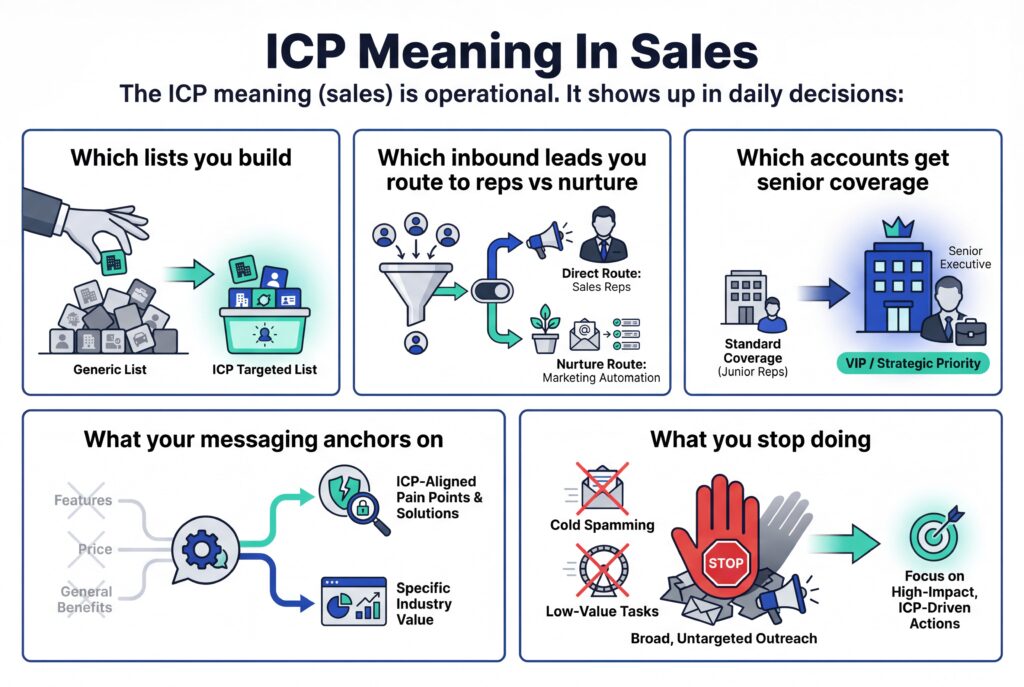
ICP vs target market vs TAM vs buyer personas
This is where teams accidentally create overlap and confusion. Keep these distinct.
- TAM: All companies that could ever buy something like yours.
- Target market: The slice you have chosen to focus on right now.
- Ideal customer profile: The best-fit subset within that target market. The accounts you can win repeatedly with healthy economics.
- Buyer personas: The people inside those ICP accounts. Their roles, incentives, objections, and decision power.
If you mix these up, you get predictable chaos – marketing optimizes for a broad target market, sales tries to win any logo that moves, customer success inherits customers who never should have been sold.
A simple ICP example
Here is an ICP example that is specific enough to run a team on:
B2B SaaS, mid-market motion
- Industry: B2B software, fintech, or SaaS services
- Size: 100 to 500 employees
- Revenue: $10M to $100M ARR-equivalent range
- Trigger: Recent funding, rapid hiring, or new compliance requirement
- Tech reality: Uses a modern CRM and has integration capacity
- Pain: Revenue performance inconsistency, forecast misses, slow ramp, low playbook adoption
- Must-have: Clear executive sponsor for revenue execution
- Disqualifier: Zero ops support, no CRM discipline, or “custom everything” expectations
Notice what is missing – generic words like “growing” or “mid-sized” with no thresholds. If you cannot point to a list and say “these are the accounts,” your team cannot execute.
Why ICP Clarity Matters More Now (& What Breaks Without It)
The modern GTM reality that forces focus
Startup CEOs and CROs are operating under tighter constraints than a few years ago:
- Buyers scrutinize ROI harder.
- Sales cycles stretch when fit is unclear.
- Procurement shows up earlier.
- Capital efficiency matters.
In that environment, a broad ICP is not “optional flexibility.” It is a tax.
What Breaks When ICP Is Missing
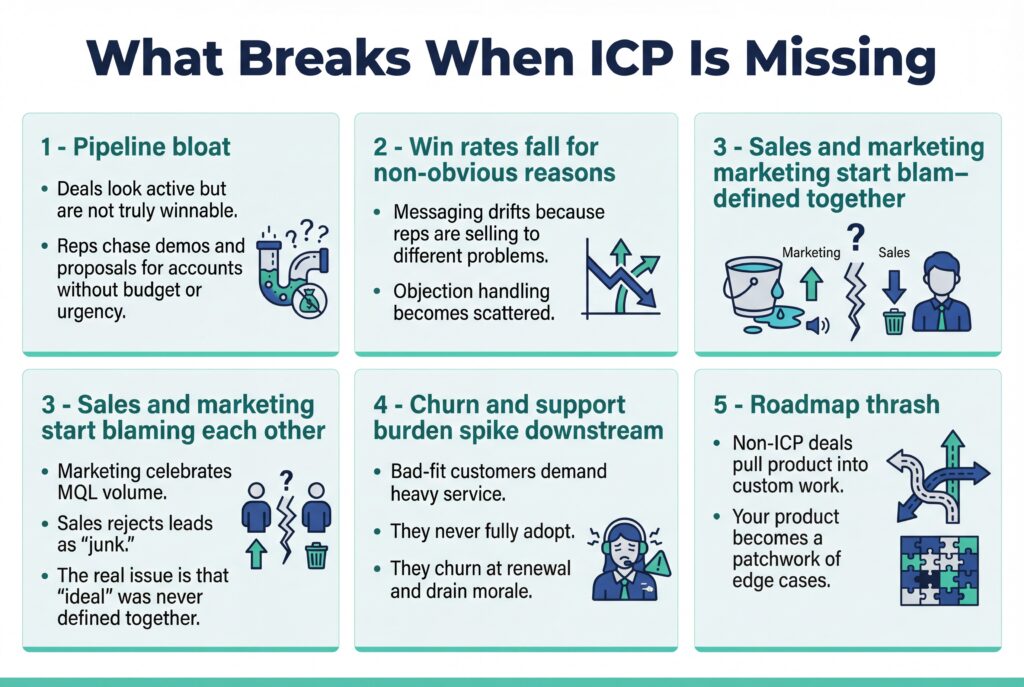
This is why ICP is not a marketing exercise. It is revenue quality control.
The predictable upside of a strong ICP
When ICP is clear and enforced, you get compounding benefits:
- More of your pipeline is real.
- Deals progress faster because value is obvious.
- Pricing is easier to defend.
- Customer success stops firefighting.
- Managers coach patterns instead of one-off situations.
In other words, the system gets calmer. That calm is a result of cleaner inputs.
The ICP Framework
A solid ICP framework is not a single dimension, but a set of attributes that together predict fit.
Think of it like underwriting.
You are not trying to describe every possible buyer. You are trying to identify the accounts that predictably produce:
- Willingness to buy
- Ability to implement
- Ability to renew
Here are the distinct buckets that belong in an ICP:
1) Firmographics (who they are)
These are the “shape of the company” attributes.
- Industry and sub-vertical
- Employee count and revenue band
- Geography
- Funding stage or ownership model
- Growth rate or stability markers
The research points out a simple but important principle: do not hide behind fuzzy terms.
Instead of “mid-market,” write “100 to 500 employees.”
Instead of “high growth,” write “20% year over year.”
Numbers make the ICP usable.
2) Technographics (what they run on)
If your solution depends on a certain environment, you need to say so.
- CRM and data discipline
- Core tools that must integrate
- Security and compliance constraints
- Tech maturity
This is where many startups lie to themselves.
They say “we integrate with anything.”
Then implementation becomes a hero project, and your CS team becomes a workaround factory.
3) Operational reality (how they work)
This is the part that separates a decent ICP from a great one.
It includes how the company actually operates.
- Process maturity
- Ability to adopt change
- Internal resources for rollout
- Sales org shape and roles
- Typical buying process complexity
This shows up as behavioral and operational characteristics like:
- Cloud-first vs legacy-heavy
- Remote workforce vs on-site-heavy
- Innovation adoption vs conservative procurement
4) Timing signals (when they buy)
Static fit is not the whole story.
Two companies can match your firmographics perfectly. One buys now. One does not.
That is where triggers matter.
Common triggers mentioned in the research include:
- Funding rounds
- Rapid hiring
- New compliance requirements
- Mergers and acquisitions
- Expansion into new regions
- Major system changes
You can treat these as an overlay on your ICP.
The profile tells you “who.”
Triggers tell you “why now.”
5) Exclusions (who you should not chase)
Exclusions are the part most leaders skip because it feels negative. Do it anyway.
You need clear disqualifiers like:
- Cannot meet minimum spend
- No champion role exists
- Environment makes implementation unrealistic
- Support burden is predictably high
- Procurement demands that kill unit economics
Exclusions protect your margin and your roadmap.
They also protect your reps. Nothing burns out a team faster than being pushed to win deals that never had a real chance.
How To Find Your ICP Using Evidence
Step 1: Define what “best customer” means for you
This is a leadership call. Pick 2 to 3 outcome metrics that define “ideal” for your business model:
- Highest LTV
- Strong retention and expansion
- Healthy gross margin
- Short sales cycle
- Low support burden
- Referenceability and advocacy
You cannot optimize for everything.
If you try, your ICP becomes a compromise that no one believes.
Step 2: Pull data from the right sources
You do not need perfect data to start. You need enough truth to see patterns.
Use:
- CRM data: closed-won, deal size, cycle length, lead source, stage conversion
- Customer success data: renewal status, expansion, usage, support volume
- Win-loss notes: why deals died, what objections repeated, which segments stalled
- Customer interviews: what value they got, what they tried before
- External tools: LinkedIn Sales Navigator, Crunchbase, ZoomInfo for firmographic and technographic enrichment
- Market research: industry spend trends, adoption rates, regulatory changes
The key is to combine quantitative and qualitative.
Numbers show patterns. Conversations explain why.
Step 3: Identify your best and worst customers
- Pull your top cohort. For example, top 10% by LTV, or accounts that renewed twice and expanded.
- Pull your worst cohort. Fast churn, low usage, heavy support, long cycles.
Then compare.
This contrast is where disqualifiers often become obvious.
Step 4: Do the pattern work
Look for clustering across your best customers:
- Do 70% of your best customers share an industry?
- Do your fastest cycles sit in a specific size band?
- Do high retention accounts share a similar tech stack?
- Are your largest deals concentrated in one ownership model?
Then check the inverse in your worst cohort.
If your “ideal” customers and your churned customers look similar, your problem is not ICP. It is product, onboarding, or pricing.
Do not use ICP to cover for that.
Step 5: Validate before rollout
A good ICP is testable.
Run simple experiments:
- Build two outbound lists. One ICP-fit, one loosely related.
- Compare response rates, meeting rates, and stage conversion.
- Track win rate and cycle length by ICP tag.
How To Create ICP Step By Step (From Scratch)
You can build an ICP in a week.
You can also spend three months polishing a doc that no one uses.
Here is the practical build process from the research, with the right level of rigor.
A 10-step build process you can run
- Align on what “ideal” means. Pick the outcomes you are optimizing for.
- Clean your baseline dataset. Fix obvious CRM gaps. Enrich missing firmographics.
- Pull best and worst cohorts. Identify the accounts you would clone, and the ones you would never repeat.
- Extract shared traits. Firmographics, technographics, operational reality, timing, exclusions.
- Draft must-haves. The criteria without which the deal is almost always a waste.
- Draft nice-to-haves. Traits that improve odds and help prioritization.
- Write disqualifiers. Hard stops.
- Pressure test with teams. Sales, marketing, success, product. This is where adoption is won.
- Publish ICP v1.0 with examples. Include 3 accounts that fit and 3 that do not.
- Operationalize it. CRM fields, routing, dashboards, and coaching routines.
This is also where most teams fail. They stop at step 9, then wonder why nothing changes.
ICP Segmentation, Tiers & Scoring
Once you have a definition, you need a way to use it at scale.
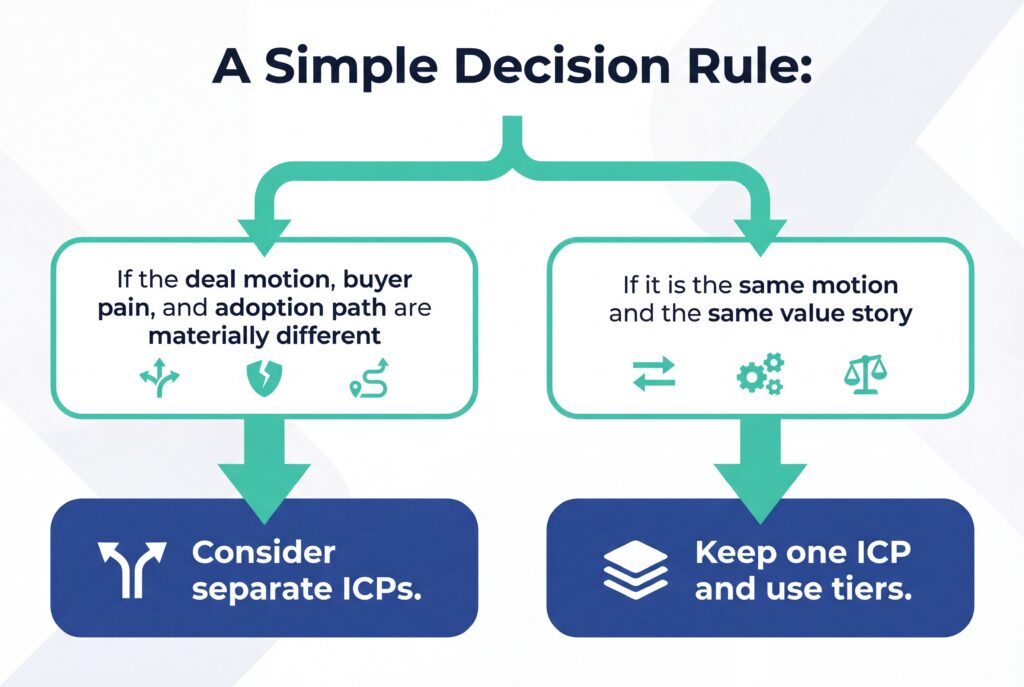
One ICP vs multiple ICPs
Some companies genuinely have more than one ICP.
Usually because they have:
- Distinct products with distinct value
- Distinct sales motions (self-serve vs enterprise)
- Distinct implementation realities
But a lot of “we have three ICPs” is just fear of focus.
ICP tiers (A, B, C)
Tiers help leaders allocate effort without pretending every account is equal.
- Tier A: Must-haves met, several nice-to-haves present. Clear path to value.
- Tier B: Must-haves met, fewer nice-to-haves. Still viable, lower priority.
- Tier C: Partial fit or experimental. Handle intentionally.
Tiers are not a moral judgement, but a resource allocation tool.
A simple ICP fit scoring model
Scoring is useful when:
- You have lots of inbound and need routing discipline.
- You run outbound and want consistent prioritization.
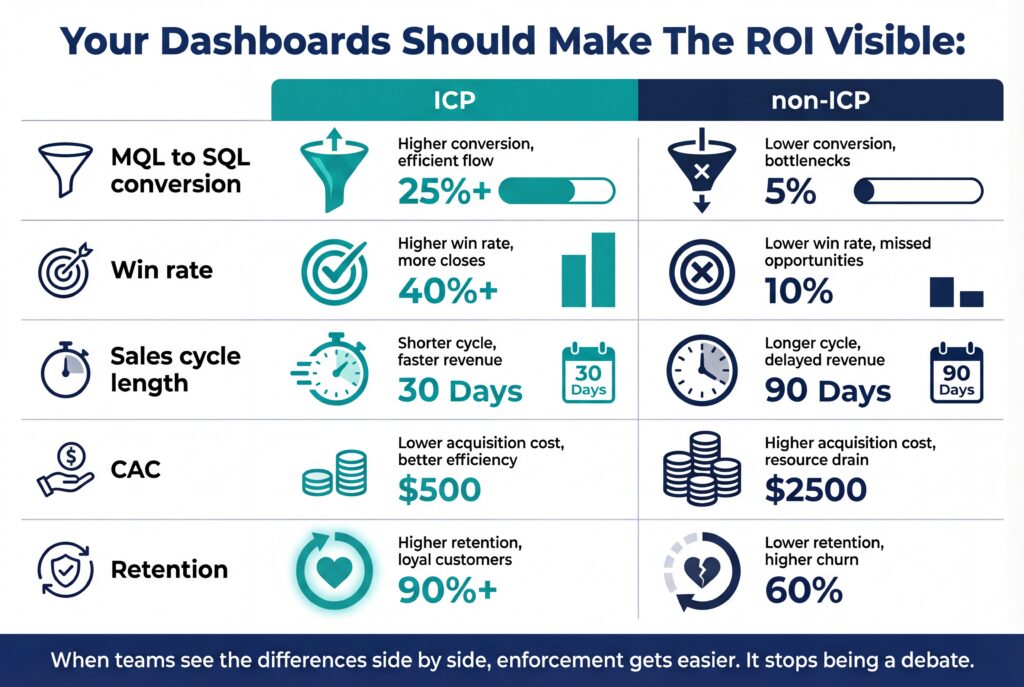
- You want reporting that proves ICP focus is working.
Keep scoring simple. The research emphasizes disqualifiers as hard stops. Everything else can be points.
Here is a practical model:
| Attribute | Criteria | Points |
| Industry match | Core verticals | 0 to 20 |
| Company size band | Your defined range | 0 to 15 |
| Tech fit | Required systems present | 0 to 15 |
| Trigger present | Funding, growth, compliance | 0 to 20 |
| Pain intensity | Clear, urgent problem | 0 to 20 |
| Adoption capacity | Ops support, change readiness | 0 to 10 |
Disqualifiers (hard stop):
- Below minimum spend
- No champion role exists
- Environment makes rollout unrealistic
Then define tiers:
- 80 to 100: Tier A
- 60 to 79: Tier B
- Below 60: Tier C
If you cannot explain your score in one sentence, the model is too complex.
Handling edge cases without breaking focus
Edge cases will exist. Treat outliers as exceptions until evidence stacks.
If you win one giant logo outside ICP, do not rewrite your ICP that afternoon.
Ask:
- Did we win because of fit, or because of custom effort and senior attention?
- Does this represent an adjacent segment, or a one-off?
- Are we seeing a repeatable pattern, or a story we want to believe?
If 20% of your revenue starts coming from outside ICP, that is a real signal. Investigate.
But do not drift quarter by quarter.
Ideal Customer Profile Template B2B (Copy-Paste)
Most ICPs fail because they stay theoretical.
This downloadable Ideal Customer Profile (B2B) template is built for execution. It helps you define who to pursue, who to deprioritize, and who to walk away from early – using criteria your sales team can apply.
Inside the template:
- Company basics and buying context
- Environment and adoption constraints
- Core problem fit and success outcomes
- Buying roles, blockers, and proof requirements
- Timing and trigger signals
- Must-haves, nice-to-haves, and disqualifiers
- Real account examples to pressure-test fit
Use it to tighten pipeline quality, improve win rates, and stop wasting cycles on bad-fit deals.
The “minimum viable ICP” for early-stage teams
If you are early and do not have much data, do not freeze.
Lock these six fields first:
- Industry or use case
- Size band
- Core pain
- Minimum spend
- Adoption capacity requirement
- One or two disqualifiers
Then run tight experiments. Your ICP will mature as your customer base grows.
Activating ICP in Sales Execution
The point of an ICP is not clarity. It is execution quality.
This is where you separate “we defined it” from “we use it.”
Prospecting & account list building
For outbound, the ICP determines your list filters.
Start with the must-haves. Then layer in triggers to prioritize.
A practical approach:
- Build messaging that is 70% templatized around ICP pains.
- Personalize 30% based on the account and stakeholder.
That gives you scale without losing relevance.
Also, do not confuse volume with progress. If your reps are sending 200 generic emails, your ICP is not real to them.
Qualification & discovery
ICP is your first-pass filter.
Discovery is where you confirm fit and expose deal risk.
Use ICP to sharpen discovery. Instead of generic questions, your reps should test the must-haves:
- Do you have the systems required for rollout?
- Who owns this problem operationally?
- What is the cost of doing nothing?
- What has been tried before?
When a deal fails ICP checks early, disqualify fast.
That is not being “picky” but protecting your team’s time and your forecast.
Messaging alignment
ICP drives the core value story.
Personas drive stakeholder tailoring.
If reps are making up different value stories for each segment, your ICP is too broad or not enforced.
Pipeline discipline
This is where CEOs and CROs earn their money.
You need rules for non-ICP pipeline:
- If it is inbound and close to fit, treat as Tier B.
- If it is far outside fit, route to nurture or partner channels.
- If it is high-value but outside fit, make it an explicit exception with executive awareness.
Do not let “exceptions” quietly become half the pipeline. That is how teams lose quarters without understanding why.
Activating ICP Across Marketing, GTM & Product
ICP only works when it becomes shared truth.
When sales and marketing align on ICP, growth accelerates.
When they do not, everyone stays busy and results stay flat.
Marketing targeting & content strategy
Your ICP should change what you publish and what you promote.
- ICP pains become content anchors.
- ICP objections become proof assets.
- ICP triggers become campaign timing.
If you are publishing content for everyone, you are publishing for no one.
GTM alignment routines
Do not rely on “alignment meetings.”
Use artifacts and routines:
- One shared ICP doc with version control
- ICP fit scoring in the CRM
- Weekly reporting split by ICP vs non-ICP
- Clear owner for updates
If marketing and sales maintain separate ICP definitions, lead quality debates are guaranteed.
Roadmap protection
A tight ICP protects product focus.
When you sell outside ICP, you often introduce:
- Custom requirements
- Unplanned integrations
- Support demands
Your product should not be shaped by your noisiest outliers.
Tools & Systems to Operationalize ICP
CRM fields & hygiene
At minimum, your CRM needs:
- ICP tier
- ICP fit score
- Disqualifier flags
- Trigger tags (funding, hiring, compliance)
If reps do not fill these fields, you do not have data. You have stories.
Enrichment & intent overlays
Separate fit from intent.
- Fit answers: are they the right kind of company?
- Intent answers: are they in-market now?
A common mistake is chasing high intent on low fit. That feels productive for a week.
Then churn shows up.
Reporting that proves ICP is working
Maintaining and Evolving Your ICP (Without Thrash)
An ICP is not a one-time decision.
It is a control system.
Review cadence & triggers
Most teams benefit from a semi-annual review.
Also watch for triggers that the research highlights:
- ICP win rate drops meaningfully for a sustained period
- Conversion rates decline inside the ICP
- A growing share of revenue comes from outside ICP
- Product or market shifts change adoption reality
When these happen, investigate.
Do not rewrite the ICP based on one quarter of noise.
Moving upmarket without confusing the team
Upmarket expansion changes your ICP in predictable ways:
- Security and compliance intensity rises
- Procurement becomes heavier
- Implementation and change management matter more
You can run a “current ICP” and a “future ICP” in parallel, but keep the field clear:
- 80% effort on current ICP
- 20% structured experiments on future ICP
No ICP focus creates chaos. Overly dogmatic ICP focus can block smart learning.
Balance is a policy decision. Make it explicit.
Common ICP Mistakes (& How To Avoid Them)
Mistake 1: ICP is too broad
👉 If your ICP could describe half the market, it does not guide decisions.
Fix it by adding thresholds, triggers, and exclusions.
Mistake 2: ICP is too complex
👉 If it takes ten minutes to score an account, reps will stop doing it.
Fix it by focusing on must-haves, a handful of point-based factors, and disqualifiers.
Mistake 3: No exclusions
👉 If you never say “no,” you will accept bad-fit revenue.
Then pay for it later through churn, support, and roadmap churn.
Mistake 4: Built in a silo
👉 If marketing builds one ICP and sales ignores it, you do not have an ICP.
You have misalignment.
Mistake 5: Not operationalized
👉 If the ICP is not in your CRM fields, routing rules, coaching routines, and reporting, it will die.
This is where most teams lose.
How EnableU Helps Teams Define & Enforce ICP
Defining an ICP is a strategy decision.
Making it real is an execution problem.
EnableU is built to handle both:
- On the Sales Excellence side, EnableU helps leadership teams define ICP as part of a broader go-to-market system. Your ideal customer profile is built from real data, aligned to market strategy, and connected to how you plan territories, quotas, and capacity.
- On the Deal Pilot side, that ICP shows up where selling happens. Reps get ICP-aware prompts and guidance during qualification, discovery, and deal progression, so fit is evaluated consistently, not subjectively.
Across both, EnableU makes ICP measurable.
Leaders can see how ICP and non-ICP deals behave differently in pipeline, win rates, and forecasts, and adjust focus with evidence, not opinion.
The result is simple: Strategy defines the right customer. Execution reinforces it.
Frequently Asked Questions
What is an ICP in sales?
An ICP defines the type of company that is most likely to buy, adopt, and renew your product. It helps sales teams focus on accounts with the highest probability of long-term revenue, not just short-term closes.
What does ICP stand for in business and marketing?
ICP stands for Ideal Customer Profile. In business and marketing, it’s used to align targeting, messaging, and sales effort around the companies that deliver the strongest performance and unit economics.
How often should you update your ideal customer profile?
Most teams review their ICP every 6–12 months, or sooner if win rates, churn, or deal cycles shift materially. ICP updates should be driven by data trends, not one-off deals.
Is an ICP framework only useful for B2B companies?
ICP frameworks are most commonly used in B2B because deals involve higher complexity and longer cycles. However, the same principles apply anywhere customer fit, retention, and lifetime value matter.
Conclusion
What is ICP in sales ultimately comes down to discipline. Not in how you describe your market, but in how tightly you define who you are built to win, serve, and keep.
A real ICP is specific, testable, and grounded in evidence. It draws clear lines around fit, timing, and exclusion, so pipeline quality improves before activity ever ramps up. When teams get this right, win rates rise, cycles shorten, and churn stops being a surprise. Most importantly, decisions get easier because focus replaces guesswork.
If you want to see how ICP can be defined, tested, or reinforced using real signals, start a free trial of EnableU and explore how the Sales Excellence framework and Deal Pilot support sharper focus across strategy and day-to-day selling.