

Sales territory planning looks simple until it’s not.
A few headcount changes, a new segment, one region overperforming, another quietly stalling, and suddenly the plan everyone agreed on no longer fits how the business actually sells.
Done well, territories create focus, fairness, and predictable coverage.
Done poorly, they distort performance and hide real problems.
We’ll break down how to plan territories that hold up in the real world, step by step, and what tools help keep them executable as you scale.
Key Notes
- Territory planning requires ICP clarity, capacity modeling, and quantified potential to ensure fairness and coverage.
- Geographic, vertical, segment, and hybrid territory models each create distinct execution trade-offs.
- Effective territory plans translate assignments into rep-level priorities, cadences, and measurable KPIs.
Sales Territory Explained
Sales territory planning is the strategic process of dividing your total addressable market into defined segments, then assigning those segments to reps.
Segments can be:
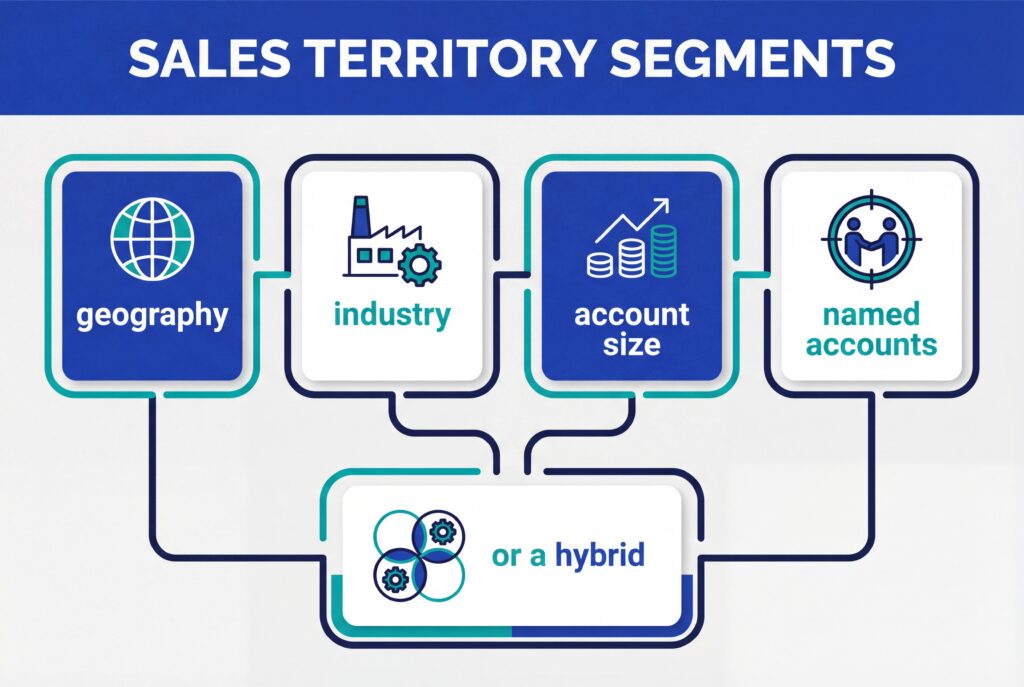
The point is not the map.
The point is coverage, efficiency, and fairness, tied to your actual go to market strategy.
A simple way to hold it in your head:
- Territories decide the where and who.
- Account plans decide the how.
What Breaks First When Territories Are Wrong?
Bad territory design does not fail gracefully. It fails in familiar ways.
- Ownership becomes political. Two reps chase the same account, or a great account gets ignored because nobody is sure who owns it.
- Morale gets weird. Reps do not mind losing a fair game. They hate feeling like the game is rigged. “He has all the good accounts” is a culture problem disguised as a planning problem.
- You misdiagnose performance. You call it a coaching issue when it is a patch issue.
- Forecasting turns into vibes. If territory potential and quota are disconnected, every forecast conversation starts with excuses, and ends with hope.
When You Need Formal Territories
Not every team needs rigid territories from day one.
Early-stage teams can run round robin or simple segmentation while they learn the ICP and stabilize the motion.
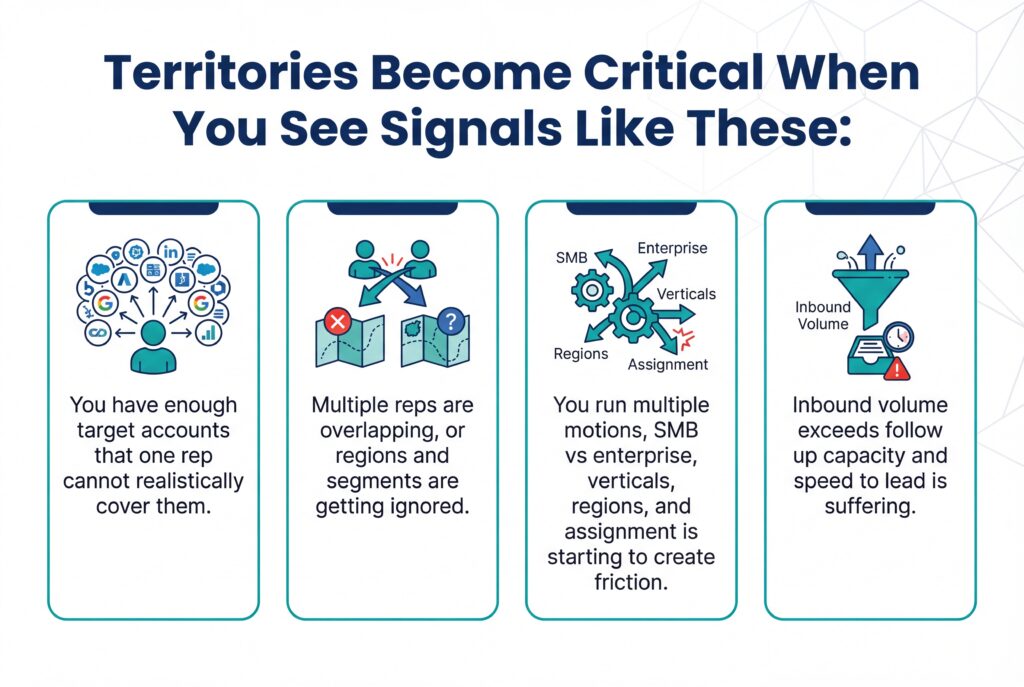
A quick red flag check before you start building anything:
- Only a couple reps.
- ICP still moving.
- No bandwidth to maintain a plan.
If that is you, keep it simple for now. Then graduate to a real model when your GTM is stable.
The 5 Step Sales Territory Planning Process
The five steps are sequential on purpose. Skip one, and you will make later steps look “data driven” while quietly anchoring to bad inputs.
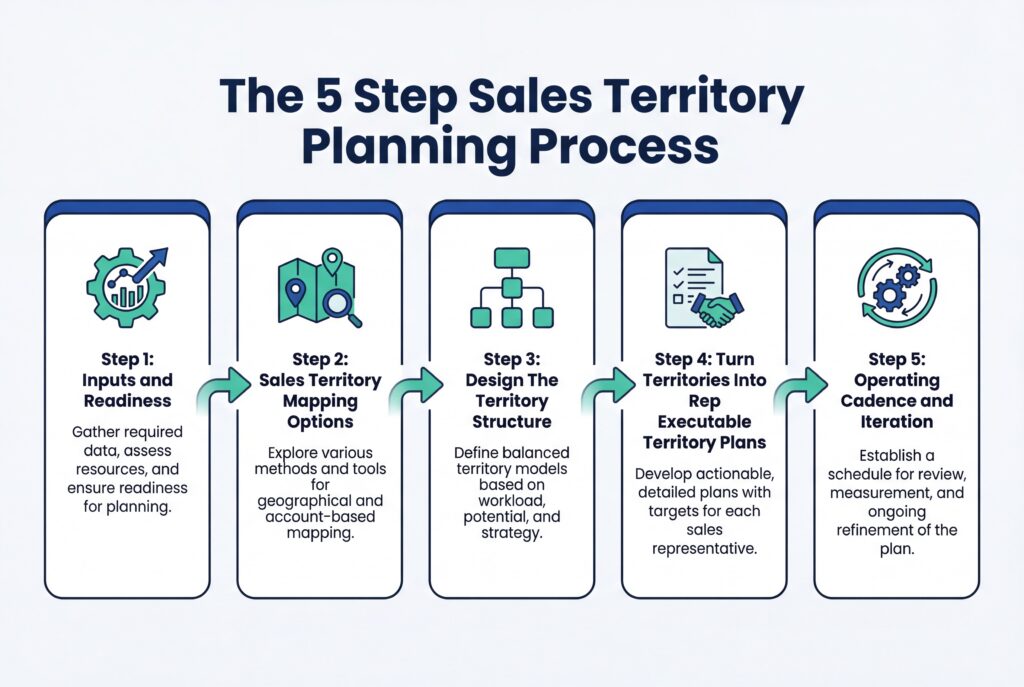
Step 1: Inputs and Readiness
Territory planning starts as a data quality and assumptions problem (not a design problem).
If you want territories that feel fair, you need a shared definition of “fair.” That is math. Or at least math adjacent.
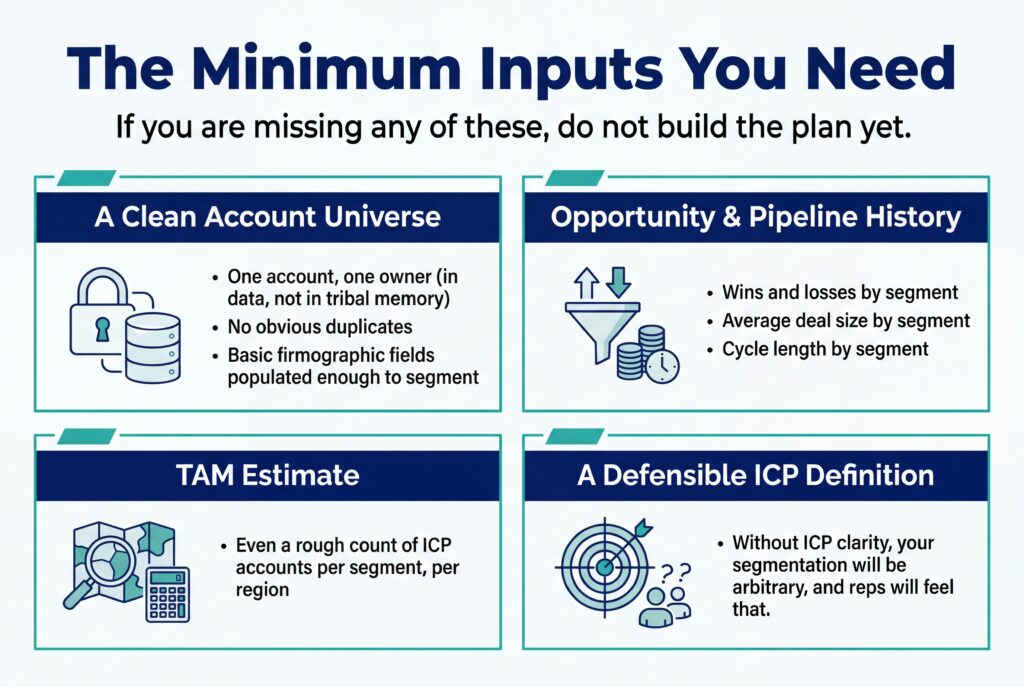
Those are the must haves. Nice to have inputs can make the model sharper:
- Competitor presence by region
- Market share by region
- Intent signals
- GIS or clustering views to spot customer density
… but do not use “nice to have” as an excuse to delay forever. Your goal is improvement, not perfection.
Is Your Market Territory Ready?
A market is territory ready when you have enough coverage needs and account volume to justify formal segmentation & enough stability to maintain it.
Signs you are ready include a large defined ICP, multiple reps that would otherwise overlap, and a GTM strategy that truly differentiates segments.
If you are not ready, you can still do useful planning work.
- Clean the account list.
- Lock the ICP for the next planning cycle.
- Segment performance reports, even if assignment stays simple.
The Planning Rules You Should Write Down
Before you draw anything, align leadership on the rules of the game.
- What is the primary segmentation axis, geo, vertical, size, named accounts.
- Are we optimizing for specialization or coverage.
- What conflicts do we allow, overlays, specialists, SE support.
- What is the fairness standard, potential, workload, or both.
Write this down. It becomes your decision filter when somebody asks for a special patch.
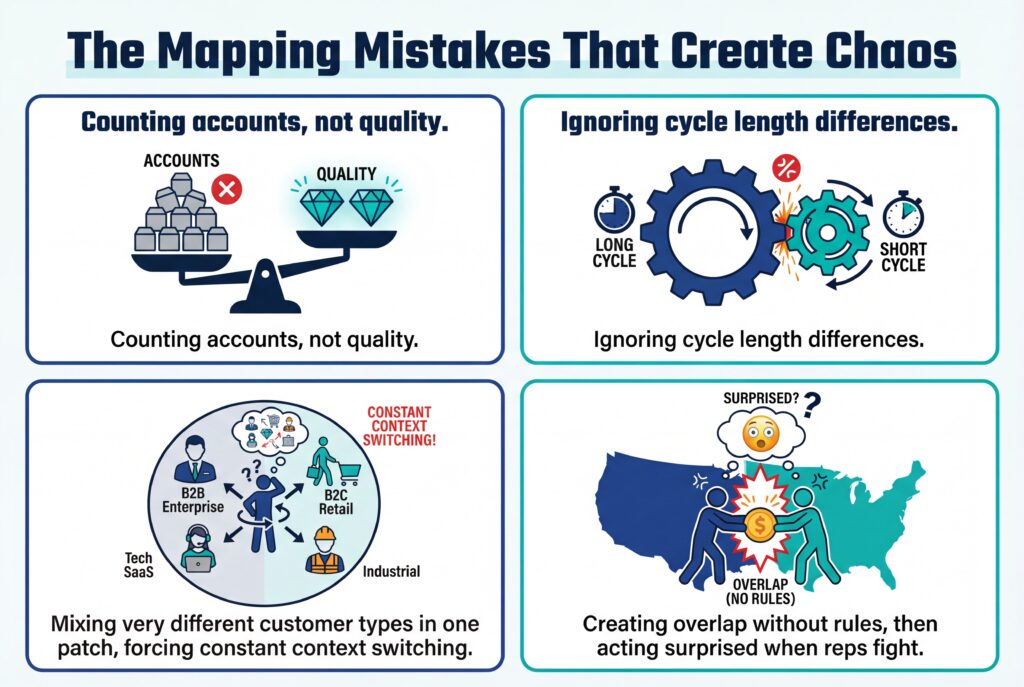
Step 2: Sales Territory Mapping Options
This is the sales territory mapping step. It is where you choose the type of territory, and more importantly, why.
A territory model should make the work easier for reps, not just easier for reporting.
The Four Core Territory Models
1) Geographic Territories
Classic. Still useful when proximity, language, regulation, or relationship networks matter. Also useful when you need clear ownership with minimal debate.
Watch out for wildly uneven potential if the market density is lumpy.
2) Vertical or Industry Territories
Great when your product is won through domain language and credibility. Specialization tends to improve discovery quality and messaging consistency.
Watch out for verticals with very different cycle lengths and ACV, unless you normalize potential.
3) Segment or Company Size Territories
Common in B2B SaaS. Lets you separate motions cleanly, SMB velocity vs enterprise consensus selling.
Watch out for segment drift if your data is messy, or if reps cherry-pick “enterprise-looking” accounts.
4) Named Account Territories
Works for ABM and top-down enterprise. Ownership is very clear.
Watch out for starving the rest of the market, or creating a named account list that never gets revisited.
Hybrid Territory Designs That Work
Most scaled teams end up hybrid.
Examples:
- Enterprise by vertical, SMB by geo.
- Named accounts for top 50, everyone else by segment.
- Regional territories plus a specialist overlay for a product line.
The rule for hybrids: keep primary ownership simple. Overlays should be explicit in who leads, who supports, and how credit works.
How To Quantify Territory Potential
This is where fairness gets real. Most “fairness” arguments are secretly about potential and workload.
Here are two workable approaches:
Potential Model (fast, defensible)
- ICP account count in the territory
- Expected win rate for that segment
- Expected ACV for that segment
A simple formula:
Territory Potential = (# ICP Accounts) x (Expected Win Rate) x (Expected ACV)
You can refine it later with intent weighting or whitespace. The main thing is consistency.
Coverage Model (keeps planning tied to execution)
Start with quota. Then work backwards.
- Quota
- Target pipeline coverage ratio (often 3x to 4x for most B2B motions)
- Stage conversion rates
If a territory cannot realistically generate the pipeline required to hit quota, you do not have a rep problem. You have a planning problem.
Step 3: Design The Territory Structure
Mapping is the “shape.” Structure is the “fit.”
The job is to right-size territories so they are manageable and rich enough in potential.
Territory Sizing, Start With Capacity
A territory can have great potential and still be unworkable. Capacity is about what a rep can realistically execute:
- How many active accounts can they run at once.
- How much prospecting time they realistically have.
- How many deals can they advance without dropping quality.
If you assign 600 accounts to an enterprise AE and call it “coverage,” you did not create coverage. You created neglect.
Balance Complexity, Not Just Volume
Two territories with the same potential can still be wildly different workloads.
Complexity drivers:
- Deal cycle length
- Buying committee depth
- Competitive intensity
- Implementation complexity
- Mix of new logo vs expansion
If you do not account for complexity, your best rep gets punished by being given the hardest patch “because they can handle it.” That is how you burn them out.
Design For Scale
Territories should be modular.
Ask this question while designing: if I needed to split this territory in six months, could I do it cleanly.
Practical design choices that help:
- Use clear boundaries, not “miscellaneous” buckets.
- Avoid one off exceptions that become precedent.
- Document split rules. For example, split when ICP account count exceeds X, or when pipeline created exceeds Y, or when quota attainment requires sustained over-capacity activity.
Governance, Who Owns What
Territory planning sales gets messy when ownership is fuzzy.
A clean split:
- CRO: Sets strategy, segmentation axis, and fairness goals.
- RevOps: Builds the model, validates assumptions, operationalizes in systems.
- Sales managers and reps: Provide ground truth on feasibility, then execute.
Reps should influence the model. They should not design it.
Step 4: Turn Territories Into Rep Executable Territory Plans
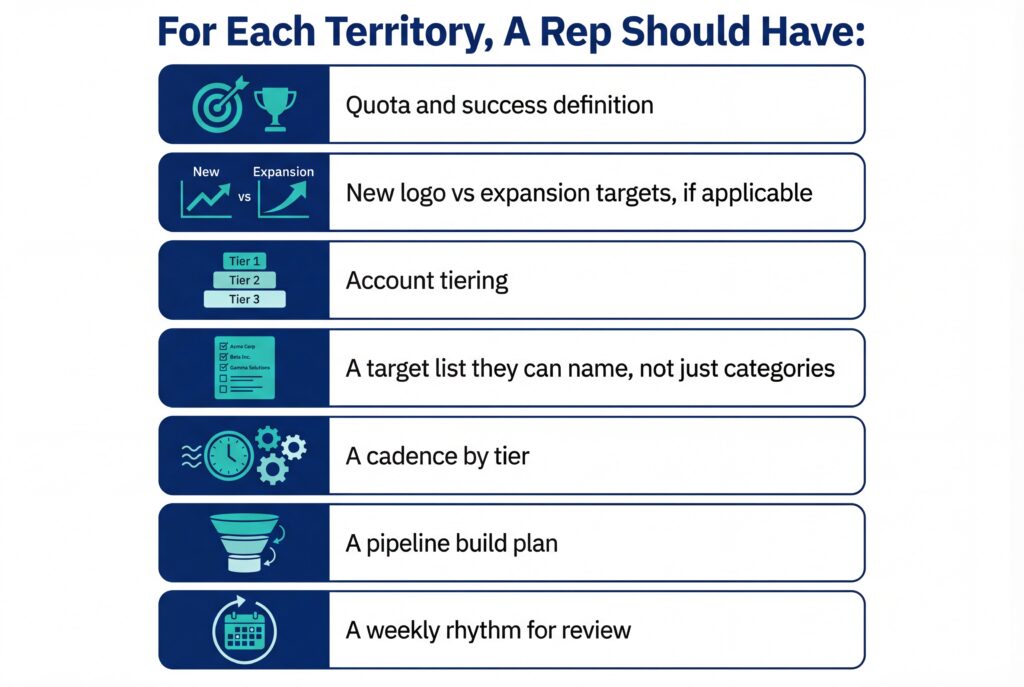
This is where most territory planning falls apart. Leadership announces a new map. Reps nod. Then Monday comes, and the patch is just a list of accounts.
A territory plan is what turns assignment into execution.
What A Good Territory Plan Includes
Account Tiering That Does Not Become Busywork
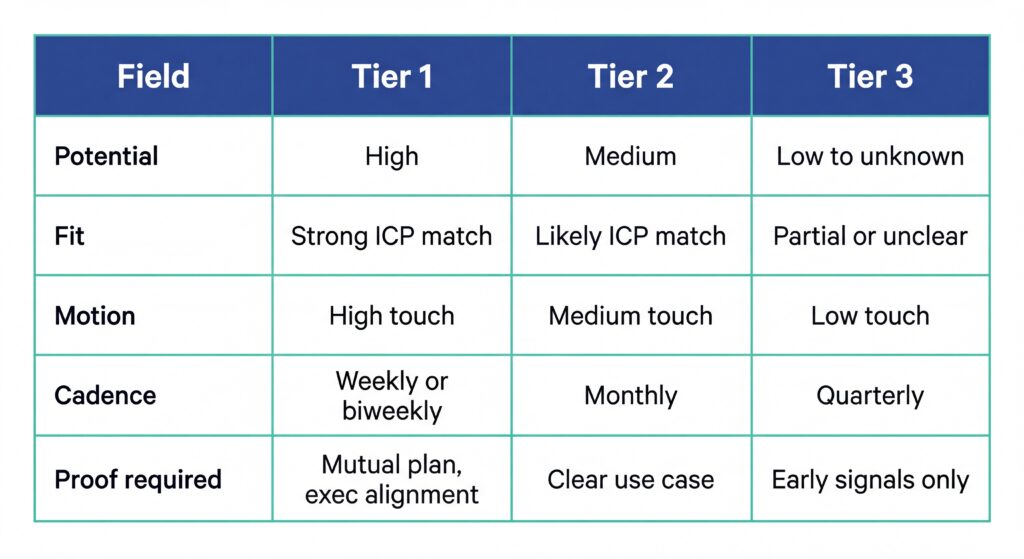
Tiering is useful when it changes behavior.
A simple approach:
- Tier 1: Highest potential, highest focus, multi threading required
- Tier 2: Solid fits, consistent cadence, tighter qualification
- Tier 3: Long tail, lighter touch, automated sequences and periodic checks
Here is a tiering table you can steal:
How Reps Should Prioritize Inside The Patch
A usable prioritization lens is fit, intent, and timing.
- Fit answers “should we ever win this.”
- Intent answers “are they showing movement.”
- Timing answers “is this quarter real.”
That lens prevents two common rep behaviors:
- Chasing logos because they look cool.
- Living in the easiest segment because it feels productive.
The KPIs That Tell You The Territory Plan Is Working
Do not treat territory performance as a single quota number. You need leading indicators, or you will find out too late.
A practical set:
| KPI | Why It Matters | What It Signals |
| Pipeline coverage ratio | Ties plan to reality | Territory can support quota |
| Pipeline creation velocity | Early health | Rep is building, not just managing |
| Win rate by territory | Quality of targeting and execution | ICP and plays are working |
| Cycle length | Capacity and forecast impact | Complexity mismatch or stalled deals |
| Penetration and touch coverage | Actual market coverage | Territory is not just a list |
Step 5: Operating Cadence and Iteration
Territory planning is not a once-a-year spreadsheet ritual. It is a system.
The goal is stability with the ability to course correct.
Operationalize Territories In Your Systems
If your CRM routing does not match the plan, the plan is fiction.
Operational basics that matter:
- Ownership rules
- Lead routing rules
- Edge case rules, multi-location accounts, acquisitions, inbound from outside the patch
- A clean handoff and credit policy
How Often Should You Change Territories?
Major changes should be infrequent. Avoid big reshuffles more than once every few years to prevent change fatigue.
Minor adjustments can happen more often, but you need triggers.
A simple trigger set:
- If a territory is under quota for 2 quarters, RevOps investigates potential mismatch and options.
- If one territory has 2x the pipeline of another, you have a fairness issue.
- If market shifts change ICP concentration, adjust.
The point is not to react to noise. It is to respond to persistent imbalance.
Align Quotas & Comp With Territory Potential
This is where teams lose trust fast.
If territories have different potential, quotas should reflect that. A rep in a $5M potential patch should not carry the same number as a rep in a $2M potential patch.
Comp planning is tied to territory design:
- Accelerators can create unfair windfalls if one patch is easier.
- Incentives need access. Do not pay on Product X if half the team has no realistic Product X targets.
And if you change territories mid plan period, you need comp protection.
A useful best practice is a hold period. When territories shift at year end, the outgoing rep has 90 days to close deals in flight, with diminishing credit after that.
It is not generosity, but maintaining momentum.
Change Management Without Crushing Morale
Reps freak out about territory changes for one reason – they think you are taking money off their desk.
So treat territory changes like you would treat a comp plan change.
Best practices that hold up:
- Plan in advance, base on data, no surprises.
- Frame the why in fairness and growth terms, show the numbers.
- Deliver the full package at once, territory, quota, comp adjustments, transition rules.
- Time it with a new fiscal period when possible.
Sales Territory Planning Best Practices & Failure Patterns
Best Practices That Consistently Win
- Start with ICP and segmentation. Then build territories.
- Model potential and workload. You need both.
- Keep ownership rules simple. Complexity belongs in support rules, not in the core assignment.
- Tie territories to quotas, comp, and forecast. Planning inputs cannot live in different documents.
- Maintain the plan. Document signals, review quarterly, adjust when evidence says so.
Failure Patterns To Watch For
- Set and forget. The market changes. Your plan does not.
- Too early territories. You force structure before the motion is stable.
- Overweighting one axis. Pure geo, pure account counts, pure “rep preference.”
- Half baked rollout. New patches with no quotas, no routing, no transition rules.
Sales Territory Planning Template
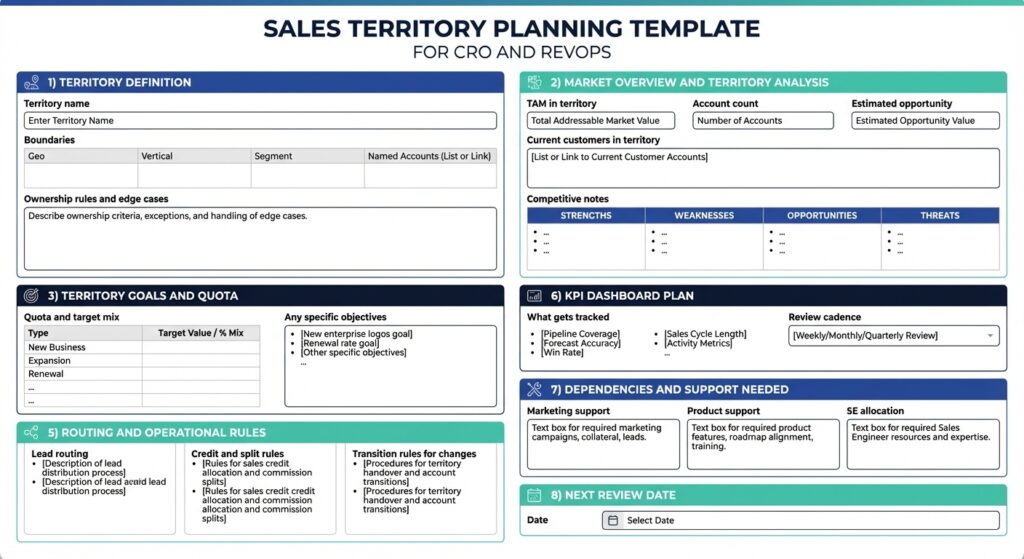
Most templates fail because they capture the list, not the plan. A solid template forces you to define the territory, the market context, the goals, the tactics, and the measurement.
Territory Planning Template for CRO and RevOps
Use this as your master planning doc.
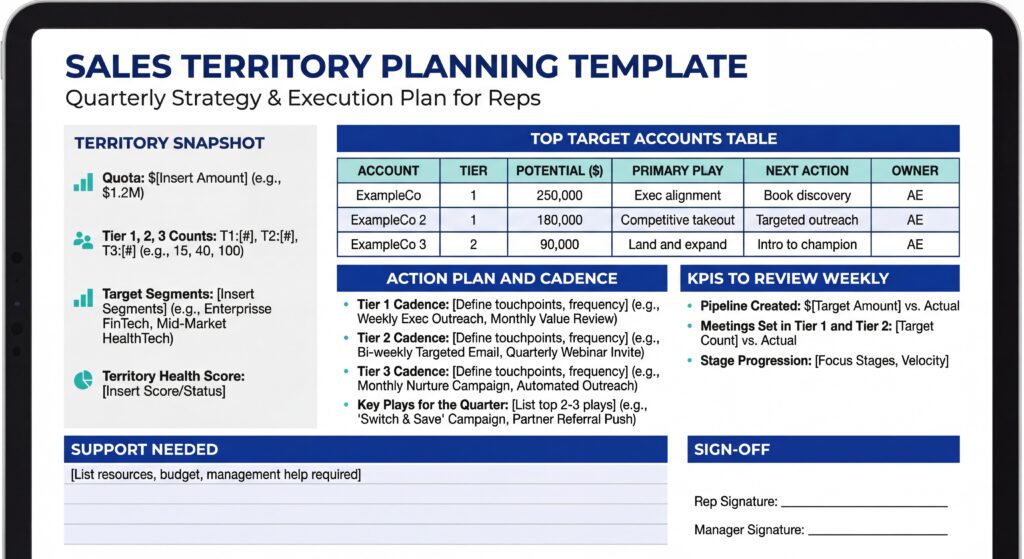
Territory Plan Template for Reps
Best Tools for Sales Territory Planning
If you are a small team, you can do basic territory planning in spreadsheets. Once you hit scale, you need a sales territory planning tool that does three things well:
- Scenario planning without version chaos
- Cross functional collaboration
- Direct links between territories, quotas, comp, and forecast
That last one is the difference between “a plan” and “an operating system.”
EnableU for Sales Territory Planning
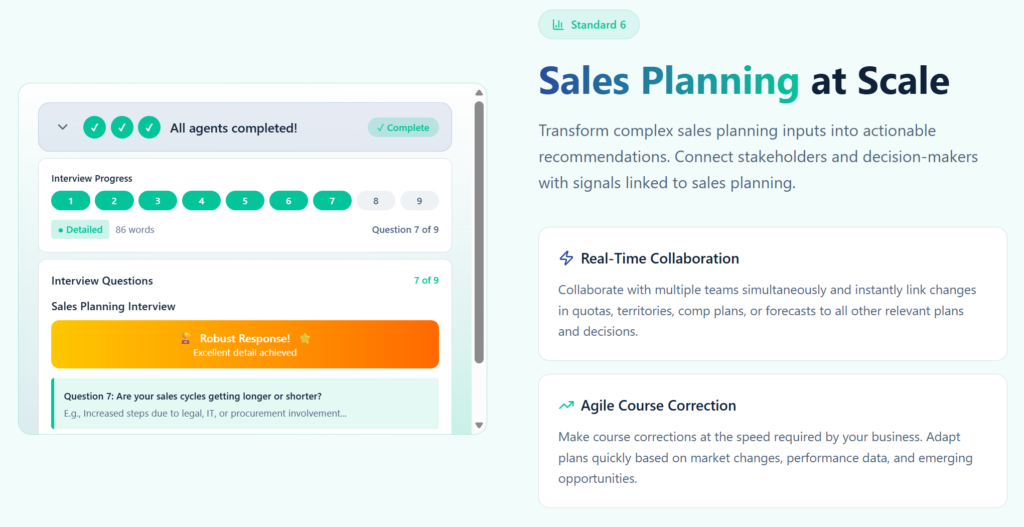
EnableU supports territory planning inside Standard 6: Sales Planning at Scale. The point is to turn complex planning inputs into actionable recommendations, then keep the plan connected to execution.
Here is what that looks like in practice:
Turn planning inputs into executable recommendations
Territory planning is a multi-input problem (CRM history, ICP distribution, win rates, cycle lengths, capacity assumptions, growth targets).
EnableU is built to connect those inputs and surface planning recommendations that can actually be acted on, not just discussed.
Real time collaboration across stakeholders
Territory changes are never “just territories.” The moment you change a patch, you ripple into quotas, comp, and forecast.
EnableU supports real-time collaboration so that changes in territories link instantly to other plans and decisions. No more sending five spreadsheet versions and hoping everyone is on the same assumptions.
Agile course correction
The market moves. Your plan should be able to move with it.
EnableU supports agile course correction by connecting market and performance signals to sales planning decisions. When a territory is persistently under quota, or a region starts surging, you can model adjustments quickly and roll them through the rest of the plan.
Keep the plan tied to execution
The quiet failure of territory planning is when it lives in planning season, then dies in execution season.
EnableU keeps planning linked to workflow and performance signals, so managers can see whether territories are healthy, whether coverage is real, and where execution gaps are showing up.
A Practical Example Workflow:
You decide to add 2 AEs in EMEA.
With EnableU, the workflow can look like this:
- Model territory splits based on ICP distribution and potential.
- Align quota assumptions to the new patches.
- Adjust routing rules and document edge cases.
- Link comp protection and transition policies.
- Monitor territory KPIs quarterly and course correct based on signals.
Same work. Less chaos.
👉 See how this works on real data. Start a free trial and build an executable territory plan.
Frequently Asked Questions
How often should sales territory planning be revisited?
Most teams review territory health quarterly and redesign annually. The key is stability with triggers for adjustment, not constant reshuffling that kills momentum and trust.
What’s the difference between sales territory mapping and sales territory planning?
Sales territory mapping defines boundaries and ownership. Sales territory planning goes further by aligning those territories to quotas, capacity, coverage, and execution realities.
Is there a standard sales territory planning template that works for every team?
No. A good sales territory planning template adapts to your ICP, sales motion, and growth stage. The structure matters more than the format.
How do you create a territory sales plan for new reps?
Start with a clear patch, realistic quota, and account tiering. Then define priorities, cadence, and KPIs so reps know exactly where to focus from day one.
Conclusion
Sales territory planning is not a one-time exercise or a box to tick before the quarter starts. It is a system decision.
When territories are built on real inputs, sized to rep capacity, and tied directly to quotas and execution, everything downstream gets cleaner. Coverage improves. Forecasts get calmer. Performance becomes easier to diagnose because the ground truth is clear.
When territories are wrong, even strong teams struggle.
When they are right, sales planning stops being theoretical and starts working.
That is the difference between drawing lines and building a revenue engine.
If you want to see how our Sales Excellence Framework turns territory planning into something your team can easily run and adjust in real time, start a free trial to test it on your own data.