
Competitive moves don’t announce themselves. They show up quietly in deals, pricing conversations, and buying criteria that feel slightly off from last quarter.
Some teams sense it early.
Others only see it after results move.
Competitive intelligence exists for that gap.
Not as a report, but as a way to understand what’s changing outside your company and what it means for strategy before decisions harden.
We’ll break down what competitive intelligence really is, how it’s used, and how to make it useful.
Key Notes
- Strong CI programs combine structured gathering, disciplined analysis, and clear routing into leadership decisions.
- Different CI types serve different needs, from pricing risk to product direction and brand positioning.
- Competitive intelligence creates advantage only when embedded into go-to-market strategy, not sales collateral.
What is competitive intelligence?
Competitive intelligence (CI) is the systematic, ethical gathering and analysis of external information about competitors, markets, customers, and the broader environment, with one purpose: support better decisions.
It takes publicly available data and turns it into actionable insight.
Not trivia. Not noise. Decisions.
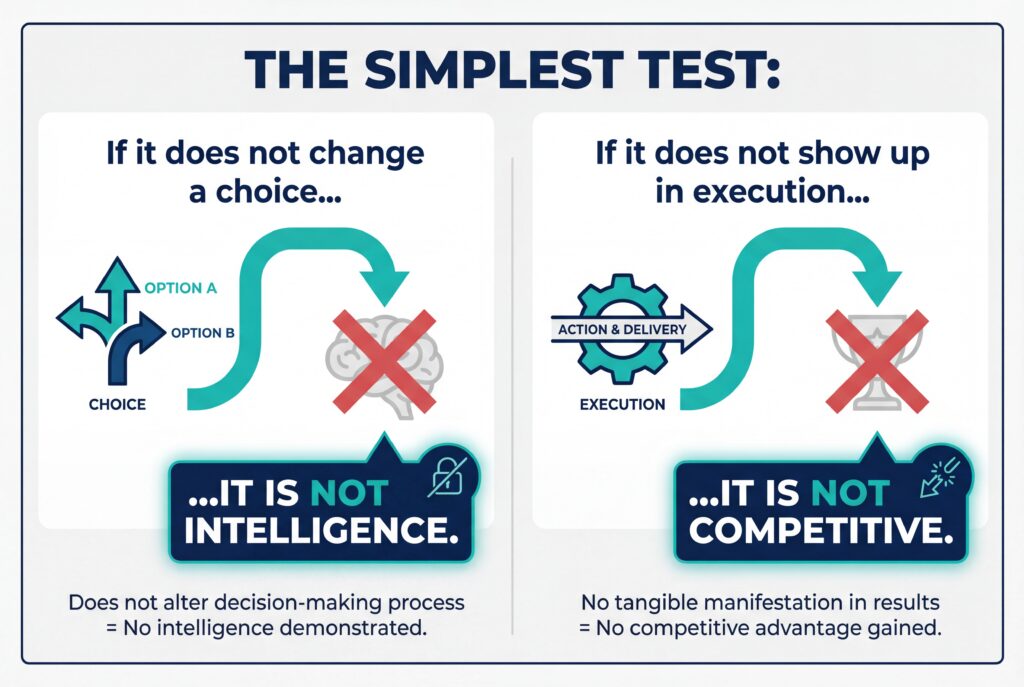
CI solves information asymmetry.
The market is moving whether you are watching or not. CI helps you spot opportunities and threats early so you are not reacting in the last two weeks of the quarter.
What CI is not
CI gets misrepresented a lot, usually by people who have never run it.
- Not corporate espionage. No deception. No hacking. No “trench coats.” CI is explicitly legal and ethical when done properly.
- Not a one-time competitor analysis. A slide deck from last year is not CI. CI is continuous.
- Not a dumping ground. A shared folder of links is not a competitive intelligence program.
If you remember one thing, make it this: CI is a loop.
Define what you need, collect, analyze, distribute, and learn from outcomes.
Competitive intelligence in business vs adjacent disciplines
Most CI programs fail because they are fuzzy about the boundary lines. Teams confuse roles. Inputs overlap. Requests pile up. Then nothing ships.
Here is the clean separation:
CI vs competitor intelligence
People use these interchangeably, but it is useful to keep the distinction.
- Competitor intelligence is narrow. Facts about a specific rival.
- Competitive intelligence is broader and strategic. It turns competitor facts into company-wide implications and action.
Competitor intelligence says: “They added usage-based pricing.”
Competitive intelligence says: “That changes how they will position to our mid-market deals, and it will pull prospects into a different evaluation path. Here is how we defend, and where we can exploit the trade-offs.”
CI vs market research
Market research is customer-first. CI is competition and environment-first.
- Market research answers: “What do customers want? What is demand? What is the segment size?”
- Competitive intelligence answers: “What are competitors doing, and what should we change because of it?”
They complement each other:
CI without market context turns into paranoia.
Market research without CI turns into wishful positioning.
CI vs competitor analysis
Competitor analysis is often point-in-time – a launch, a board deck, a budget season.
CI is the running system.
- Competitor analysis: periodic snapshots.
- CI: ongoing detection, interpretation, and routing.
If you are in a high-velocity category, a static competitor analysis will be wrong before it gets approved. That is why mature programs build refresh cadence into the operating rhythm.
How competitive intelligence is used
If you are a CRO, you do not need more information. You need fewer surprises.
If you are RevOps, you do not need another dashboard. You need signals that explain why the dashboard moved.
Here are the highest leverage ways competitive intelligence is used in real organizations:
1) Strategy & planning
CI grounds strategy in external reality.
It supports decisions like:
- Which segments are heating up or getting commoditized
- Where new entrants are clustering
- How incumbents are defending
- What “table stakes” just changed
This is where CI goes beyond competitor monitoring. You are not only watching your rivals; you’re watching the shape of the field.
2) Forecast risk reduction
Most forecast misses are not random. They are predictable patterns that show up as weak signals.
CI contributes to forecast hygiene by identifying competitor moves that change the probability of late-stage conversion.
Examples:
- A competitor changes packaging and suddenly wins more “good fit” mid-market deals.
- A major partner starts co-selling with them.
- A new enterprise security certification closes a gap.
Those are not marketing anecdotes. They are conversion drivers.
3) Win rate & deal execution
This is the piece teams talk about, but rarely operationalize.
Competitive intelligence improves win rate when it becomes part of how reps prepare and how managers coach.
The output is not “battlecards exist.”
The output is “battlecards are used, current, and linked to deal stages.”
4) Pricing & packaging
Pricing is where poor CI gets teams in trouble.
Copying a competitor price is easy. Understanding why they changed it is harder.
CI should help you answer:
- What is the strategic intent behind the move?
- What segment are they trying to pull?
- What trade-offs did they make that you can expose?
5) Product & roadmap
CI supports product decisions when it blends:
- Product intelligence: what is shipping, what customers are reacting to
- Technology signals: what they are building next
- Customer feedback: where the competitor experience is failing
Job postings, patents, and regulatory filings can give you forward-looking visibility months before a launch. They are underused for exactly that reason.
6) Competitive brand intelligence
Brand is not vibes. It is preference, credibility, and the permission to charge more.
Competitive brand intelligence looks at how the market perceives you versus alternatives and how competitors are positioning themselves through messaging themes and customer conversations.
For CROs, this shows up as:
- Which claims are landing in late-stage deals
- Which narratives are becoming default assumptions
For RevOps, it shows up as:
- Which competitor is increasingly present in stage 2 or 3
- Which talk tracks correlate with stage regression
What are the goals of competitive intelligence?
It helps to separate “how CI is used” from “what CI is trying to achieve.” The goals are stable. The use cases change.
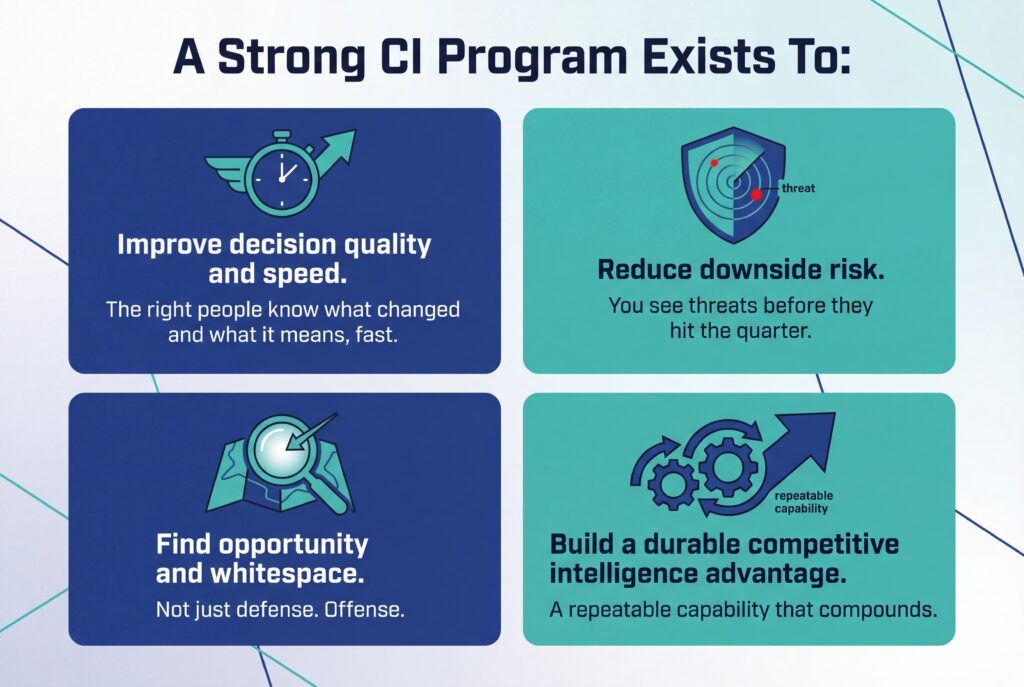
Most firms report CI helps them make better decisions and stay ahead of rivals. The point is not the number, but the mechanism. CI improves the odds you are acting on reality.
Types of competitive intelligence
“Types” are useful for clarity, but in execution, categories overlap. Mature teams handle overlap by tagging and correlating intel in a shared system.
Here is a practical breakdown:
Strategic CI vs tactical CI
- Strategic CI answers: “Where is the market going and how will competitors shape it?”
- Tactical CI answers: “What changed this week that affects deals, messaging, pricing, or pipeline?”
If your CI program only does strategic work, sales stops listening.
If it only does tactical work, leadership stops trusting it.
You need both.
Core intelligence categories
Market intelligence
Industry-level context. Growth rates, segment shifts, demand patterns.
It tells you how urgent a competitor move is.
Product intelligence
What competitors ship, how it works, how customers react, and what that means for your differentiation.
Technology intelligence
Signals about what they are building. Patents, technical papers, hiring patterns.
Financial intelligence
Funding announcements, filings, investor priorities, acquisitions. For public companies, filings legally reveal strategic intent.
Competitive brand intelligence
Perception and messaging. What they want to be known for, and what customers actually say.
Customer intelligence
Voice of customer across your pipeline and installed base. It often contains competitor comparison data.
Environmental intelligence
Regulation, macro shifts, platform changes, and any external force that changes buying behavior.
How to prioritize CI types by CRO and RevOps needs
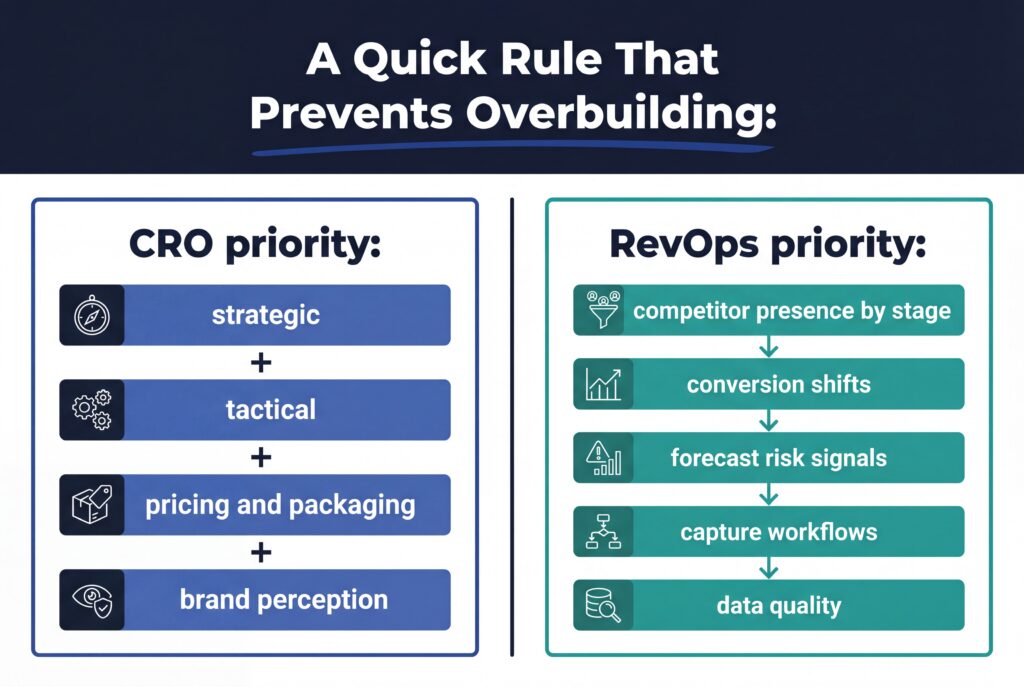
CI is a revenue system when it is measurable and routable. Not when it is comprehensive.
Competitive intelligence gathering
This is where most teams either overdo it or underdo it.
Overdo it and you drown in noise.
Underdo it and you miss the early signals that would have saved you.
What good competitive intelligence gathering involves
CI gathering is not “research.” It is planned collection against defined intelligence needs.
That starts with a coverage model:
- Which competitors matter by segment
- Which categories of intelligence you track for each competitor
- What frequency you need based on market velocity
A tech market may require weekly or monthly scanning.
A slower-moving industry may be fine on a quarterly rhythm.
The point is to match cadence to change rate, not to your calendar.
Sources of competitive intelligence
A useful way to think about sources is “how close are we to the source of truth?”
Tier 1: Competitor-owned and primary proof
- Competitor websites, product docs, pricing pages
- Official blogs, webinars, press releases
- Public filings and investor presentations for public companies
Tier 2: Curated external sources
- Industry publications
- Analyst reports
- Government and industry datasets
Tier 3: Market voice and community signals
- Customer review sites, forums, communities (G2, Reddit, niche Slack groups)
- Social media and social listening
Tier 4: Forward-looking signals
- Job postings and hiring patterns
- Patents and regulatory filings
These are underused because they require interpretation.
That is also why they are valuable. A spike in hiring for a specific skillset can precede a strategic shift by months.
Tier 5: Field intelligence
- Sales and CS conversations
- Win-loss interviews
- Partner chatter
Field intel is messy. It is also real.
The fix is not to ignore it – it is to structure capture and validation.
Primary vs secondary collection
- Primary methods: customer and expert interviews, surveys, events, mystery shopping, win-loss interviews. These generate insight you cannot Google.
- Secondary methods: published sources, filings, reports, monitoring competitor digital presence and messaging.
Good programs do both – they automate secondary monitoring and reserve human time for primary insight.
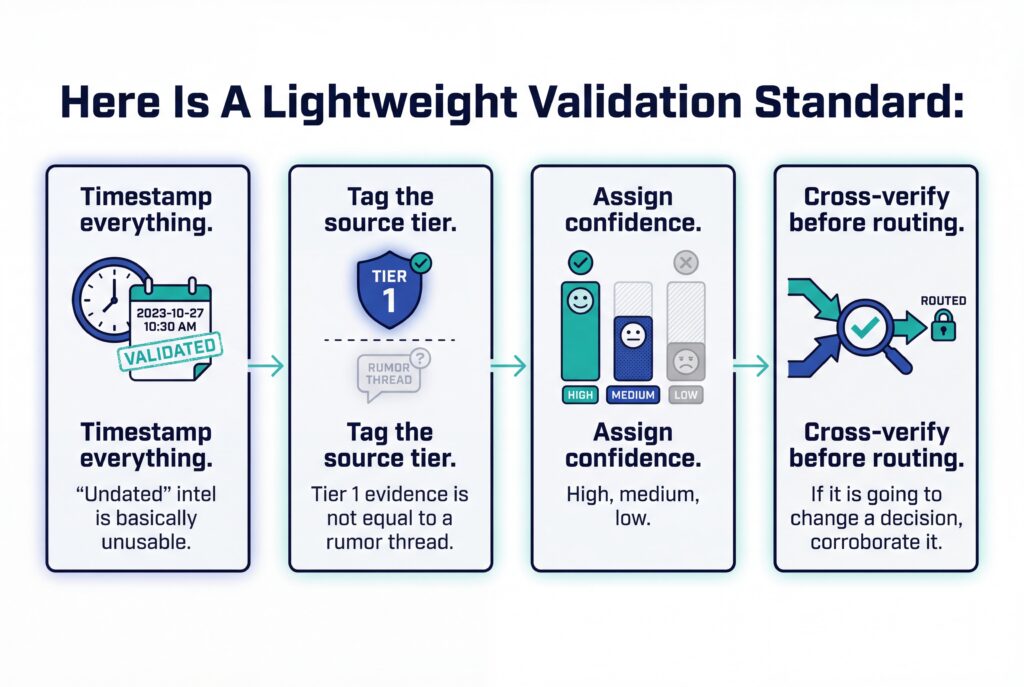
Data quality & validation rules
CI becomes dangerous when it looks confident and is wrong.
Cross-checking and source credibility hierarchy is important. This should be explicit in your operating model.
Competitive intelligence analysis
Collection gives you information.
Analysis gives you clarity.
CI analysis is the step that turns fragments into a narrative with implications. It is the part that closes the loop from data to decision.
The job of analysis
Competitive intelligence analysis should answer three questions, every time:
- What changed? The factual signal.
- So what? The implication for our strategy, pipeline, or execution.
- Now what? The action, owner, and timeline.
If you cannot get to “now what,” you have research, not intelligence.
Frameworks that work in practice
Use frameworks to prevent blind spots, not to impress people.
- SWOT: Fast baseline, useful for periodic updates.
- Porter’s Five Forces: Industry structure and competitive pressure.
- Porter’s Four Corners: Predict competitor motivations and likely moves.
- Perceptual mapping: How the market perceives options. Often price vs value, or simplicity vs control.
- Value chain analysis: Where the competitor is stronger or weaker in execution, not just features.
Multiple frameworks reduce blind spots because each forces a different lens.
A practical signal scoring model
Most teams struggle with signal vs noise. They try to track everything, then stop trusting the output.
You can fix this with a simple scoring model:
Signal Score = Impact × Likelihood × Time-to-act
- Impact: how much this could change win rate, cycle time, ACV, or forecast
- Likelihood: how confident we are that this signal is real and meaningful
- Time-to-act: how quickly we need to respond before it matters
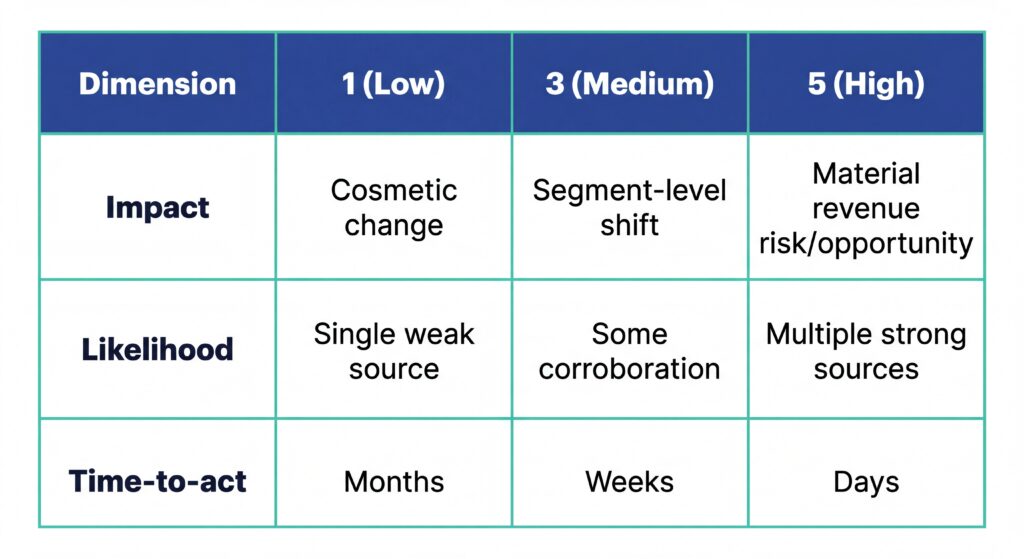
This model creates discipline.
It also makes routing easier:
- High scores trigger alerts.
- Medium scores go into weekly review.
- Low scores get tagged and parked.
Common CI analysis failures
- Over-collection leads to analysis paralysis. You build a library, not a program.
- Lack of context. Raw facts get ignored because nobody knows what to do with them.
- Confirmation bias. Teams see what they want to see and ignore contradicting evidence.
- Bad packaging. Five paragraphs in Slack is not distribution. It is where intel goes to die.
Building a CI program that works
A mature competitive intelligence program is continuous and structured: planning, collection, analysis, and closed-loop distribution with feedback.
Where CI should live
Ownership varies.
CI often sits in product marketing or strategy, with distributed inputs from sales, R&D, and marketing. Leading firms may have centralized CI units, but a coordinator role is the common denominator.
For CROs and RevOps, the implication is straightforward:
- CI needs executive sponsorship.
- CI needs operational integration with sales execution.
- CI needs a single owner who can say no.
A simple CI operating cadence
Cadence should match market pace.
High velocity markets may need weekly or bi-weekly reviews, plus real-time alerts for major events.
A workable cadence looks like this:
- Daily or real-time: automated alerts for high-score signals
- Weekly: 30-minute signal review, triage, and assignments
- Monthly: competitive brief for leaders with implications and decisions
- Quarterly: deeper landscape review, positioning refresh, and play updates
The goal is consistency, not volume.
Deliverables that get used
CI deliverables should be tailored to the audience:
- Executives need implications.
- Product needs feature-level details.
- Sales needs concise talk tracks and traps to avoid.
A practical set:
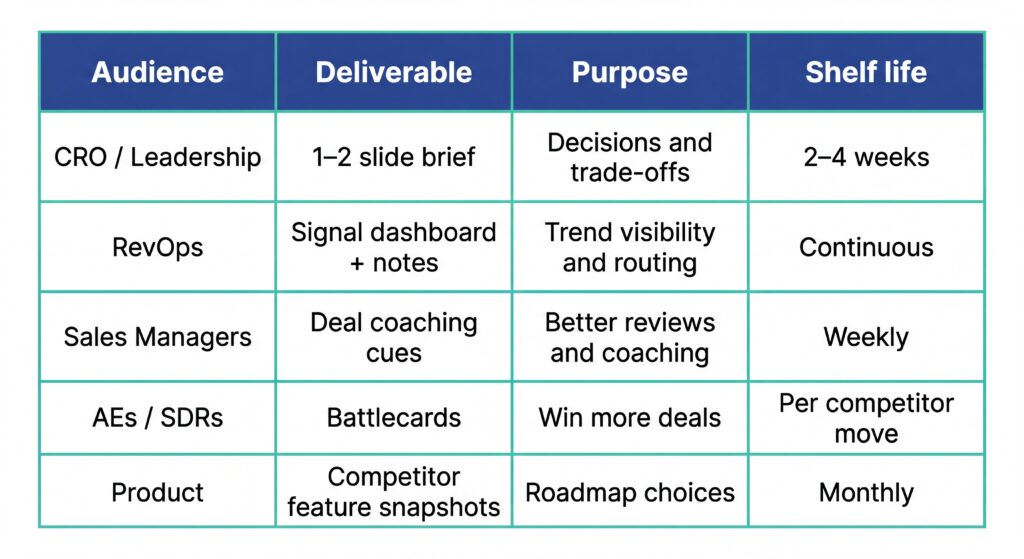
Battlecards, SWOTs, market maps, newsletters, and dashboards are common formats.
The important detail is to keep them living. A competitor move should trigger a refresh, not a quarterly “update.”
Tools & technology for business competitive intelligence
Most CI tools promise “everything in one place.” The reality is more modular.
There are 2 broad groups:
- General tools: search, alerts, social listening, RSS, spreadsheets, BI
- Specialized platforms: CI and market intelligence tools that aggregate sources and often apply AI
The CI stack by job
Monitoring and alerts
- Web changes, news mentions, social chatter
Research databases
- Company funding, filings, patents, market reports
Repository and tagging
- A central place to store intel with source, date, and confidence
BI and dashboards
- Trend lines, competitor presence, conversion shifts, win-loss patterns
CRM capture workflows
- Field intel logged in a structured way so it is searchable and analyzable
Automation vs human analysis
Automation is great at collecting and processing high volume signals. Humans are required for interpretation, context, and deciding what it changes.
If you flip it, you waste your best people.
AI in competitive intelligence
Modern CI often uses AI to scan vast data.
Use AI for:
- Summarization and clustering
- Early anomaly detection
- Drafting briefs and routing suggestions
Do not use AI for:
- Declaring intent without evidence
- Treating weak sources as facts
- Making pricing or positioning calls without operator judgment
A mature program keeps AI in service of decision-makers, not in charge of them.
How EnableU Supports Competitive Intelligence at the Strategy Layer
Most competitive intelligence tools focus on collecting information.
EnableU focuses on using it at the strategy level.
Within the Sales Excellence Platform, competitive intelligence is used to:
- Define and maintain a clear competitive landscape
- Pressure-test ICPs and positioning against real market behavior
- Inform GTM and market entry decisions before execution
- Keep strategic assumptions aligned as competitors and markets change
EnableU doesn’t replace CI tools.
But it ensures competitive intelligence shapes strategy early, where it has leverage.
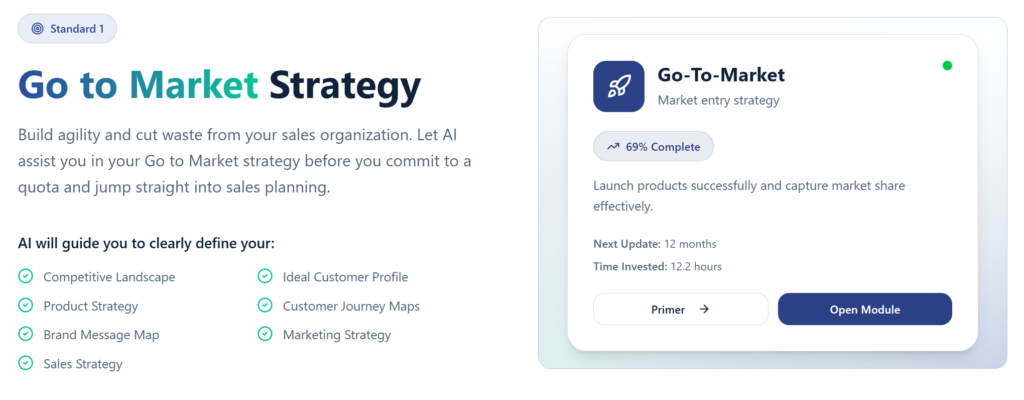
👉 Start a free trial and see how competitive intelligence shows up in strategy decisions.
Ethics, legal boundaries & risk
Competitive intelligence only works when people trust it.
That includes legal trust.
CI gathering must be legal and ethical, relying on public or legitimately acquired information. Avoid hacking, theft, and deception. Train teams and publish guidelines.
A practical CI code of conduct should cover:
- What sources are allowed
- What behaviors are forbidden
- How you handle competitor confidential information if it appears
- How you avoid antitrust risk
Keep it simple. Make it explicit. Protect the program.
Measuring impact & proving ROI
If you cannot measure impact, CI becomes “nice to have.” It gets cut.
The trick is to avoid measuring activity.
Measure outcomes and usage.
Metrics that matter
Speed and relevance
- Time-to-insight (from signal detected to routed decision)
Adoption and usage
- Battlecard usage in active deals
- Brief views and shares
- Manager coaching assets used in reviews
Revenue outcomes
- Win rate against target competitors when CI assets were used
- Cycle time changes after a CI-driven play update
- Forecast variance reduction tied to early competitor signals
Decision attribution
- Which strategic decisions cited CI (pricing changes, packaging shifts, segment focus)
CI should feed strategic planning cycles and everyday tactics.
That is how you avoid “CI theater.” It touches decisions.
Frequently Asked Questions
What is competitive intelligence analysis?
Competitive intelligence analysis is the step where raw competitive intelligence information is interpreted and translated into implications and actions. It focuses on answering what changed, why it matters, and what should be done next rather than summarizing facts.
What are the main sources of competitive intelligence?
Sources of competitive intelligence include public competitor assets, customer reviews, sales conversations, job postings, financial filings, analyst reports, and market data. Strong programs combine multiple sources to validate signals and avoid relying on a single viewpoint.
How is competitive intelligence gathering different from market research?
Competitive intelligence gathering focuses on competitors, market dynamics, and external threats or opportunities, while market research centers on customer needs and demand. Both are valuable, but CI is designed to inform competitive positioning and execution decisions.
What creates a real competitive intelligence advantage?
A competitive intelligence advantage comes from speed, consistency, and execution. Teams win when they detect meaningful signals early, analyze them correctly, and embed the output into sales, pricing, and planning workflows instead of treating CI as a side project.
Conclusion
Competitive intelligence only earns its keep when it changes decisions.
What is competitive intelligence comes down to a simple discipline: systematically tracking competitor moves, market shifts, and customer signals, then translating them into choices leaders can defend.
Done well, it separates signal from noise, exposes where strategy is built on assumptions, and surfaces risk before it shows up in forecast misses. It sharpens ICPs by revealing where competitors are strong or vulnerable, grounds pricing and packaging in real trade-offs, and informs product direction long before launches force a reaction.
Treated as a system, CI keeps GTM strategy aligned with reality as markets move.
If you want to see how competitive intelligence can shape strategy before plans are locked, start a free trial to see how EnableU’s Sales Excellence Framework uses market signals across its eight standards to guide clearer go-to-market decisions.