
AI sales prospecting sounds simple in theory. Plug it in, point it at your ICP, watch pipeline grow.
In reality, teams end up with bloated lists, messy CRM syncs, AI recommendations nobody trusts, and dashboards full of activity but light on outcomes.
The problem usually isn’t effort.
It’s fit. Data fit. Workflow fit. Behavior fit.
We’ll break down the best AI tools for sales prospecting, where each one wins, and how to choose without burning budget or credibility.
Top 3 Picks
- Best For Signal-Driven Prioritization & ICP Clarity: Deal Pilot
- Best For All-In-One Outbound On A Lean Budget: Apollo.io
- Best For Enterprise Sales Engagement & AI-Guided Execution: Outreach
1. Deal Pilot (by EnableU)
Best For: Sales teams that want real-time prospect intelligence and in-call AI coaching.
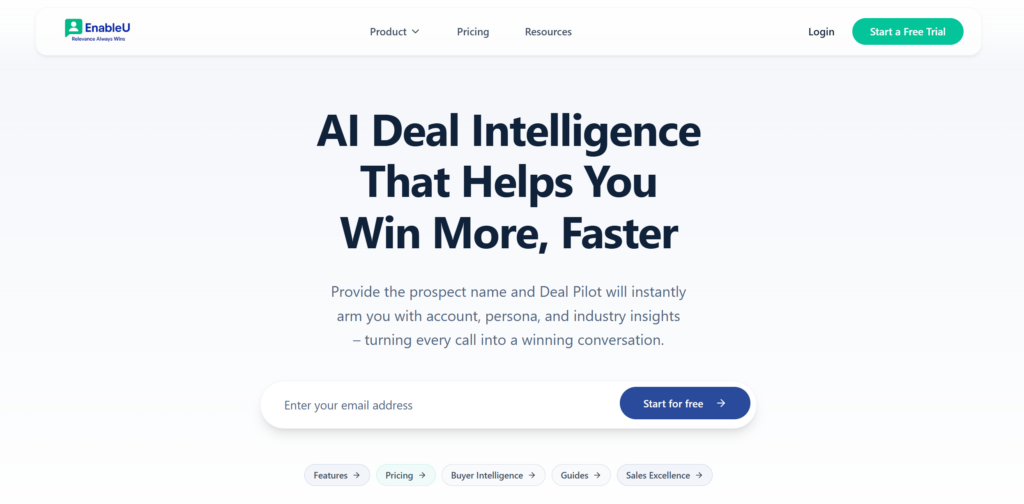
Deal Pilot is ours, and yes, we’re putting it at number one. But not just because it’s ours.
It’s first on the list because most AI prospecting tools stop at contact data and generic outreach. Deal Pilot goes further. It connects prospect research, buyer intelligence, messaging, and live deal coaching into one workflow. This means less time researching and more time selling with context.
Instead of jumping between tools to piece together company data, persona insights, and intent signals, reps get a structured account brief in minutes. Then the system helps them act on it with contextual messaging and in-the-moment coaching.
It’s built for teams who care about predictable execution, not just activity volume.
What It Offers for Sales Prospecting
- Account analysis with company, industry, and role insights
- Deep buyer role intelligence including influence patterns
- Real-time buying signals and intent indicators
- Discovery questions tailored to persona and stage
- Hyper-personalized message sequences and collateral generation
- Real-time in-call coaching and next-best-action prompts
- CRM and sales tool integrations
Pros
- Moves beyond surface-level data into actionable buyer intelligence
- Account planning in under 5 minutes saves serious rep time
- Real-time coaching reduces dependency on post-call feedback
- Aligns prospecting with broader deal strategy, not just top-of-funnel
- Strong fit for AEs and leaders who want consistent methodology adherence
Cons
- More robust than simple list-building tools, which may feel heavy for pure SDR motion
- Best value shows when integrated with existing sales content and CRM
- Not ideal for teams only looking for bulk contact scraping
Pricing
14-day free trial. Thereafter, $39/user/month
Score: 4.8/5
2. Apollo.io
Best For: Outbound-heavy SDR and AE teams that want data, sequencing, and dialing in one platform.
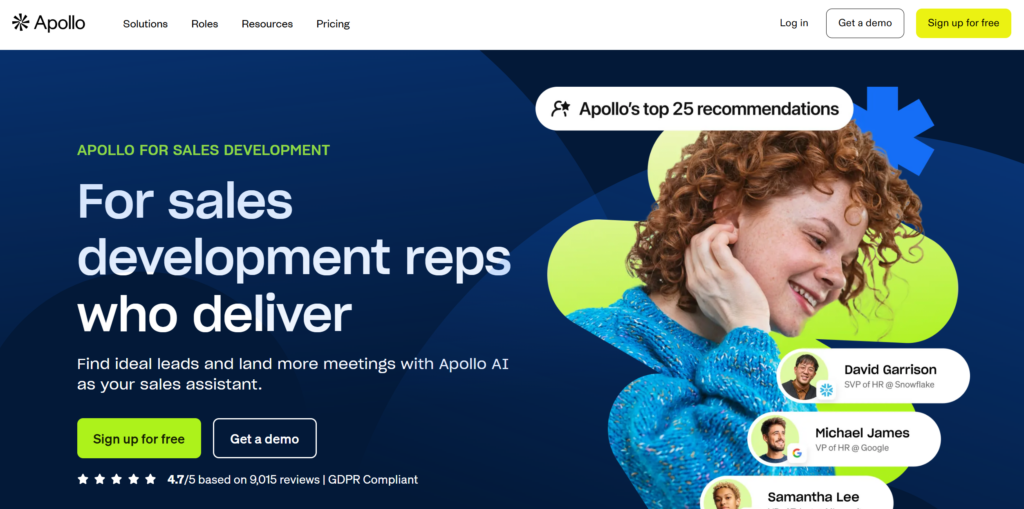
Apollo.io has become the default answer for early and mid-stage B2B teams asking, “Can we just get one tool that does most of this?”
It combines a massive B2B contact database with multichannel outreach, a dialer, enrichment, and even a lightweight CRM. For outbound-driven teams, that consolidation is the appeal. Instead of stitching together a data provider, sequencer, and dialer, Apollo gives you one environment to build lists, launch campaigns, and track replies.
The tradeoff is that it’s broad. It does a lot. But depth and data quality can vary depending on your ICP and region.
What It Offers for Sales Prospecting
- Large B2B contact and company database with advanced filters
- ICP-based search and segmentation with 200+ data points
- AI-assisted lead prioritization and research summaries
- Multichannel email sequences with automation and A/B testing
- Built-in dialer and call logging
- Data enrichment and CRM sync
- Chrome extension for prospecting directly from LinkedIn/web
Pros
- Strong value for money compared to stacking multiple tools
- Generous free tier for solopreneurs and small teams
- Advanced filtering makes ICP list building fast
- Multichannel outreach and data in one place
- Scales well for outbound-first teams
Cons
- Data accuracy can vary by region and niche
- Can feel complex during setup due to breadth of features
- Built-in CRM may not meet enterprise needs long-term
- AI features are helpful but not as deep as specialized intelligence tools
Pricing
Free plan with 75 credits/month. Paid plans start at $59/user/month
Score: 4.7/5
3. ZoomInfo
Best For: Mid-market and enterprise GTM teams that prioritize US data accuracy, buying intent, and AI-guided account prioritization.
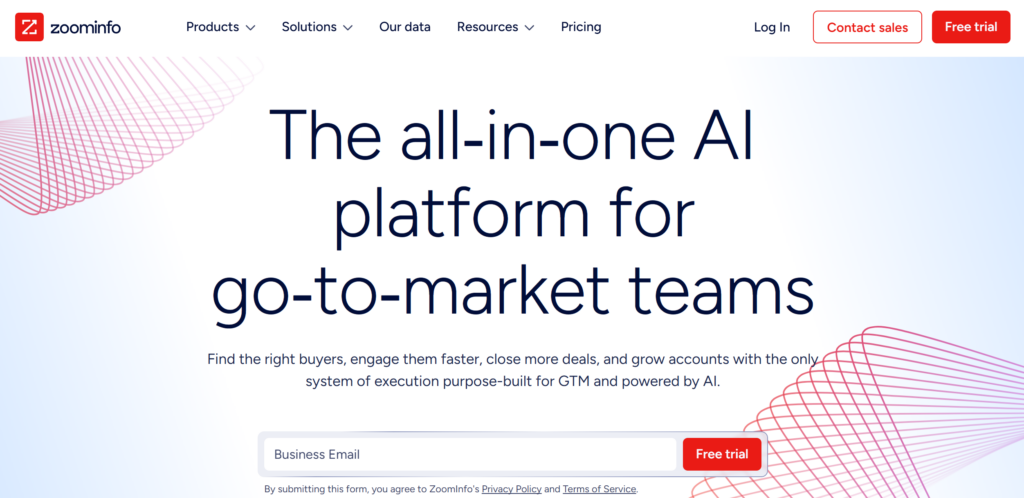
ZoomInfo sits at the top end of the sales intelligence market. It’s not trying to be a scrappy all-in-one outbound tool. It’s built as a data and intelligence layer for serious GTM organizations that care about signal quality, buying intent, and orchestration across CRM, marketing automation, and sales engagement tools.
If Apollo is about consolidation, ZoomInfo is about depth. Especially in the US. Its direct dials, verified emails, and intent signals are often cited as best-in-class.
The catch? It’s priced and structured like an enterprise platform, not a self-serve tool.
What It Offers for Sales Prospecting
- 300M+ professional profiles and 100M+ companies
- Advanced firmographic, technographic, and org chart filtering
- Topic-based buyer intent data
- Web visitor identification and account engagement tracking
- AI Copilot for account prioritization and email drafting
- Buying committee and stakeholder mapping
- CRM, MAP, and sales engagement integrations
Pros
- Market-leading US contact and direct-dial accuracy
- Strong intent ecosystem for timing outreach
- AI Copilot uses proprietary signals, not generic prompts
- Excellent integration depth for RevOps-heavy environments
- Proven ROI when embedded into full GTM workflows
Cons
- High, contract-based pricing with opaque structures
- Best suited for US-heavy ICPs
- Requires RevOps maturity to unlock full value
- Still needs external sequencer for full engagement execution
- Multi-year contracts and renewals can feel rigid
Pricing
ZoomInfo does not publish transparent pricing.
- Entry-level contracts typically start around $15,000 per year for small seat packages.
- Mid-market and enterprise agreements often range from $25,000 to $100,000+ annually, depending on seats, intent data, WebSights, and add-ons.
- Credit-based usage applies to exports and certain features.
Score: 4.6/5
4. Clay
Best For: Data-driven GTM and RevOps teams that want maximum control over enrichment, AI research, and outbound workflows.
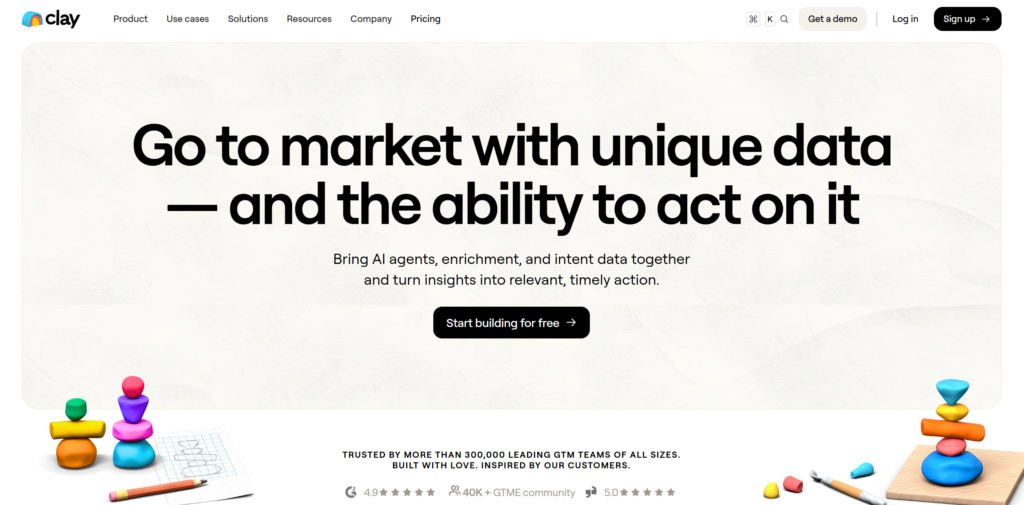
Clay is not a traditional “database + sequencer” tool. It’s more like a programmable data engine for go-to-market teams.
Instead of relying on one data provider, Clay connects 75–150+ enrichment sources and lets you build waterfall logic to maximize coverage. Then it layers AI agents on top to research accounts, generate personalized snippets, score leads, and trigger workflows.
It’s powerful. But it assumes you want to design your own system.
For teams with a GTM engineer or strong RevOps, Clay can unlock serious prospecting leverage. For less technical teams, it can feel overwhelming.
What It Offers for Sales Prospecting
- Waterfall multi-provider enrichment for email, phone, firmographics, technographics
- AI agents (Claygent) for research, summarization, and first-line personalization
- Multi-channel lead sourcing including LinkedIn, Google Maps, GitHub, directories
- No-code workflow automation with conditional logic
- CRM enrichment and syncing
- Intent-style signals via combined enrichment and triggers
- Native Sequencer (basic) or integrations with Outreach/Salesloft
Pros
- Extremely flexible and customizable prospecting engine
- Strong enrichment coverage when configured well
- AI research embedded directly inside workflows
- Great for niche or non-standard ICP sourcing
- Unlimited users with usage-based pricing
Cons
- Steeper learning curve than traditional prospecting tools
- Credit usage requires monitoring and optimization
- Native sequencer is basic compared to dedicated engagement tools
- Requires thoughtful configuration to unlock full data quality
- Best results require a power user or GTM ops ownership
Pricing
Clay is credit-based and usage-driven. You pay for enrichment calls, AI usage, and workflows.
- Free: $0/month with limited credits
- Starter: ~$134/month (annual billing)
- Explorer: ~$314/month
- Pro: ~$720/month
- Enterprise: Custom credits and pricing
Score: 4.4/5
5. Cognism
Best For: Outbound teams selling into the UK and EMEA that need compliant, high-accuracy mobile data.
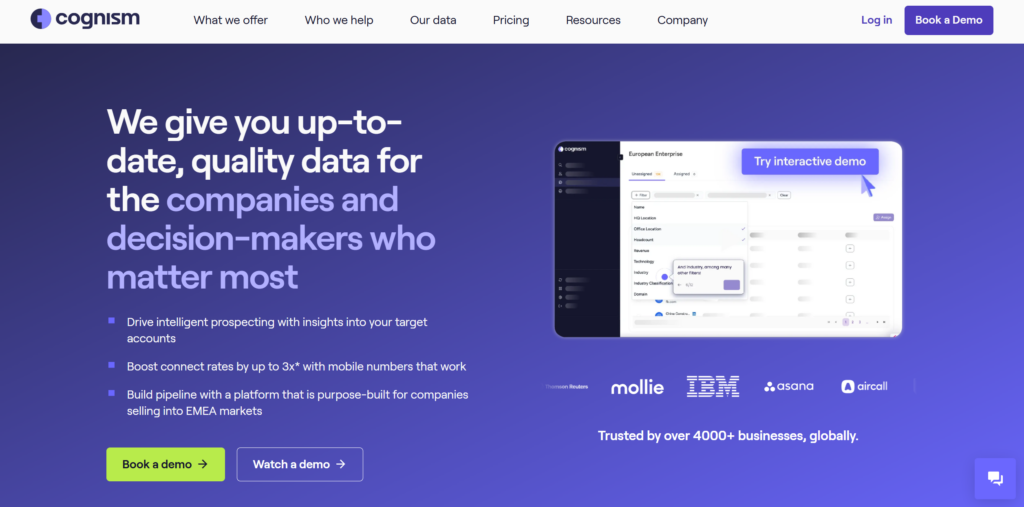
Cognism doesn’t try to win on “biggest database.” It wins on quality and compliance.
Its core pitch is simple: better mobile numbers, stronger European coverage, and fewer legal headaches. For teams running phone-heavy outbound into the UK and wider EMEA, that matters more than flashy AI features.
The standout is Diamond Data®, Cognism’s phone-verified mobile dataset. If connect rates are your bottleneck, especially in regulated markets, Cognism can materially change the math.
It’s less about automation layers and more about getting the right decision-maker on the line.
What It Offers for Sales Prospecting
- 400M+ B2B profiles with strong EMEA mobile coverage
- Phone-verified Diamond Data® mobile numbers
- GDPR and Do-Not-Call screened contact data
- Intent data and buying signals
- Job change, funding, and company trigger alerts
- Salesforce, HubSpot, and Sales Engagement integrations
- Sales Companion Chrome extension for LinkedIn prospecting
Pros
- Best-in-class EMEA mobile accuracy
- Strong compliance posture for GDPR-sensitive teams
- High-quality senior decision-maker coverage
- Designed specifically for outbound SDR workflows
- Improves connect rates meaningfully for call-first teams
Cons
- Opaque, contract-based pricing
- Less compelling for US-first ICPs
- Requires separate sequencer/engagement platform
- AI features are more prioritization-focused than workflow-heavy
- Annual commitments limit flexibility
Pricing
Cognism does not publish list pricing. Contracts are customized by seat count, region, and add-ons.
- Entry packages often start around $15,000 per year
- Higher tiers with Diamond Data and intent typically exceed $25,000+ annually
- Larger deployments frequently reach $30,000–$100,000+ per year
Score: 4.3/5
6. Salesloft
Best For: Mid-market and enterprise revenue teams that want structured, AI-guided outbound execution layered on top of CRM and data tools.
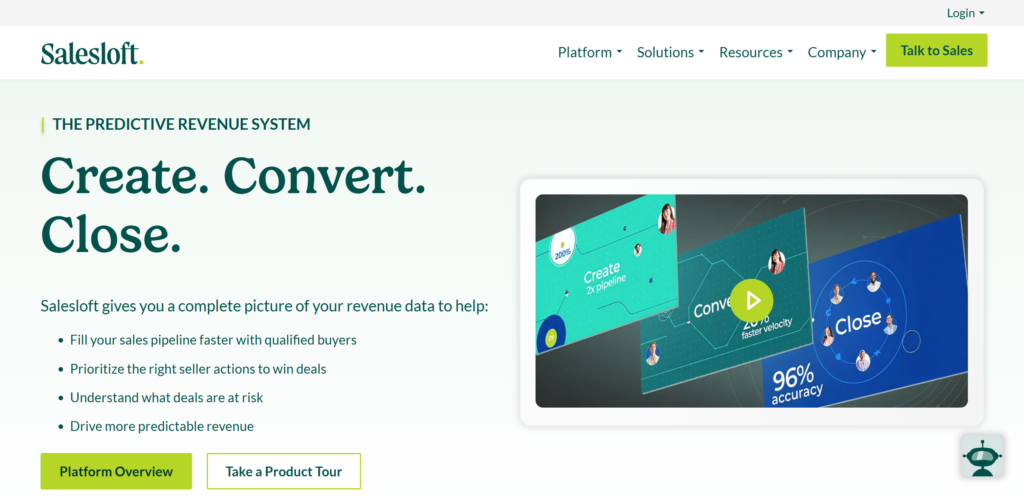
Salesloft is not a data provider. It’s an execution engine.
If ZoomInfo or Cognism helps you decide who to go after, Salesloft helps you control how reps go after them. Cadences, dialing, AI-prioritized tasks, call intelligence, deal health, forecasting. It’s built for teams that want process discipline and signal-driven action, not just more contacts.
The standout feature is Rhythm, which turns buyer signals, CRM data, and engagement activity into a prioritized daily action list. For larger teams, that focus layer can materially improve consistency.
What It Offers for Sales Prospecting
- Multi-channel cadences across email, calls, and social
- Built-in dialer and call logging
- AI-powered Rhythm task prioritization
- Signal ingestion from CRM, intent, and data providers
- Conversation intelligence with AI summaries
- Deal health scoring and forecasting
- Deep Salesforce and HubSpot integrations
Pros
- Best-in-class cadence engine for structured SDR motions
- AI prioritization reduces rep guesswork
- Strong CRM integration and ecosystem support
- Conversation intelligence tied directly to pipeline
- Enterprise-grade governance and reporting
Cons
- Not a contact data source
- Quote-based pricing with no transparent list rates
- Can feel heavy for small teams
- Requires thoughtful implementation and enablement
- Best ROI comes with mature RevOps processes
Pricing
Salesloft uses quote-based pricing with annual contracts.
- Independent reports suggest $125–$175 per user/month for core packages
- A 20–30 rep team typically represents a mid-five-figure annual investment
There is no true free tier, and evaluation usually requires a sales-led process.
Score: 4.2/5
7. Outreach
Best For: Enterprise and scaling revenue teams that want AI-driven execution across prospecting, deal management, and forecasting.
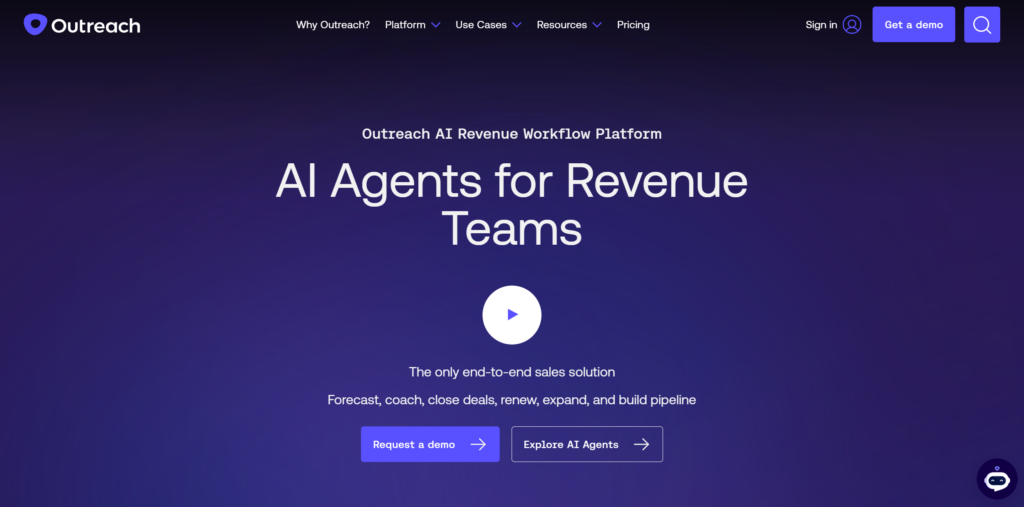
Outreach calls itself an AI Revenue Workflow Platform. That framing matters.
Like Salesloft, Outreach is not a data provider. It sits between your CRM and your data tools and orchestrates how reps execute. Sequences, task queues, AI email assistance, call intelligence, deal health, forecasting. The value is in structured execution plus AI embedded throughout the funnel.
Where Outreach differentiates is the breadth of AI agents. Prospecting agents. Email personalization blocks. Real-time call assistance. Forecast confidence scoring. It is trying to unify pipeline generation and revenue intelligence into one operating layer.
What It Offers for Sales Prospecting
- Multi-channel sequences with advanced rules and A/B testing
- Automated task prioritization and CRM sync
- AI email drafting and personalization blocks
- AI prospecting and research agents
- Conversation intelligence via Kaia Smart Assist
- Deal health scoring and forecasting via Outreach Commit
- Deep Salesforce and CRM integrations
Pros
- Highly mature and battle-tested sales engagement engine
- AI embedded across prospecting, calls, and forecasting
- Strong Salesforce integration and ecosystem depth
- Built for structured, scalable outbound execution
- Proven performance at enterprise scale
Cons
- Not a contact database
- Quote-based, opaque pricing
- AI add-ons and usage credits increase total cost
- Implementation requires RevOps ownership
- Can feel heavy for lean or early-stage teams
Pricing
Outreach uses quote-based, per-user pricing. No public price list or free tier.
- Enterprise marketplace listings cite ~$180 per user/month
- AI agents and voice usage are often consumption-based
- A 20–30 rep team typically lands in the mid- to high-five-figure annual range
Score: 4.0/5
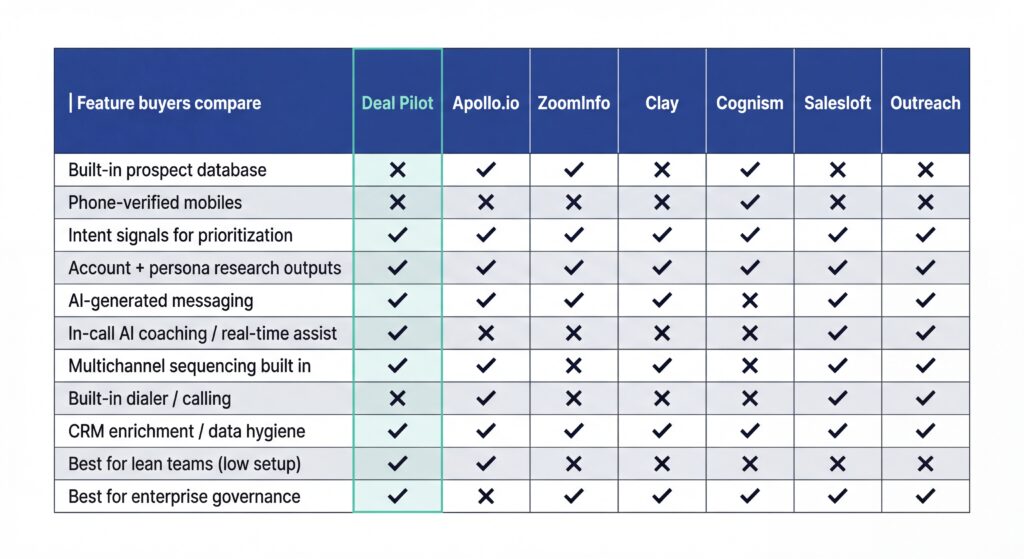
Comparison: Best AI Tools For Sales Prospecting
How To Choose The Right AI Sales Prospecting Tool
The right tool depends less on features and more on fit.
Here’s a practical way to think about it.
1. What Problem Are You Actually Solving?
Are you missing data, struggling with prioritization, or lacking structured execution?
- If you lack good contact data: ZoomInfo, Apollo.io, and Cognism are strong. Clay can also help via enrichment workflows. Deal Pilot, Salesloft, and Outreach are not data providers.
- If prioritization and timing are weak: Deal Pilot, ZoomInfo (intent), Apollo.io, Cognism, Salesloft, and Outreach all layer in signals and AI ranking.
- If execution is chaotic: Salesloft and Outreach are built for workflow control. Apollo.io offers sequencing at lower cost. Deal Pilot supports orchestration but is not a heavy enterprise sequencer.
- If personalization is the bottleneck: Clay, Apollo.io, Outreach, and Salesloft offer AI drafting. Deal Pilot focuses more on account intelligence than copy alone.
Misalignment here is the most common reason tools fail.
2. Data Quality & Geographic Fit
Data quality directly affects deliverability, connect rates, and AI scoring accuracy.
- Best for US breadth: ZoomInfo, Apollo.io
- Best for EMEA and compliant calling: Cognism
- Workflow-driven enrichment: Clay
- Not data-first platforms: Deal Pilot, Salesloft, Outreach
If your ICP is UK or EMEA and phone-first, Cognism stands out. If you need broad US SaaS coverage, ZoomInfo or Apollo.io are stronger fits.
3. AI That Changes Rep Behavior
AI should drive “who to contact next,” not just write better emails.
- Strong prioritization engines: Deal Pilot, Salesloft (Rhythm), Outreach (Revenue Agents)
- Intent-led targeting: ZoomInfo, Cognism
- Research automation: Clay, Apollo.io
- Copy assistance only: Apollo.io and Clay lean more here compared to workflow-driving AI.
If AI doesn’t influence daily task lists, adoption will fade.
4. Workflow & Stack Fit
Tools must slot into CRM and daily rep workflows.
- Deep Salesforce execution layer: Salesloft, Outreach
- All-in-one stack consolidation: Apollo.io
- Flexible builder with integrations: Clay
- Intelligence overlay with lighter execution: Deal Pilot
- Data backbone feeding CRM: ZoomInfo, Cognism
5. Governance & Enterprise Readiness
- Strong governance and forecasting: Salesloft, Outreach
- Enterprise-grade data contracts: ZoomInfo, Cognism
- Flexible but requires technical ownership: Clay
- Simpler operational footprint: Apollo.io
- Strategy-layer intelligence: Deal Pilot
Complex orgs need dedicated ownership. Simpler teams need opinionated workflows.
6. Total Cost of Ownership
- Lower upfront cost: Apollo.io
- Premium enterprise spend: ZoomInfo, Cognism, Salesloft, Outreach
- Credit-based automation model: Clay
- Execution-layer ROI tied to adoption: Salesloft, Outreach
- Intelligence ROI tied to win-rate lift: Deal Pilot
Look at the full stack cost, not just seat price.
Frequently Asked Questions
What is the difference between AI sales prospecting and traditional sales prospecting?
Traditional sales prospecting relies heavily on manual research, static lists, and rep intuition. AI sales prospecting uses intent data, automation, and machine learning to prioritize accounts, surface insights, and reduce time spent on research and list building.
How do AI prospecting tools improve lead quality?
AI prospecting tools analyze firmographics, technographics, buying signals, and engagement data to score and prioritize leads. This helps sales teams focus on accounts that are more likely to convert, improving pipeline quality and reducing wasted outreach.
Can AI tools fully automate sales prospect research?
Some AI tools can automate large parts of prospect research, including account summaries, contact discovery, and talking point generation. However, high-performing teams still layer human judgment and personalization on top of AI-generated insights.
What should I look for in an AI outreach tool?
Look for strong CRM integration, reliable data sources, intent signals, AI-powered prioritization, and built-in analytics. The best AI outreach tool fits your sales motion and reduces research time without creating workflow friction.
Conclusion
Choosing among the best AI tools for sales prospecting comes down to alignment.
If you need raw data and coverage, ZoomInfo, Apollo.io, and Cognism lead in different geographies. If you want research automation and workflow flexibility, Clay stands out.
If structured execution and rep discipline matter most, Salesloft and Outreach offer strong orchestration layers. And if the real problem is deciding who to go after, when, and why, Deal Pilot focuses on turning signals, ICPs, and performance data into clear next actions.
The right choice depends on whether you’re fixing data gaps, execution drift, or prioritization noise.
If prioritization and signal clarity are your bottleneck, start a free trial of Deal Pilot to see how it turns scattered prospecting data into focused, revenue-driving action.