

Some sales reps walk into a conversation and change how a buyer sees the problem. Others run through the motions and hope momentum carries the deal.
The difference rarely comes down to personality.
It’s skill.
Specific, learnable sales skills that shape how deals move, stall, or close.
We’ll break down the skills that matter most in 2026 and how sales leaders and recruiters should think about building them.
Key Notes
- Consultative thinking, AI fluency, EQ, curiosity, and domain expertise now define top sales skills.
- High-performing sellers blend sales soft skills with hard sales skills like data analysis and CRM discipline.
- Skill priorities vary by sales environment, from enterprise deal orchestration to rapid SMB qualification.
The 5 Sales Skills That Matter Most In 2026
Every few years someone publishes a giant list of sales skills.
Fifty items. Sometimes more.
In reality, a handful of capabilities drive the majority of performance differences. The rest are supporting behaviors.
Five stand out consistently across modern sales organizations:
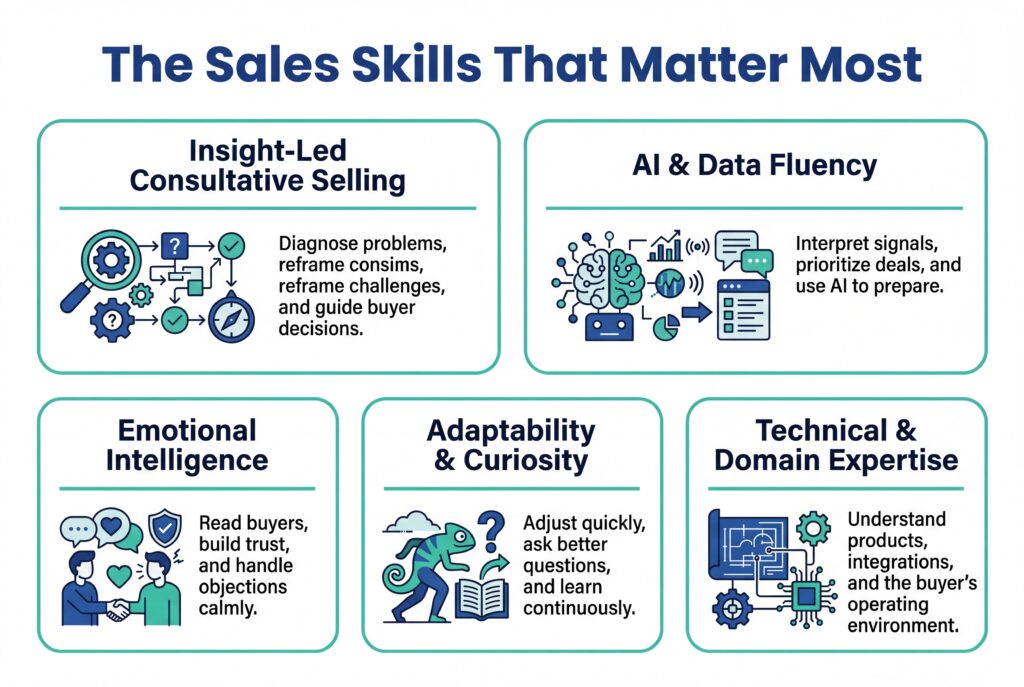
1. Insight‑led consultative selling
The strongest sellers do not start with a pitch.
They start with a diagnosis.
- They ask questions that surface problems the buyer has not articulated yet.
- They connect operational symptoms to strategic consequences.
- They help buyers see the cost of inaction.
Consultative selling has existed for decades, but the standard is higher now. Buyers already know the basics. They expect a seller to add perspective. That requires curiosity, preparation, and the ability to translate product capability into business outcomes.
When this skill is strong, conversations feel collaborative rather than transactional.
When it is weak, the interaction turns into a feature walkthrough very quickly.
2. AI & data fluency
One of the most important hard sales skills today is the ability to work effectively with data and AI tools.
That does not mean coding or technical expertise.
It means knowing how to use modern tools to accelerate preparation and improve decision quality.
Examples include:
- Interpreting pipeline signals and deal velocity
- Using AI to summarize accounts and industries
- Identifying patterns in win and loss data
- Prioritizing opportunities based on likelihood to close
The skill is not the tool itself.
The skill is judgment about what the signals mean.
Many organizations now expect sellers to interpret data, not just report it.
3. Emotional intelligence
Technology may be reshaping sales, but human dynamics still decide most deals.
Emotional intelligence shows up in several ways:
- Recognizing hesitation in a buyer’s response
- Adjusting tone based on stakeholder roles
- Handling objections without defensiveness
- Building credibility quickly in unfamiliar rooms
This is why sales soft skills remain foundational. Trust cannot be automated.
In complex deals, buyers are not simply evaluating a product.
They are evaluating whether the seller understands their situation.
High EQ sellers detect friction earlier and adapt before it becomes a deal blocker.
4. Adaptability & curiosity
Curiosity may be the most underestimated capability in modern selling.
Markets change. Messaging evolves. Competitors reposition constantly.
Sellers who treat every interaction as a learning opportunity improve faster than those who rely on scripts.
Adaptability appears in subtle moments:
- A rep notices a shift in buyer priorities and adjusts the conversation.
- A question opens a new angle worth exploring.
- A competitor enters the discussion and the rep pivots without panic.
- These moments rarely appear in CRM fields, yet they shape outcomes more than most metrics.
5. Technical & domain expertise
Many products today involve integrations, workflows, or operational trade‑offs. Buyers expect sellers to understand the environment their solution fits into.
This is especially true in SaaS, AI, infrastructure, and enterprise technology.
Domain expertise allows a salesperson to:
- Speak credibly with technical stakeholders
- Anticipate implementation concerns
- Translate technical features into operational value
Without this depth, conversations remain superficial. Buyers notice quickly.
Taken together, these five capabilities form the core of modern sales capabilities.
Sales Soft Skills That Still Drive Trust
Soft skills often get dismissed as vague personality traits.
In reality, they are operational behaviors that influence buyer confidence.
Several stand out as consistently decisive:
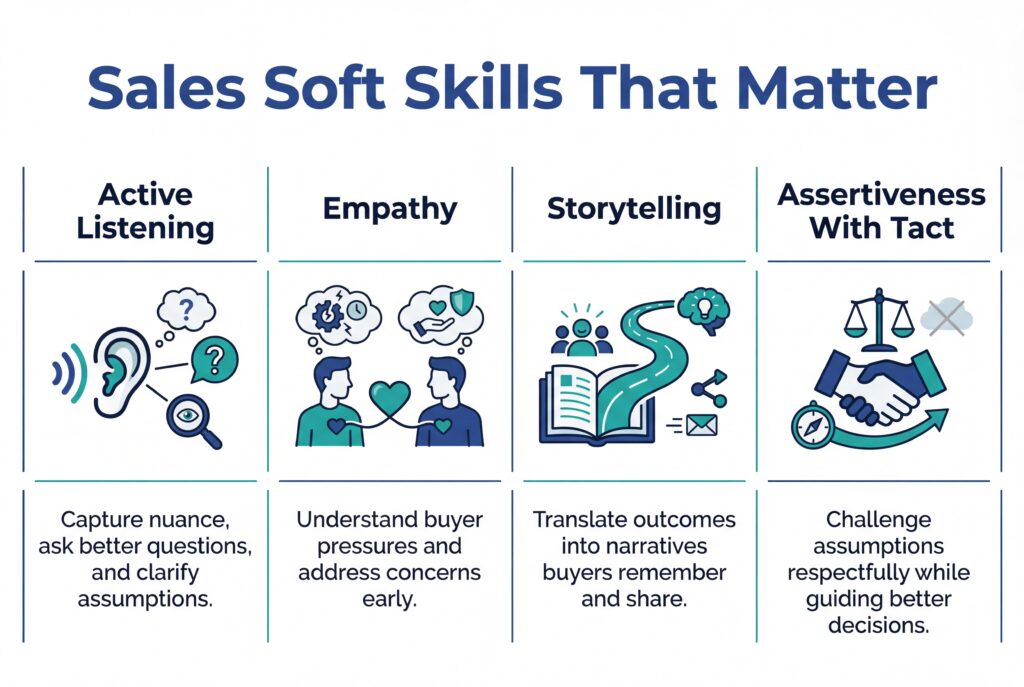
Active listening
Listening is more complex than staying silent while someone speaks.
Strong listeners capture nuance. They ask follow‑up questions that show genuine understanding. They summarize accurately and clarify assumptions before moving forward.
Weak listening creates subtle damage:
- Buyers repeat themselves.
- Key signals go unnoticed.
- Misalignment grows quietly.
Empathy
Empathy is the ability to understand the pressures on the other side of the table.
Buyers juggle risk, internal politics, budgets, and competing priorities. Sellers who recognize these pressures design conversations differently. They address concerns earlier and frame recommendations in ways that reduce perceived risk.
Empathy does not mean agreement.
It means awareness.
Storytelling
Data informs decisions; stories make them memorable.
Effective sellers translate customer outcomes into narratives that buyers can picture inside their own organization. Instead of presenting isolated facts, they connect cause and effect.
This ability helps complex ideas travel across buying committees.
Assertiveness with tact
Sales conversations sometimes require pushing back. Buyers may pursue unrealistic timelines or overlook hidden constraints.
Strong sellers challenge respectfully. They guide decisions without sounding combative. That balance builds credibility.
Hard Sales Skills That Are Now Non‑Negotiable
While soft skills shape trust, technical proficiency shapes execution.
Several hard sales skills now appear in nearly every high‑performing team:
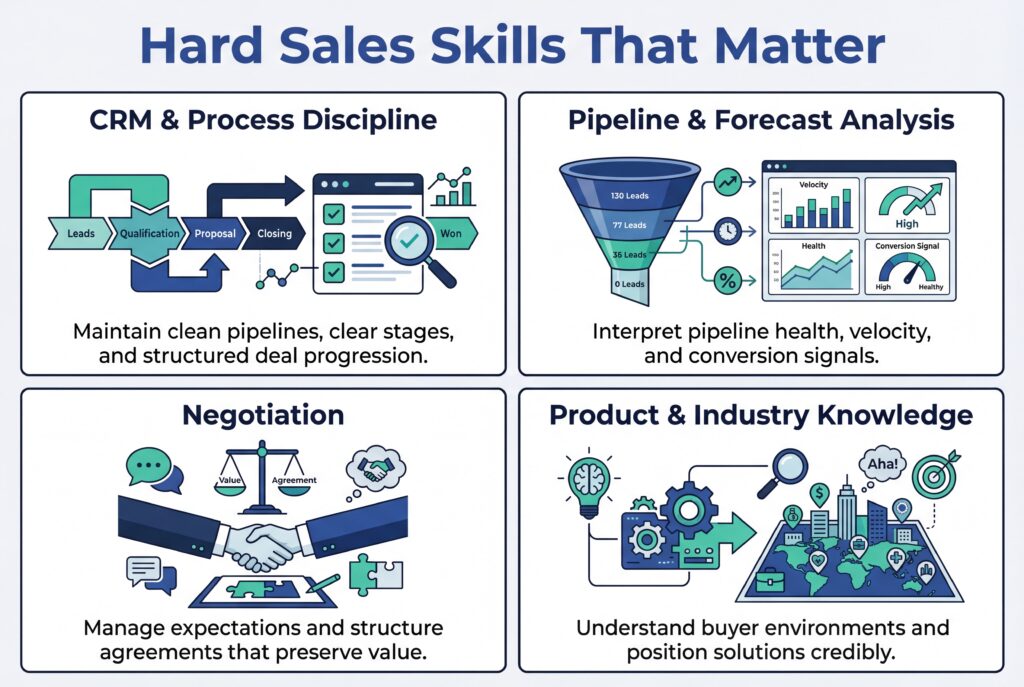
CRM & process discipline
CRM hygiene often seems administrative, yet it reveals deeper behavior patterns.
Clean pipelines, clear next steps, and accurate deal stages indicate structured thinking. Messy pipelines usually signal weak deal control.
Leaders increasingly measure process signals because they predict outcomes earlier.
Pipeline & forecasting analysis
Modern sellers cannot rely solely on intuition.
Understanding pipeline health, conversion rates, and deal velocity helps reps prioritize time effectively. It also improves forecast reliability.
Data literacy is becoming a core component of sales proficiency.
Negotiation
Negotiation is not simply about price.
It involves:
- managing expectations
- identifying trade‑offs
- and structuring agreements that preserve value for both sides.
Sellers who negotiate well protect margins and reduce late‑stage friction.
Product & industry knowledge
Technical fluency enables deeper conversations with stakeholders. It allows reps to address concerns before they escalate and position solutions within the broader operational environment.
In many industries, this knowledge is now considered one of the best skills for sales.
Sales Skills That Are Losing Value
Not every traditional selling behavior remains useful.
Several practices are steadily declining in relevance:
Script‑driven pitching
Rigid scripts break down quickly once buyers ask unexpected questions. Modern selling requires flexibility and problem‑solving, not memorization.
Generic outreach at scale
Automation made mass outreach easier. Buyers adapted by ignoring most of it.
Relevance now beats volume.
Aggressive closing tactics
High‑pressure closing techniques may still appear in training courses, but they rarely succeed with sophisticated buyers.
Trust moves deals forward more reliably than urgency manufactured at the end of a conversation.
Sales Skills by Context: What Matters in Different Environments
Not every skill for sales matters equally in every environment. Context changes priorities.
Enterprise B2B sales
Enterprise deals involve multiple stakeholders and longer timelines. Sellers must orchestrate conversations across technical, financial, and executive audiences.
Key capabilities include:
- multi‑threading
- strategic questioning
- relationship management
SMB & transactional sales
Speed becomes more important. Buyers expect clear explanations and efficient decision paths.
Concise communication and rapid qualification stand out here.
Long‑cycle sales
Patience and momentum management matter most. Sellers must keep deals progressing without creating pressure that damages trust.
Account expansion
Account managers rely heavily on listening and pattern recognition. Growth opportunities often appear as small operational shifts inside existing customers.
Recognizing those signals requires attentiveness more than persuasion.
What Sales Leaders Should Assess When Hiring
Hiring decisions shape team capability more than any training program.
Recruiters and leaders evaluating sales skills and abilities should focus on signals that predict long‑term performance.
Curiosity
Curious candidates ask thoughtful questions during interviews. They explore the problem space rather than rushing to demonstrate expertise.
Coachability
Top performers treat feedback as data. They experiment with suggestions instead of defending their previous habits.
Communication clarity
Strong sellers explain complex ideas simply. Interviews reveal this quickly.
Learning agility
Markets evolve rapidly. Reps who absorb information quickly adapt faster when messaging or strategy changes.
How To Improve Sales Skills
Improvement rarely happens through occasional training sessions.
Developing sales skills requires repetition and feedback.
A simple improvement loop works well:
- Practice a specific capability
- Review real interactions
- Receive structured feedback
- Apply lessons immediately
Call recordings, peer reviews, and coaching sessions make this process concrete. Over time, small adjustments compound into measurable performance gains.
How Organizations Build Sales Capabilities Across Teams
Individual improvement matters, but sustainable performance comes from systems.
Organizations that consistently produce strong sellers share several habits:
- Competencies are clearly defined
- Coaching happens frequently
- Managers review real deals, not theory
- Skills are reinforced inside daily workflows
Training becomes effective when it connects directly to live opportunities.
A Practical List of Sales Skills for 2026
For quick reference, modern sales professional skills typically fall into four categories:
Human skills
- Empathy
- Active listening
- Curiosity
- Communication clarity
Commercial skills
- Discovery
- Negotiation
- Objection handling
- Account planning
Technical skills
- CRM proficiency
- Pipeline analysis
- AI literacy
- Product knowledge
Growth skills
- Coachability
- Reflection
- Learning agility
Together these capabilities form the foundation of modern sales capabilities.
Frequently Asked Questions
What are the most important skills in sales for beginners?
The most important skills for sales early in a career are curiosity, active listening, clear communication, and resilience. Beginners should focus on understanding customer problems before trying to sell solutions. Building strong discovery habits early is one of the fastest ways to improve long-term sales proficiency.
What is the difference between sales soft skills and hard sales skills?
Sales soft skills involve human interaction, such as empathy, listening, communication, and relationship building. Hard sales skills are technical capabilities like CRM usage, pipeline analysis, negotiation, and product knowledge. High-performing sales professionals combine both, using technical insight to guide conversations and soft skills to build trust.
What skills do recruiters look for when hiring sales professionals?
Recruiters typically prioritize a mix of sales skills and abilities, including communication clarity, curiosity, coachability, and problem-solving. Strong candidates also demonstrate structured thinking about deals and the ability to learn quickly. These traits often predict long-term performance more reliably than industry experience alone.
How long does it take to develop strong sales skills?
Developing top sales skills usually takes years of deliberate practice. Most sellers see meaningful improvement within 6–12 months when they consistently review calls, seek coaching, and refine their discovery and negotiation techniques. Continuous learning and feedback loops are key to sustaining sales proficiency over time.
Conclusion
Sales today demands a different mix of sales skills than it did even a few years ago.
Buyers arrive informed, technology handles much of the routine work, and sellers are expected to bring judgment, clarity, and real commercial understanding to every conversation.
The strongest performers combine consultative thinking, emotional intelligence, technical fluency, and disciplined deal execution. Soft skills like listening and empathy build trust, while hard skills such as pipeline analysis, negotiation, and product expertise keep deals moving.
For leaders and recruiters, the takeaway is simple: defining and developing the right skills is the foundation of consistent sales performance.