
Hiring decisions shape everything that follows – ramp time, team performance, even how much time managers spend fixing problems instead of coaching.
Yet many hiring processes still rely on surface signals that only hint at capability.
Skills based hiring brings the focus back to what matters most: the abilities someone brings to the role and the evidence behind them.
We’ll break down what is skills based hiring, how it works, and why more companies are redesigning hiring around real skills and measurable performance.
Key Notes
- Skills based hiring evaluates candidates on demonstrated abilities instead of degrees, titles, or tenure.
- Structured assessments, work samples, and scorecards create stronger hiring signal than resume screening.
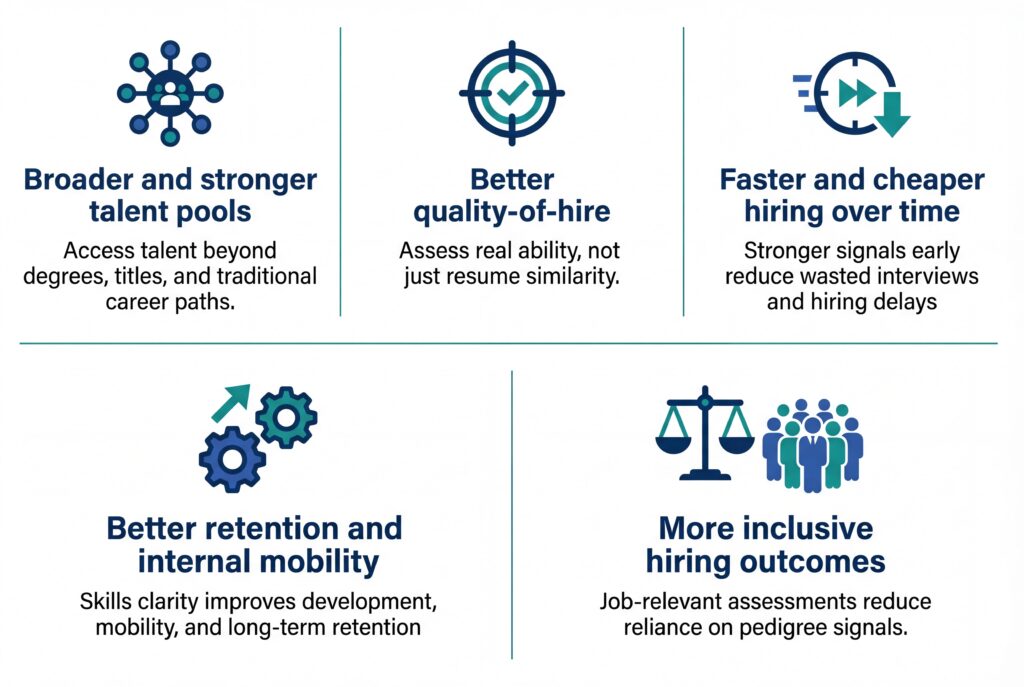
- Skills based recruitment expands talent pools while improving quality-of-hire and ramp speed.
What Is Skills Based Hiring?
Skills based hiring is a recruiting approach that evaluates candidates based on demonstrated abilities and role-relevant competencies rather than relying mainly on traditional proxies like degrees, past job titles, or years of experience.
In practice, that usually means hiring teams:
- define the real skills needed for the job
- separate must-haves from nice-to-haves
- assess candidates with practical evidence
- use structured interviews and scorecards
- make decisions based on proof, not pedigree
That is why skills based hiring and skills based recruitment are often used interchangeably. Both point to the same core move: away from credential screening, toward competency-driven selection.
Skills based hiring vs traditional hiring
Traditional hiring tends to lean on shortcuts – a degree from the right school, a familiar logo on the resume, five years in a similar title.
Skills based recruitment starts from the opposite direction.
It defines the work first.
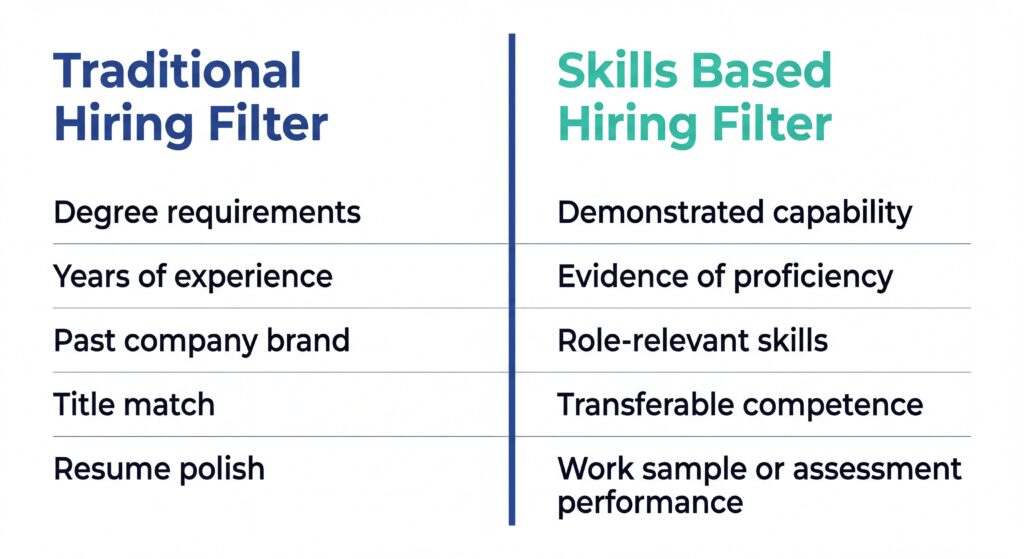
That difference matters because the old model often rewards similarity and presentation. The newer model rewards readiness.
Why did this shift happen?
This did not become a major hiring conversation by accident.
A few things changed at once:
- Degree inflation pushed more jobs to require credentials that were never truly necessary.
- Skill demands started moving faster, especially in tech, AI, RevOps, and modern sales orgs.
- Labor markets tightened.
- Internal mobility became more important.
- Companies got more honest about how often resume-based hiring fails.
In short, the old filters stopped matching the real market.
The Core Principles Behind a Skills-Based Hiring Approach
Plenty of companies say they support skills first hiring.
Fewer actually design for it.
The difference usually comes down to four principles:
1. Start with role outcomes, not resume filters
A good hiring process begins by asking a blunt question: what does this person need to achieve in the first 6 to 12 months?
Not what background sounds impressive.
Not what the last person had.
What outcomes matter.
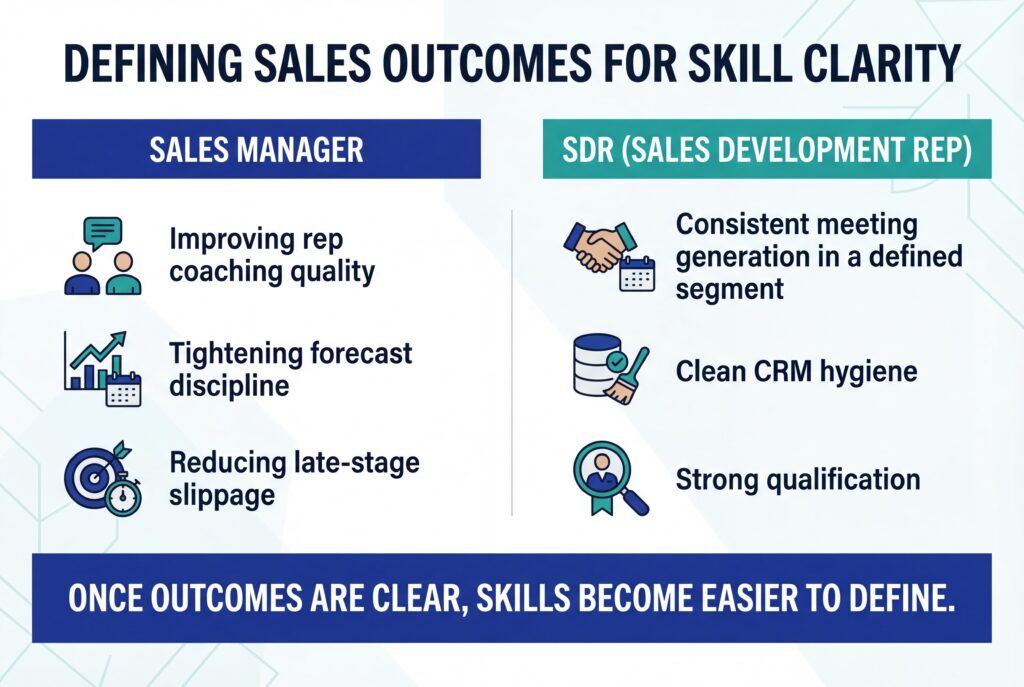
That shift matters because poor hiring design often starts too early. Teams copy a stale job description, bolt on old requirements, and hire against a memory instead of a need.
2. Separate core, transferable, and trainable skills
This is one of the most useful shifts in the whole model.
Not every skill belongs in the same bucket:
- Core skills are the ones the candidate must already have to perform.
- Transferable skills come from adjacent roles or environments and can still predict success.
- Trainable skills are gaps you can reasonably develop after hire without putting the role at risk.
Here is a simple framework:
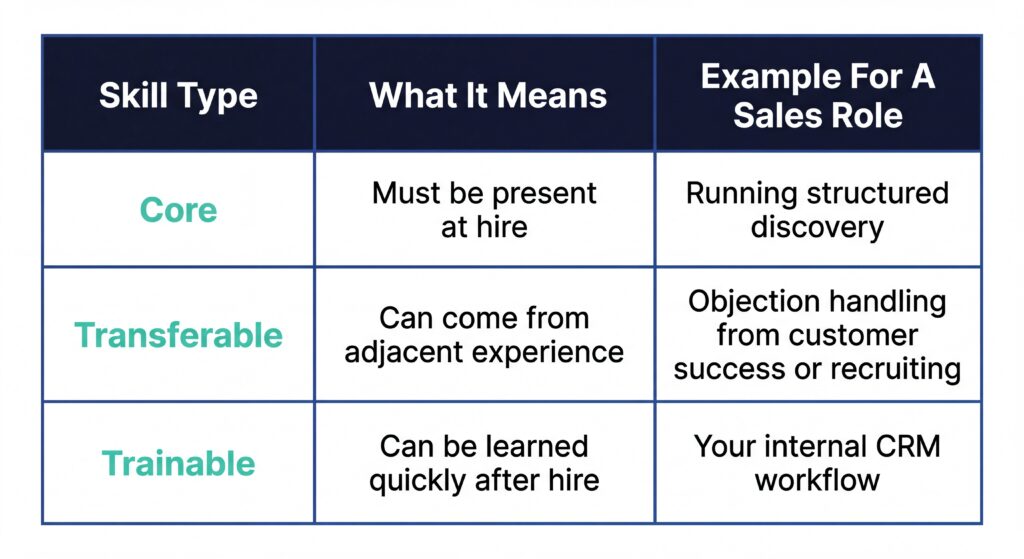
Companies that skip this step usually over-hire for polish and under-hire for potential.
3. Use evidence, not intuition
A skills-first model only works if the process produces real evidence.
That evidence can take different forms depending on the role:
- work samples
- job simulations
- portfolio reviews
- practical exercises
- structured behavioral interviews
- scored role-plays
The key is job relevance.
The closer the assessment is to the work itself, the stronger the signal tends to be.
This also makes interviews better
Instead of vague conversations about “fit,” the team can discuss what the candidate demonstrated, where they were strong, and where risk still exists.
4. Build a shared skills language
A lot of hiring inconsistency is really a language problem.
- The recruiter says “strong communicator.”
- The hiring manager means “can run a tight discovery call.”
- The CRO means “can influence a multi-threaded buying group.”
Everyone thinks they agree, but they are scoring different things.
That is where a skills taxonomy helps. Not because it sounds sophisticated, but because it forces shared definitions.
A simple, usable skills framework gives the team a common way to define what good looks like, what proficiency means, and how to assess it.
Without that, skills based recruitment turns into another subjective process wearing better branding.
The Benefits of Skill Based Hiring
The best case for skills based hiring is operational:
What Skills Based Recruitment Looks Like in Practice
This is the section many teams need most, because agreement on the idea is rarely the problem. Workflow is.
Step 1: Define the role by outcomes and skills
Start with the job itself.
List the actual outcomes required in the role. Then translate those into competencies. Keep the list focused. If every role suddenly has 19 “critical” skills, the framework is broken.
A sales leadership role might require:
- forecast discipline
- coaching effectiveness
- pipeline inspection quality
- cross-functional communication
- hiring judgment
That is already more useful than asking for “10+ years of sales leadership experience.”
Step 2: Rewrite the job description
This is where many companies fake the transition.
They remove the degree line and leave everything else untouched. Same vague responsibilities. Same bloated requirements. Same unclear success profile.
A real skills-first job description explains:
- what the person is expected to achieve
- what skills are required to do it
- which capabilities are preferred but learnable
- what evidence of fit might look like
That gives stronger candidates a fairer shot and makes the role easier to understand.
Step 3: Source for skills, not pedigree
If your sourcing strategy still chases the same employers and titles, you are not doing skills based hiring. You are doing resume hiring with better messaging.
- Broaden the search.
- Use skill tags.
- Search adjacent backgrounds.
- Build role-specific outreach.
- Look at communities where the skill lives, not just where the title lives.
That is how you find people who can perform, not just people who look familiar.
Step 4: Screen using practical evidence
Move some of the signal upstream.
Instead of using resume review as the main gatekeeper, use a short practical screen where appropriate. That might be a mock outbound email, a qualification exercise, a mini case, a portfolio review, or a call critique.
You are not trying to build a candidate obstacle course.
You’re trying to see the work.
Step 5: Interview with structured rubrics
This is where a lot of hiring quality is won or lost.
- Every interview should map to defined competencies.
- Questions should be designed to surface evidence, not just conversation.
- Scoring should be standardized enough that interviewers cannot quietly drift back to gut feel.
Good hiring teams do not eliminate judgment. They discipline it.
Step 6: Make the decision based on proof
At the offer stage, the team should be able to answer a simple question: what evidence do we have that this person can succeed here?
Not “who did we like most?”
Not “who felt most polished?”
Actual evidence.
That usually includes assessment performance, structured interview scores, examples of learning agility, and the candidate’s fit against core versus trainable skills.
Common Mistakes Companies Make With Skills Based Hiring
Removing degree requirements without changing the process
This is the most common one.
A company updates the job post, announces a new hiring philosophy, and then still screens resumes the old way, interviews loosely, and hires based on familiarity.
Nothing really changed.
Defining skills too vaguely
If a scorecard says “strong communication” or “leadership presence,” you do not have a skills model yet.
You have filler.
Skills need enough specificity to be observable:
- What exactly should the candidate be able to do?
- In what setting?
- At what level?
Overcomplicating the framework
This happens a lot once people discover competency models.
They build giant libraries of skills, sub-skills, behavioral dimensions, and scoring layers that nobody really uses. The result is slower hiring and lower adoption.
A useful framework is one people can run consistently.
Relying too much on AI or automation
Technology can help with skill tagging, screening support, assessment delivery, and internal matching. It can also create false confidence.
If the process becomes a black box, or if teams cannot explain why a candidate passed or failed, trust drops fast:
- Recruiters worry about bias.
- Sales leaders worry about relevance.
- CROs worry about risk.
Fairly enough.
AI should support signal. It should not replace judgment, validation, or process accountability.
Failing to train hiring managers
Recruiters cannot carry the whole model alone. If hiring managers still chase pedigree, ignore rubrics, or improvise interviews, the system breaks.
Skills based hiring needs manager calibration.
Without it, strong process design gets washed out in the final round.
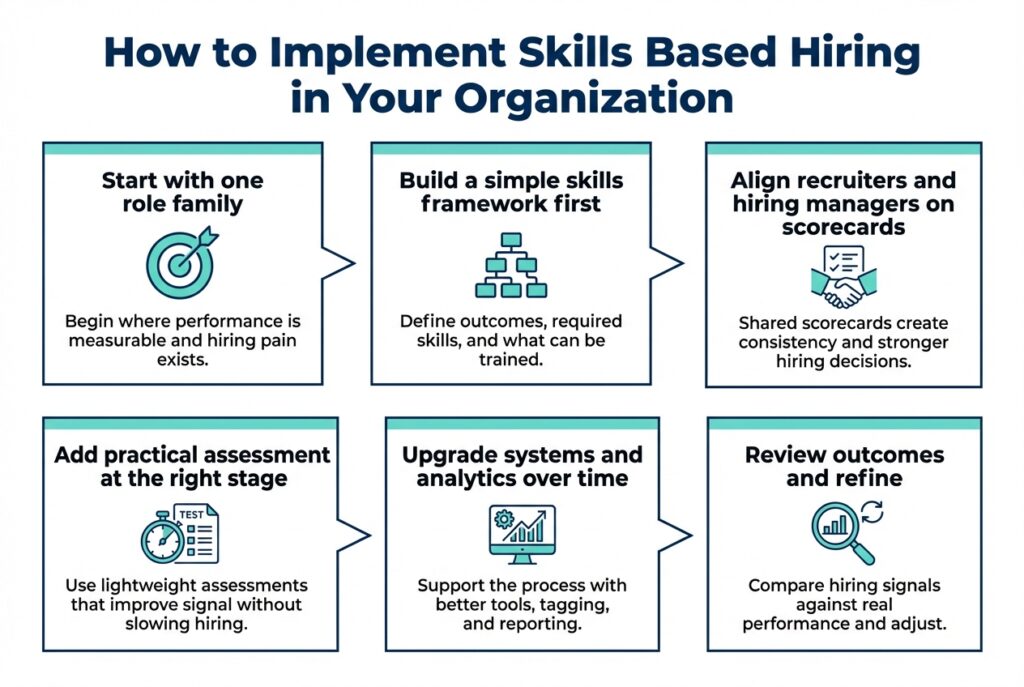
How to Implement Skills Based Hiring in Your Organization
The best rollout is usually narrower than people expect. Start where the pain is real and the role is repeatable.
How to Measure Whether Skills Based Hiring Is Working
If the process is real, the measurement should be too.
Hiring efficiency metrics
Start with the basics:
- time-to-hire
- cost-per-hire
- stage conversion rates
- interview-to-offer ratio
These show whether the process is getting sharper or just heavier.
Hiring quality metrics
This is where the model earns its keep.
Look at:
- quality-of-hire
- first 90-day performance
- ramp time
- manager satisfaction with the hire
- assessment-to-performance correlation
That last one matters. If your assessment scores have no connection to job success, rethink the assessment.
Retention & internal mobility metrics
You should also track whether the hires stay and grow.
Useful measures include:
- 6-month retention
- 12-month retention
- internal promotion rate
- internal fill rate for open roles
- reskilling success where relevant
Revenue-facing metrics for sales roles
For sales teams, connect hiring directly to execution.
That means measuring things like:
- time to first qualified pipeline
- time to first closed deal
- quota attainment trajectory
- manager coaching load per rep
- methodology adherence during ramp
That is where Recruiters and CROs often get back on the same page. The hire either improved predictable execution or it did not.
Who Should Use Skills Based Hiring First?
Different stakeholders get different value from it.
Recruiters
Recruiters benefit from better signal, stronger shortlists, broader talent pools, and less dependence on weak resume proxies.
It gives them a more defensible process and often a better partnership with hiring managers.
Sales Leaders
Sales leaders benefit because they spend less time recovering from bad hiring decisions.
They get reps and managers who ramp faster, need less remedial cleanup, and operate with more consistency.
CROs
CROs care about the bigger system – hiring affects ramp, productivity, coaching load, forecast confidence, and the cost of scaling revenue.
A skills-first model gives them a better way to connect talent decisions to operational outcomes.
Best-fit scenarios
This approach is especially useful when:
- mis-hires are expensive and frequent
- time-to-fill is too long
- roles are changing quickly
- internal mobility matters more than before
- sales performance is uneven and hiring quality is part of the cause
The Future of Skills Based Hiring
This shift is still early, even though the language is everywhere.
A few things are likely to become more common from here:
First:
Skill portfolios will matter more than job titles.
Candidates will increasingly bring proof in the form of projects, assessments, certifications, performance samples, and demonstrated operating ability.
Second:
Internal talent marketplaces will keep growing.
As companies get better at mapping workforce skills, they will use that data for mobility, reskilling, promotion planning, and succession.
Third:
Hiring and development will keep converging.
Once a company has a real skills framework, it usually stops being only a recruiting tool. It becomes useful for onboarding, coaching, performance management, and promotion too.
That is the long-term play. Skills based hiring becomes part of a broader capability system.
Frequently Asked Questions
What is the difference between skills based hiring and competency-based hiring?
Skills based hiring focuses on evaluating specific, demonstrable abilities required to perform a job. Competency-based hiring looks at broader behavioral traits such as leadership, adaptability, and decision-making. Most modern hiring frameworks combine both to assess whether a candidate can perform and grow in the role.
How do companies transition from traditional hiring to skills based recruitment?
Most companies start by redefining one or two key roles using a skills framework, then updating job descriptions and interview scorecards to evaluate those capabilities. From there, assessments and structured interviews are introduced so candidates are evaluated on demonstrated skills rather than resume signals alone.
Is skills based hiring only useful for technical roles?
No. While it gained traction in technical hiring, skills based hiring works equally well in sales, operations, customer success, and leadership roles. Any position where performance depends on practical ability rather than credentials can benefit from a skills based recruitment approach.
Does skills based hiring reduce the importance of experience?
Experience still matters, but it becomes supporting evidence rather than the primary filter. A candidate’s past roles help provide context, while the hiring process focuses on whether they currently possess the skills required to succeed in the position.
Conclusion
Hiring has relied on the wrong signals for a long time – degrees, brand-name employers, and tidy career paths often look convincing but say very little about whether someone can really perform in the role.
What is skills based hiring really comes down to replacing those shortcuts with evidence. Define the outcomes a role must deliver. Identify the capabilities that make those outcomes possible. Then hire based on proof, not pedigree.
When Recruiters, Sales Leaders, and CROs build hiring around real skills, the effects compound: stronger candidate pools, better quality-of-hire, faster ramp, and teams that operate with more consistency.
The bar does not drop. It simply moves closer to the work that matters.