
Some opportunities look promising at first glance – a strong title, a recognizable company, a few good signals.
Then the deal drifts…
Weeks pass, calls pile up, and the opportunity slowly fades out of the pipeline. Moments like this usually trace back to one thing: qualification that wasn’t rigorous enough early on.
Strong sales teams treat qualification as a structured process that protects time, pipeline quality, and forecast accuracy.
We’ll walk through how to qualify sales leads step by step so you can identify real opportunities earlier and move forward with clearer signals.
Key Notes
- Strong lead qualification relies on defined criteria, buying signals, and disciplined stage progression.
- Early discovery conversations reveal urgency, authority, and real business problems worth solving.
- Qualification improves pipeline quality, forecast accuracy, and sales team prioritization.
The Lead Qualification Process at a Glance
Lead qualification is a short sequence of checks that happens across early pipeline stages.
Most B2B organizations follow a process that looks roughly like this:
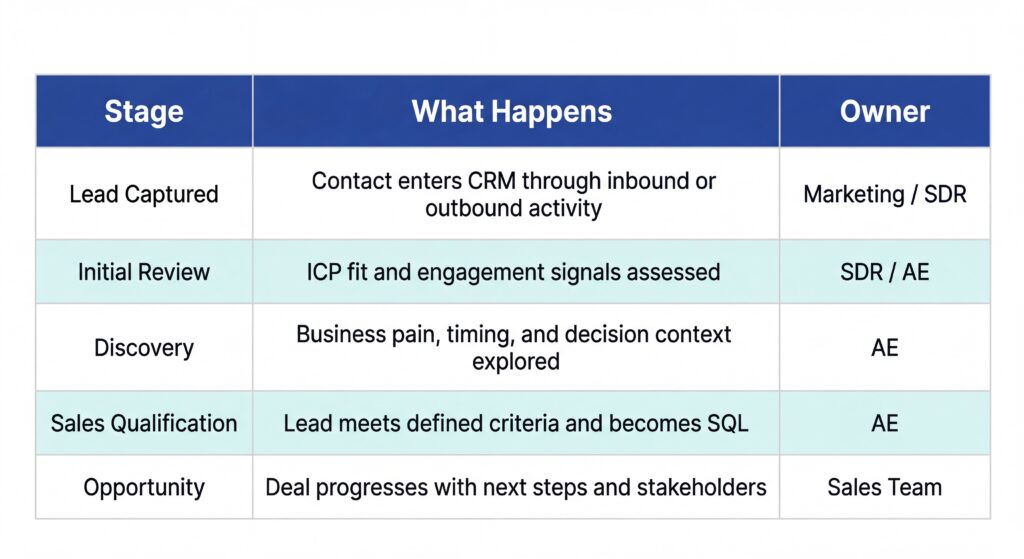
The key point here is alignment. Sales and marketing must agree on what qualifies as “sales ready.”
Without shared definitions, leads bounce between teams and qualification standards drift.
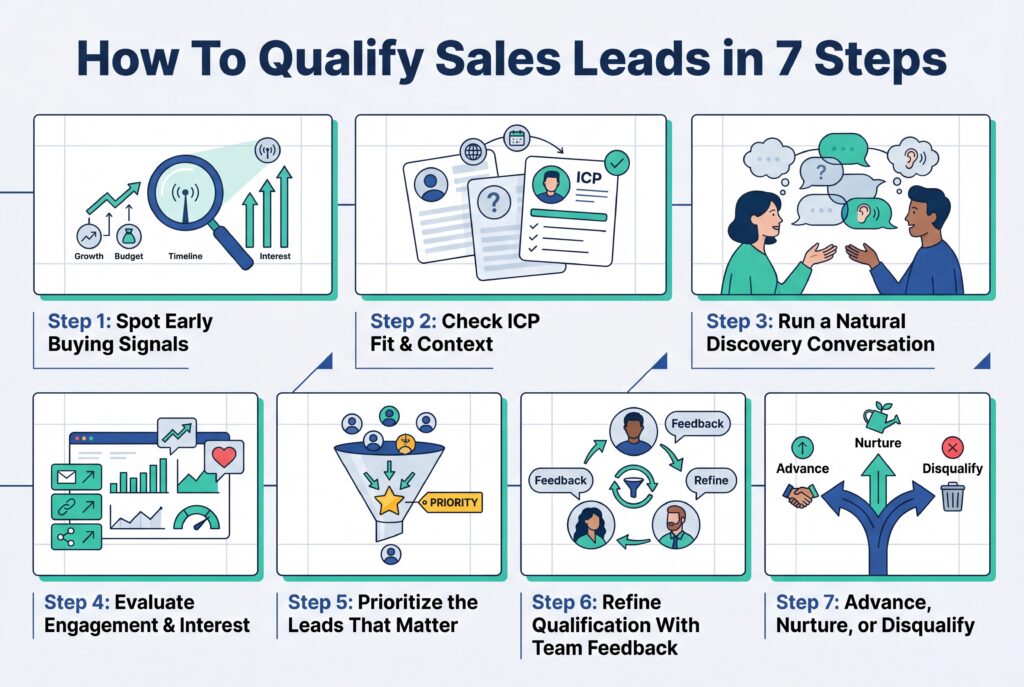
How To Qualify Sales Leads in 7 Steps
Qualification is often described as a framework or checklist.
In practice it is a flow of decisions.
The 7 steps below represent a clean progression from early signal to final qualification decision.
Step 1: Spot Early Buying Signals
Qualification begins before the first conversation.
Modern buyers leave signals long before speaking with sales – product page visits, repeated content engagement, webinar participation, pricing page traffic. These behaviors reveal curiosity moving toward evaluation.
Reps who notice these signals respond faster and with more relevant outreach.
This step is about recognizing when a conversation may be worth starting.
Step 2: Check ICP Fit & Context
Before investing in discovery, confirm whether the lead fits your market.
Key ICP factors typically include:
- Industry alignment
- Company size
- Geography or service coverage
- Technology environment
- Role and decision authority
If a lead fails these basic criteria, no amount of enthusiasm will create a viable deal.
Experienced reps run this filter quickly.
30 seconds of research can prevent hours of wasted effort later.
Step 3: Run a Natural Discovery Conversation
Once fit is established, discovery begins.
This is where many qualification frameworks fail. Reps treat discovery like an interrogation, running through scripted questions instead of understanding the buyer’s situation.
Good discovery feels conversational.
The goal is to uncover three things:
- What problem exists
- Why the problem matters now
- Whether solving it is realistic
Buyers reveal these answers gradually. Listening matters more than asking.
Step 4: Evaluate Engagement & Interest
Intent is rarely stated directly.
Instead it appears through behavior. A prospect who attends multiple meetings, introduces colleagues, and requests examples is showing far stronger intent than one who replies sporadically.
Engagement signals include:
- Follow up responsiveness
- Stakeholder introductions
- Request for pricing or demos
- Depth of discussion about implementation
Combine those signals with ICP fit and the picture becomes clearer.
Step 5: Prioritize the Leads That Matter
Not every qualified lead should receive equal attention.
Some deals have high revenue potential but longer timelines.
Others are smaller but moving quickly.
Prioritization helps reps focus on the opportunities most likely to close soon.
A simple prioritization lens includes:
- Revenue potential
- Buying timeline
- Stakeholder access
- Engagement level
Reps who actively prioritize avoid a common trap. Treating every deal equally until the quarter ends.
Step 6: Refine Qualification With Team Feedback
Qualification improves when it becomes a team discipline rather than an individual skill.
Managers should regularly review discovery calls, stage movement, and deal outcomes to identify patterns.
Questions worth asking include:
- Which early signals predicted closed won deals?
- Which qualification assumptions proved wrong?
- Where did deals stall unexpectedly?
Over time these insights sharpen qualification criteria across the entire team.
Step 7: Advance, Nurture, or Disqualify
Every qualified lead ends with a decision:
- Advance the deal if real buying activity exists. Move it forward with a defined next step.
- Nurture the lead if fit is strong but timing is unclear. Keep the relationship active without forcing pipeline progression.
- Disqualify when the opportunity is unrealistic.
This final step protects the integrity of the pipeline.
Disqualification is not failure; it’s discipline.
Lead Qualification Criteria Every Sales Team Should Define
A qualification framework only works if criteria are explicit.
Most B2B sales teams evaluate three core dimensions:
Fit Criteria
Fit measures whether the organization itself aligns with your target market.
Typical signals include:
- industry relevance
- company size
- technology environment
- and operational maturity
Without these elements, even interested buyers may struggle to adopt your solution.
Intent Criteria
Intent reflects whether the prospect is actively exploring change.
This can appear through research activity, repeated conversations, internal discussions, or evaluation of alternatives. Intent indicates momentum.
Buying Readiness
Finally, qualification assesses whether the organization can realistically execute a purchase.
Budget availability, decision authority, and timing all matter here. A strong fit with no buying path remains a nurture opportunity rather than a qualified deal.
Clear criteria prevent subjective decisions. Reps know what qualifies. Managers know what to expect inside each pipeline stage.
Lead Qualification Example: From Signal to Sales Qualified Lead
Consider a mid market software company researching workflow automation.
A director downloads a product comparison guide and later registers for a webinar. That activity triggers an SDR outreach.
During the initial conversation the director explains their team currently manages approvals manually and errors are increasing. A new system is being considered before the next fiscal year.
A follow up discovery call reveals additional details.
- Two departments are affected by the problem
- Leadership has approved exploring solutions
- Budget discussions are scheduled for the next quarter
These signals indicate both fit and intent.
The deal moves forward as a SQL because a defined problem, stakeholder involvement, and realistic timing exist.
Without those elements the lead would remain in nurture rather than pipeline.
Lead Qualification Checklist for Reps & Managers
A short checklist helps reinforce qualification standards.
Before advancing a deal, confirm the following:
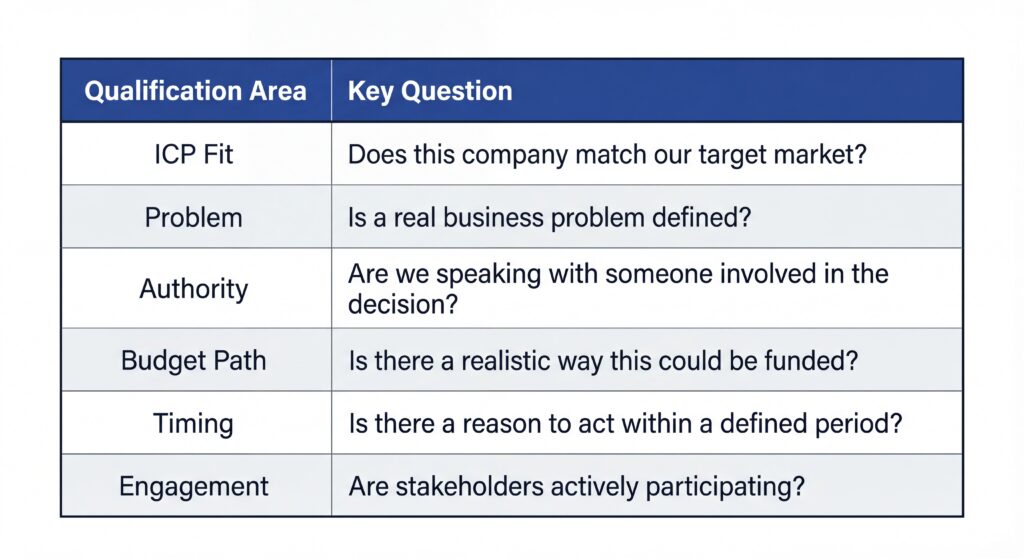
Managers can use the same checklist during pipeline reviews. If answers are unclear, the deal likely needs deeper discovery before advancing.
Common Lead Qualification Mistakes That Kill Pipeline Quality
Several patterns repeatedly appear in struggling sales organizations:
- Unclear qualification criteria. Reps rely on intuition rather than defined standards.
- Volume obsession. Teams chase lead quantity rather than deal quality.
- Advancing deals prematurely. Meetings occur but discovery remains shallow, leaving critical information missing.
Each of these issues weakens pipeline reliability.
Strong qualification replaces guesswork with structure.
How Sales Managers Improve Qualification Consistency
Qualification becomes powerful when it is reinforced at the team level.
Managers play a critical role here.
Regular call reviews help identify where discovery questions fall short. Pipeline reviews reveal whether deals truly meet stage criteria.
Metrics can also highlight patterns.
- MQL to SQL conversion
- SQL to opportunity progression
- Stage drop off rates
When these numbers shift, qualification quality is often the root cause.
Strong managers treat qualification as a repeatable discipline rather than an individual talent.
Frequently Asked Questions
How do you qualify leads and prospects quickly without sacrificing quality?
Start with clear ICP criteria and a short discovery framework. Focus on fit, urgency, and buying authority early in the conversation. When those signals are missing, move the lead to nurture instead of forcing it into the pipeline.
What is the difference between a lead qualification framework and a lead qualification process?
A framework defines the criteria used to evaluate leads, such as need, authority, or timing. The lead qualification process is the step-by-step workflow reps follow to apply those criteria during research, discovery, and pipeline progression.
What tools help sales teams qualify B2B sales leads more effectively?
Modern teams combine CRM data, intent signals, call analysis tools, and qualification scorecards. The goal is to surface buyer signals early so reps can prioritize high-potential deals and avoid wasting time on poor-fit accounts.
What is a simple lead qualification checklist sales teams can use?
A basic lead qualification checklist includes: ICP fit, defined business problem, stakeholder involvement, realistic budget path, timeline for action, and clear next step. If several of these signals are missing, the lead likely belongs in nurture rather than active pipeline.
Conclusion
Lead qualification decides whether your pipeline is built on real opportunities or quiet wishful thinking.
The strongest sales teams treat it as a discipline. They watch early buying signals, check ICP fit quickly, run discovery that surfaces real problems, and only advance deals when the criteria hold up.
Do that consistently and the downstream benefits are obvious: cleaner pipeline stages, better prioritization, and forecasts that reflect reality.
If you’ve been wondering how to qualify sales leads in a way that holds up in real deals, the answer is simple – define the signals, apply them early, and stay disciplined about what moves forward.
If you want help doing that faster, try Deal Pilot. It arms you with buyer intelligence, account research, and discovery prompts before the call so you can qualify leads with real evidence instead of guesswork.
Start a free trial and see how sharper qualification changes the deals that make it into your pipeline.