
The moment a buyer pushes back, the real conversation starts.
Price questions, timing concerns, internal approvals – they show up in almost every deal.
Some stall momentum.
Others reveal exactly what the buyer needs to move forward.
The difference usually comes down to how the rep handles that moment.
Strong objection handling techniques turn resistance into clarity and hesitation into progress.
We’ll break down the most common sales objections, why they surface, and the practical objection handling techniques that help reps navigate them with confidence.
Key Notes
- Most sales objections fall into predictable categories: price, timing, fit, authority, and risk.
- Effective objection handling techniques focus on diagnosing buyer risk before responding.
- Frameworks like LAER and value reframing turn objections into productive deal conversations.
The Most Common Sales Objections
Most common sales objections fall into a handful of buckets. The wording changes. The underlying pattern does not.
1. Price & budget objections
Examples of sales objections here include:
- It is too expensive
- We do not have budget
- Your competitor is cheaper
- We need a discount to make this work
This category is rarely just about price. More often, it is a value clarity issue or a justification issue.
2. Need & fit objections
These sound like:
- I am not sure this solves our problem
- We already have a tool for that
- This feels too broad for what we need
- I do not think our team would use it
These objections usually point to weak discovery, weak tailoring, or both.
3. Timing objections
Examples include:
- Now is not a good time
- Come back next quarter
- We need to revisit this later in the year
Sometimes timing is real. Sometimes it is a soft no.
The rep’s job is to find out which one it is.
4. Authority & consensus objections
These sound like:
- I need to run this by my manager
- Procurement needs to review it
- Legal has to look at the contract
- We need broader buy-in
In complex deals, this is normal. It usually means the internal decision path was not mapped tightly enough.
5. Trust & risk objections
These are the ones that matter late in the deal:
- How do I know this will work for us?
- What if adoption is slow?
- We cannot afford a messy rollout
- This feels like a lot of change
This is where proof, implementation clarity, and decision safety matter most.
12 Objection Handling Techniques That Work
A lot of sales objection handling techniques get taught as lines. That is the wrong level.
What matters is the move behind the line.
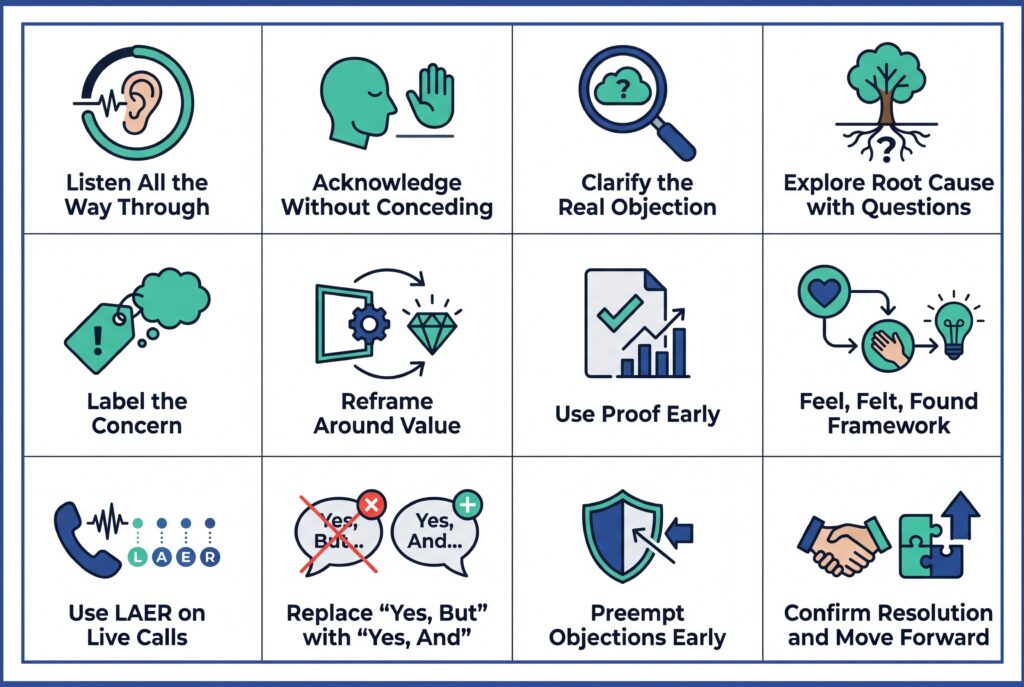
1. Listen all the way through
Do not answer halfway through the objection. Let the buyer finish.
Obvious? Yes. Still ignored all the time.
When reps interrupt, they signal two things:
- First, they care more about rebutting than understanding.
- Second, they assume they already know what the buyer means.
That is how reps answer “budget” when the real problem is change risk.
2. Acknowledge without agreeing away your position
You do not need to concede the point.
You do need to show the concern is reasonable.
Useful language:
- That is a fair concern
- I get why that would come up
- Makes sense that you would look at it that way
This lowers defensiveness fast.
Acknowledgment is one of the most practical methods of handling customer objections because it keeps the conversation collaborative.
3. Clarify the real objection
Before you respond, isolate the issue.
Questions like these help:
- When you say budget, what part is the constraint?
- Is the concern the cost itself or the return you would need to justify it?
- When you say timing, what is taking priority right now?
This is where a lot of bad objection handling scripts fail. They jump from empathy straight into answer mode.
4. Explore root cause with open questions
Open-ended questions slow the conversation down in a good way. They help the buyer think more clearly and they give you something concrete to work with.
Examples:
- What would need to be true for this to feel worth moving forward?
- What outcome are you worried you would not get?
- What is the biggest risk on your side if you made a change here?
Now you are not batting objections back and forth.
You’re working the problem together.
5. Label the concern
Labeling is underrated.
It shows the buyer you understand the issue beneath the words.
- It sounds like the bigger concern is rollout risk, not the feature set
- It seems like the budget question is really about proving ROI internally
- It sounds like you do not want to champion something that creates extra work for the team
Buyers relax when they feel accurately understood.
And once they relax, the quality of the conversation goes up.
6. Reframe around value, not just price
If the objection is price, a weak rep defends the number. A strong rep reframes the decision.
That does not mean getting abstract.
It means connecting cost to business impact.
Instead of repeating pricing logic, move to questions like:
- What would solving this be worth if it cut cycle time by two weeks?
- What is the cost of staying with the current workflow for another two quarters?
- How are you comparing price today, against line-item spend or total business impact?
This is one of the strongest B2B sales objection handling techniques because enterprise buyers rarely buy on sticker price alone. They buy on risk, return, speed, and confidence.
7. Use proof early
Evidence lowers perceived risk faster than persuasion.
That proof can take different forms:
- a short customer story
- implementation specifics
- a quantified outcome
- a relevant case study
- a pilot path or trial structure
Do not save proof for the end of the conversation. Time-to-confidence matters. The earlier the buyer can see that someone like them succeeded with you, the less work you have to do later.
8. Use Feel, Felt, Found carefully
This classic framework still works when it sounds human.
- I understand how you feel
- Other teams felt the same way
- What they found was that the rollout was lighter than expected once they scoped the first phase correctly
The danger is obvious. If it sounds memorized, it dies on contact. The principle is strong. The canned version is not.
9. Use LAER on live calls
LAER stands for Listen, Acknowledge, Explore, Respond.
It works because it forces discipline.
Most reps skip Explore.
That is the expensive part to skip.
The objection handling technique is not powerful because the acronym is clever. It is powerful because it protects the conversation from premature answers.
10. Replace “yes, but” with “yes, and”
“But” resets tension.
“And” keeps momentum.
Compare these:
- Yes, but our implementation is actually very simple
- Yes, and that is exactly why we usually map rollout before anyone commits
Tiny shift. Big difference.
One sounds defensive. The other sounds like partnership.
11. Preempt objections before they surface
Top reps do not just react well. They reduce avoidable objections upfront.
- If pricing is likely to be a concern, set up ROI early.
- If implementation risk is common, explain the rollout motion before the buyer has to ask.
- If internal buy-in is usually messy, arm the champion sooner.
Preemption works because it shows pattern recognition. It tells the buyer, “We have seen this before, and we know how to help you navigate it.”
12. Confirm resolution & transition
Once you handle the objection, do not just drift back into the meeting.
Confirm it. Then move.
- Does that address the concern?
- Is that enough to keep exploring this?
- Should we map the next step from here?
A Simple Objection Handling Script
A useful objection handling script should give structure without turning the rep into a robot.
Here is a simple one:
Empathize
That is a fair concern.
Clarify
Can I ask what is driving that specifically?
Reframe
Based on what you have said, the bigger issue sounds like getting confidence in the rollout, not the price itself.
Confirm
If we can show a low-friction rollout path, would that resolve the concern enough to keep moving?
👉 That works because it does four things in order. It validates. It diagnoses. It sharpens. It advances.
Sales Objections & Answers: Real Examples
“It is too expensive”
Bad answer:
“We are actually priced very competitively.”
Better answer:
“Fair concern. When you say expensive, are you comparing line-item cost, or are you looking at what it would need to return to feel worth it?”
Why it works:
It separates price from value and gets the buyer to define the decision logic.
“We already use another vendor”
Better answer:
“Makes sense. Usually when teams revisit this, it is because the current setup is good enough in some areas but breaking down in others. What is working well today, and what is still frustrating?”
Why it works:
It respects the status quo while creating room for dissatisfaction to surface.
“Now is not a good time”
Better answer:
“Understood. Is that because the problem is not urgent yet, or because something else is taking priority?”
Why it works:
Timing objections often hide prioritization problems. This separates the two.
“I need to think about it”
Better answer:
“Of course. Usually when someone says that, there is one piece that still does not feel clear or safe. What would you want to think through most?”
Why it works:
It invites the hidden objection into the open.
“I need to check with my manager”
Better answer:
“Absolutely. Happy to help with that. What do you think they are most likely to ask, and would it be useful if we brought them into a short call so we can answer those directly?”
Why it works:
It turns a stall into an internal alignment plan.
“Send me more information”
Better answer:
“Happy to. To make it useful, what specifically would help you evaluate this, ROI examples, rollout details, or a stakeholder summary?”
Why it works:
It avoids the inbox graveyard and forces relevance.
B2B Sales Objection Handling Techniques for Complex Deals
B2B objections are harder for a simple reason – the buyer is rarely one person.
AEs are not just handling concerns.
They are handling concern distribution across finance, procurement, legal, end users, and executive sponsors.
That changes the work:
- An executive objection usually needs strategic clarity and proof.
- A procurement objection needs transparency, commercial logic, and total cost framing.
- An end-user objection often needs usability and adoption confidence.
- A manager objection may need team impact and implementation predictability.
This is why overcoming objections in sales cannot be reduced to call confidence.
It is a multi-stakeholder discipline.
Methods of Handling Customer Objections by Deal Stage
Different stages create different objection patterns:
Discovery stage
Focus on fit, urgency, current-state pain.
This is where you surface hidden objections before they harden.
Demo stage
Focus on relevance.
Generic demos create “this is not for us” objections because the buyer cannot map the product to their workflow.
Proposal stage
Focus on value justification, implementation clarity, and stakeholder alignment. This is where price objections often appear, but they usually started earlier.
Closing stage
Focus on decision safety.
At this point, unresolved risk gets louder. Buyers need confidence that the decision will hold up internally after the contract is signed.
The Secret to Getting a Yes Every Time
The title promise sounds dramatic, but the answer is not.
The secret to getting a yes every time is not pressure, clever phrasing, or objection judo. It is making the decision feel safe.
That is what great reps do better than average reps.
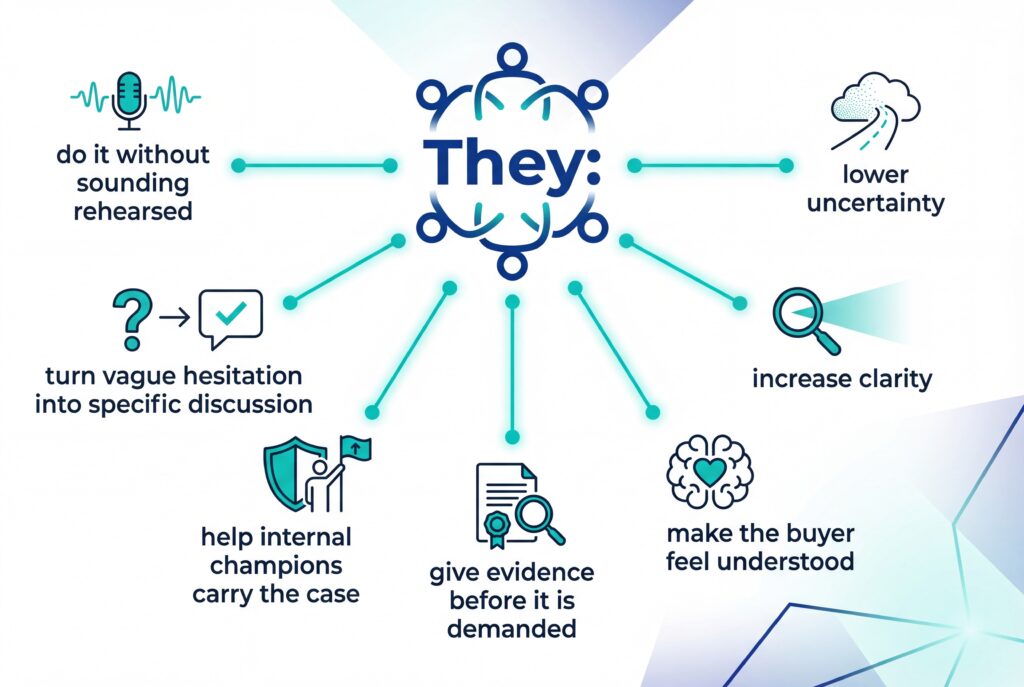
A buyer says yes when the path feels credible.
Not frictionless. Credible.
How Sales Managers Can Scale Objection Handling Across the Team
If objection handling lives only in rep talent, it stays inconsistent.
If it gets operationalized, it becomes a performance lever.
Start with call reviews. Log recurring objections by stage, segment, and competitor context.
Then build a shared objection library that includes:
- the exact objection wording
- what it usually means underneath
- strong follow-up questions
- proof points that work
- example responses from winning calls
From there, coach the behavior, not just the answer
- Are reps listening fully?
- Are they isolating the issue?
- Are they labeling risk accurately?
- Are they confirming resolution before moving on?
This is where sales excellence shows up
Not in having a playbook folder.
In having playbook enforcement, real-time guidance, and deal coaching that helps reps handle objections in-flow, while managers can see patterns, coach earlier, and reduce late-stage slippage.

Frequently asked questions
What are the best objection handling techniques in sales for beginners?
The best objection handling techniques start with listening, clarifying the concern, and responding with relevant proof or context. New reps should focus on understanding the real issue behind the objection rather than trying to “win” the conversation. Strong objection handling is about lowering risk for the buyer, not overpowering them.
What are the most common sales objections in B2B deals?
The most common sales objections usually fall into four categories: price, timing, fit, and internal approval. Buyers may say things like “it’s too expensive,” “now isn’t the right time,” or “we already have a solution.” Each objection usually signals uncertainty or perceived risk rather than a flat rejection.
Is there a simple objection handling script sales reps can follow?
Yes. Many reps use a simple four-step objection handling script: acknowledge the concern, clarify the real issue, reframe the value, and confirm whether the concern is resolved. This structure helps keep conversations natural while ensuring objections are addressed thoughtfully instead of rushed.
How can sales teams improve at overcoming objections consistently?
Sales teams improve by analyzing objection patterns across deals and coaching reps on how to handle them earlier in the sales process. Reviewing call recordings, documenting sales objections and answers, and sharing proven responses across the team helps create consistency and stronger deal execution.
Conclusion
Objections are rarely the real problem. Confusion, risk, and missing information usually sit underneath them.
That’s why the strongest objection handling techniques focus less on clever responses and more on diagnosis. Listen fully. Clarify what the buyer means. Reframe around value. Then use proof to reduce uncertainty.
When reps approach objection handling techniques in sales this way, conversations stop feeling adversarial and start becoming collaborative problem-solving moments. Buyers gain confidence and deals move forward.
If you want those conversations to be easier to run, Deal Pilot helps reps walk into calls with buyer intelligence, discovery prompts, and real-time guidance so objections are handled with clarity instead of guesswork.
Start a free trial to see how it supports better objection handling in the moments that matter most.