
Prospects see a lot of outreach.
What really stands out is timing, relevance, and a message that feels thought through.
That is where a strong sales cadence earns its keep. It brings structure to prospecting so every touch has a reason, every channel has a role, and conversations build momentum instead of stalling.
We’ll unpack how the best teams design a sales cadence, real outbound examples, and the best practices that turn outreach into consistent pipeline.
Key Notes
- High-performing sales cadences combine timing, channel mix, and message progression to drive replies.
- Outbound and B2B sales cadence design varies by deal complexity, segment, and buyer signals.
- Effective email cadence evolves messaging across touches instead of repeating the same ask.
How a High-Performing Sales Cadence Works
A good cadence is a sequence where each step earns the next one.
That is the difference between structured outreach and noise. If Touch 4 says basically the same thing as Touch 2, the cadence is not progressing. It is stalling.
Here is what strong cadence design looks like in practice:
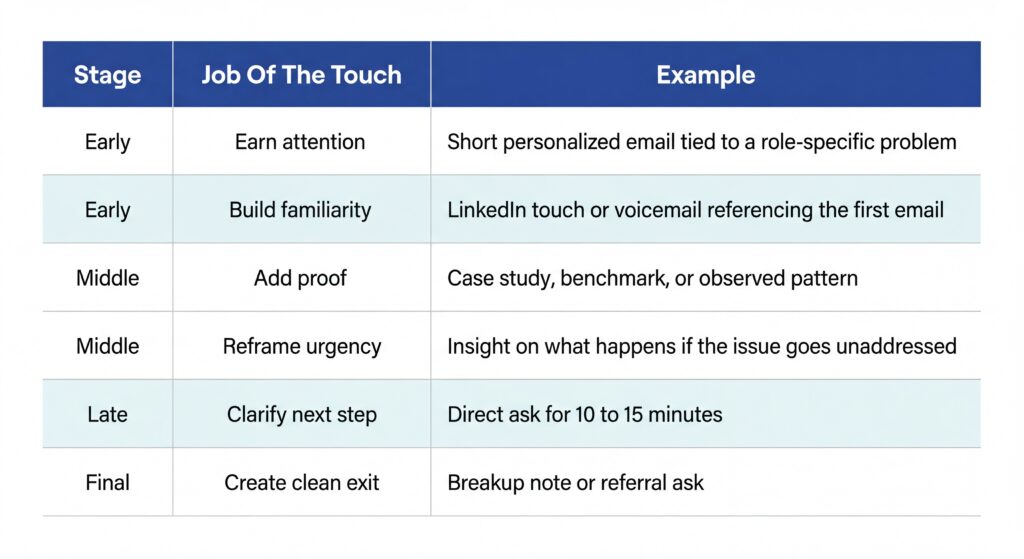
1. Each touch has a job
- Early touches should create relevance and familiarity.
- Middle touches should deepen the case with proof, insight, or a sharper point of view.
- Later touches should make the next step clear and reduce ambiguity.
A rough breakdown looks like this:
2. The channel mix supports the message
Multi-channel does not mean using every channel because you can. It means picking channels that help the message land.
- Email is good for clarity and proof.
- Calls are good for immediacy and tone.
- LinkedIn helps warm cold outreach and build familiarity.
- Video can break pattern when the sequence starts feeling predictable.
The mistake teams make is treating channel variety as the strategy itself. It is not. Channel mix only works when the message changes with it.
3. The messaging evolves
This is where many cadences fall apart. Reps are told to personalize, but what they really do is rewrite the first line while keeping the rest of the sequence the same.
That is not progression.
That is decoration.
A real progression might look like this:
- Touch 1: I noticed a signal worth discussing
- Touch 2: Here is the specific problem teams like yours run into
- Touch 3: Here is proof that the problem is fixable
- Touch 4: Here is the cost of waiting
- Touch 5: Here is a low-friction next step
Same account. Same problem space. Different angle.
Sales Cadence Strategy: Timing, Psychology & Buyer Response
There is no perfect number of touches.
There is only a number that fits the buying context.
That is why blanket advice around the “best sales cadences” usually disappoints.
Touch count depends on:
- how cold the lead is
- how complex the problem is
- how many stakeholders are involved
- and how much trust the rep has to build before a meeting even makes sense
Still, a few patterns are useful:
How many touches should a sales cadence have?
For most outbound motions, six to twelve touches across two to three weeks is a workable range.
- Warmer inbound follow-up can move faster, often with tighter spacing across ten to fifteen days.
- Enterprise outreach may need a longer runway if you are building familiarity across multiple stakeholders.
The bigger point is this: more touches do not automatically make a better cadence.
More valuable touches do.
How often should reps follow up?
A useful rule is to leave two to four business days between most email touches, then tighten or loosen based on signal strength.
- If a prospect is opening every email quickly, a call sooner may make sense.
- If the account is high-value but completely cold, slowing the pace slightly can prevent fatigue.
This is where managers need judgment, not just process compliance. Rigid sequencing without signal handling is just cleaner failure.
Why buyers respond
Most buyers do not reply because a rep was persistent.
They reply because something finally felt specific enough to deserve a response.
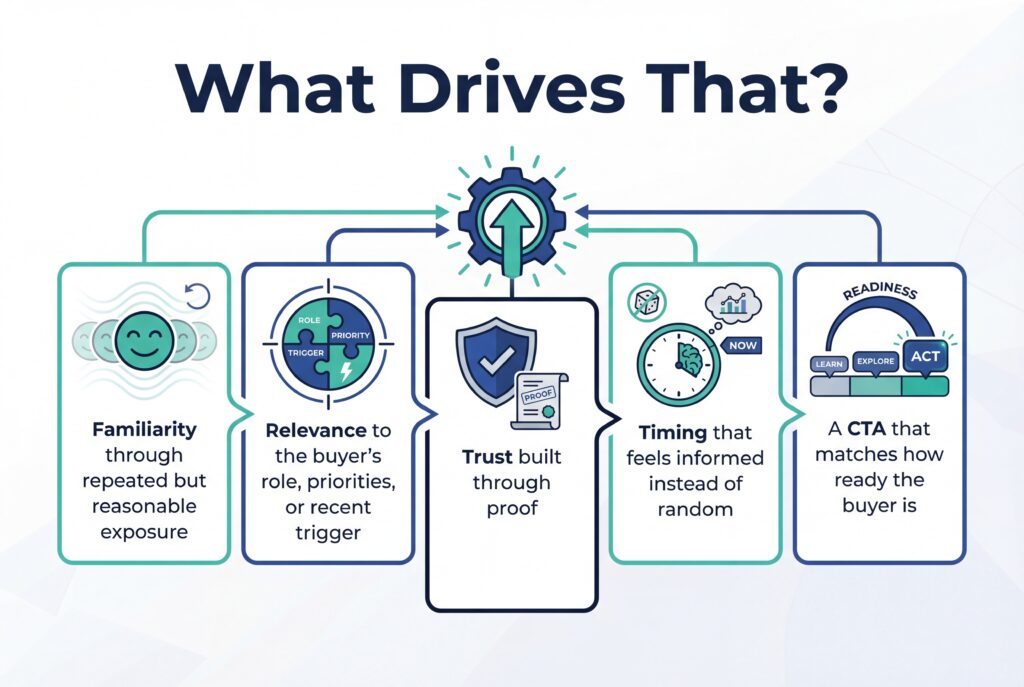
That last one matters – you can easily lose a good sequence by asking for too much too soon. Early touches should usually ask for less (a quick perspective, the right owner, 10 minutes, a reaction).
Sales Cadence Best Practices
Most sales cadence best practices sound fine in theory. Fewer of them survive contact with a sales floor.
These do:
Personalize beyond the opener
A lot of sequences have a custom first sentence and a generic rest.
Buyers can feel that instantly.
Real personalization carries through the body of the message.
It shows up in the:
- pain point you choose
- proof you use
- metric you mention
- CTA you make
A prospecting email to a RevOps leader should not sound like the same note sent to a VP of Sales with the title swapped out.
Use multiple channels, but make them earn their place
Phone, email, LinkedIn, and video are often the four most useful channels in a modern outbound sales cadence. That does not mean every sequence needs all four.
- If inboxes are saturated, a call can add contrast.
- If calls go unanswered, LinkedIn can add familiarity.
- If a sequence is getting ignored, a short personalized video can reset attention.
Keep every touch value-led
“Just checking in” is rarely worth sending.
Each touch should give the buyer something new. A benchmark. A pattern. A case study. A better-framed question. An observed risk. Even a concise summary of what peers in their role are doing differently.
The cadence should feel like an informed conversation that keeps getting sharper, not a reminder system.
Standardize the framework, not the rep’s brain
Templates matter. Teams need repeatable plays.
But copy-pasting one script across every account is where cadences go stale.
Document the structure. Then leave room for judgment inside it.
Great reps know when to swap the order, tighten the gap, change the proof point, or pause the sequence because the buyer signal says so.
Make the CTA fit the touch
A weak cadence often has the same ask from start to finish.
Usually a demo request.
A stronger approach looks more like this:
- Early: “Are you the right person to speak with about this?”
- Middle: “Worth a quick discussion?”
- Later: “Open to 15 minutes next week?”
- Final: “Should I close this out or speak with someone else on the team?”
That progression respects buyer readiness.
It also improves reply quality.
Common Sales Cadence Mistakes That Kill Response Rates
The most common failure mode is low-value repetition.
Here are the patterns that hurt teams most:
Generic messaging
If the message could be sent to any company in the segment, it will feel like it. Prospects are not just filtering for relevance. They are filtering for effort.
Too many touches with no new value
Ten emails saying slightly different versions of the same thing will exhaust the sequence fast.
Frequency without progression creates fatigue.
Being too aggressive too early
Cold prospects usually need curiosity and relevance before they need urgency.
Pushing hard for a meeting in the first touch can work sometimes, but as a standard it usually lowers response quality.
Over-relying on email
Email is important. It is not enough on its own in many markets.
A cadence that never leaves the inbox is easier to ignore.
Automating without thinking
Automation should handle scheduling, reminders, and workflow consistency.
It should not remove judgment.
If the system keeps pushing after a clear soft no, or misses an opening signal because nobody is watching, the cadence is broken.
Outbound Sales Cadence: What Good Looks Like
An outbound sales cadence starts with a cold or semi-cold lead. That means the rep is not capturing existing demand. They are creating interest from scratch.
That changes the design.
Warm outbound contacts, like webinar attendees or whitepaper downloaders, can move faster. You can reference known activity. You can get to the point quicker. Cold outbound needs more trust-building and usually more channel variety before the meeting ask lands.
Here is a practical outbound sales cadence example:
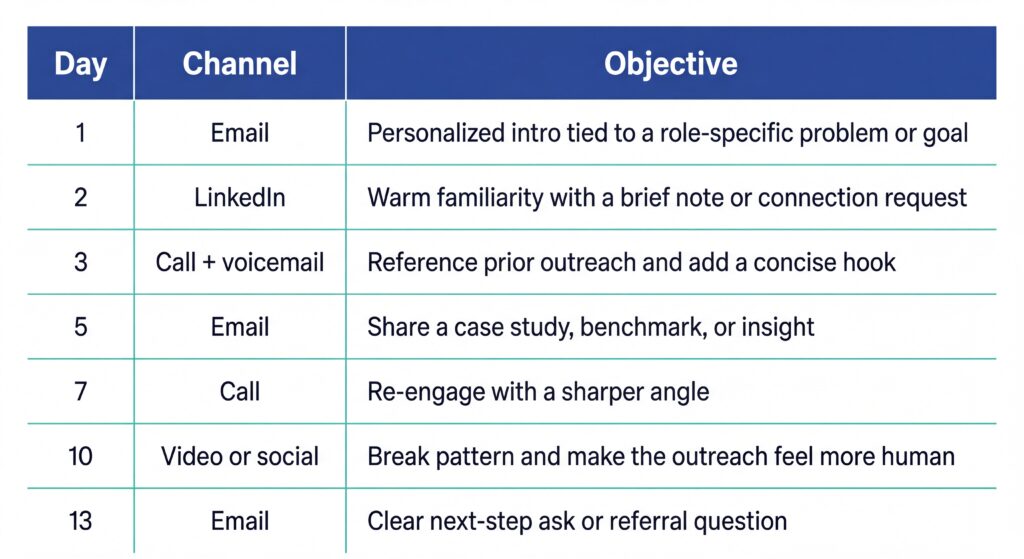
This works because it balances familiarity, proof, and momentum. It also avoids the classic mistake of sending one intro email, then hammering the same CTA for ten days.
B2B Sales Cadence by Segment & Deal Type
A B2B sales cadence should change with deal complexity.
SMB cadence
SMB deals tend to move faster.
The cadence can be tighter, the touches more direct, and the value proposition more immediate. Reps can lean into quick wins, fast implementation, or obvious efficiency gains.
Mid-market cadence
Mid-market usually needs more proof and a more consultative message progression.
The buyer may not need a long education cycle, but they often do need confidence that the problem is understood in their context.
This is where case studies, role-specific benchmarks, and sharper call planning matter.
Enterprise cadence
Enterprise outreach is slower and more layered. One-thread outreach is risky. A single champion can go dark and kill momentum.
That is why enterprise cadences should be multi-threaded. Economic buyer, functional owner, technical stakeholder, and end user often need different messages, different proof, and different pacing.
In other words, you are not running one sequence.
You are running a coordinated system.
Prospecting Cadence: How to Win the First Response
The purpose of a prospecting cadence is simple – start a real conversation.
Not impress the prospect.
Not dump every capability in the first email.
Not prove how hard you worked on research.
👉 Open a thread worth continuing.
That means the first touch should usually do three things well:
- Show why the outreach is relevant now
- Give the buyer a reason to care
- Ask for something small enough to answer quickly
For example:
A good first-touch CTA might ask whether the prospect owns a problem area, whether a benchmark would be useful, or whether there is a better person to speak with.
Those asks create motion without overcommitting the buyer.
And when a full prospecting cadence runs its course with no response, stop pushing. Recycle the lead into nurture. Send occasional useful content. Revisit when a trigger appears.
Overworking dead leads is wasted capacity.
Email Cadence Best Practices
An email cadence should feel like a coherent conversation over time.
Not random one-off blasts.
A practical outbound email cadence often includes four to eight emails over two to three weeks, with two to four business days between most touches.
But the count matters less than the progression.
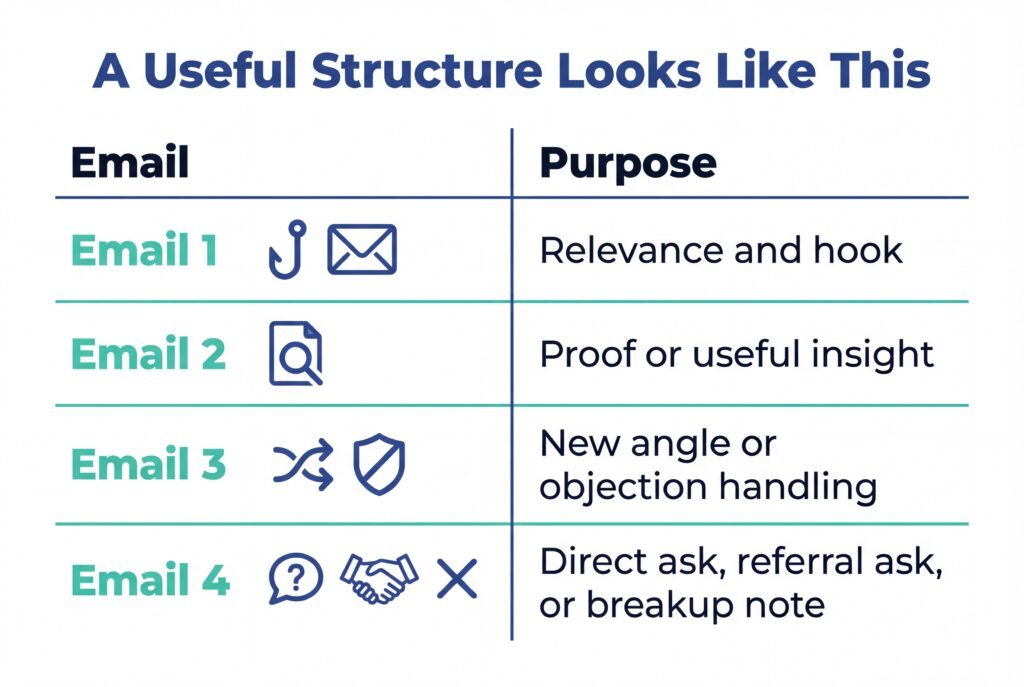
A few rules matter here:
First:
Subject lines should be clear and curiosity-led, not cute.
“Quick question about pipeline coverage” beats most forced cleverness.
Second:
every email should introduce something new – a new data point, a new consequence, a new angle.
Repeating “following up” in three different ways is still repetition.
Third:
Do not let email carry the whole sequence alone if another channel would help the message land.
Sales Cadence Templates and Examples
Templates are useful when they preserve what matters and remove what does not.
They become useless when teams treat them like scripts.
Here are three practical sales cadence templates:
7-touch outbound cadence template
Best for standard outbound prospecting into SMB or mid-market accounts.
- Day 1: Personalized intro email
- Day 2: LinkedIn touch
- Day 3: Call and voicemail
- Day 5: Proof-led email
- Day 7: Call
- Day 10: Pattern-break touch such as video
- Day 13: Direct next-step email
14-day high-intensity cadence
Best for time-sensitive outreach, event follow-up, or warm outbound.
- Tighter spacing
- Fewer educational touches
- Faster move to direct CTA
- Works best when intent already exists
30-day enterprise cadence
Best for named-account prospecting and larger buying groups.
- Slower pace
- More tailored content
- Multi-threaded stakeholder outreach
- Built-in checkpoint for pause, recycle, or handoff to nurture
A good rule here:
Template the structure, not the specifics. The hook, proof point, and CTA should still reflect the account, role, and trigger.
How to Measure & Optimize Sales Cadence Performance
If your team only measures activity completion, you will miss the truth.
Cadence performance should be measured at three levels:
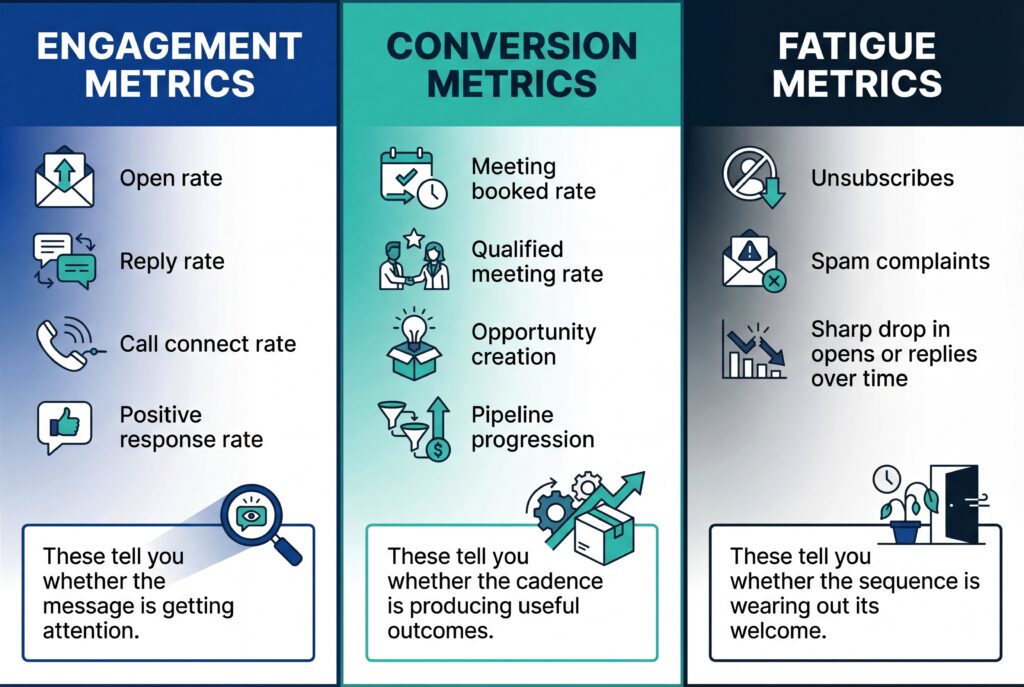
For testing, change one variable at a time – subject line, spacing, CTA, touch order, channel mix.
If you change everything at once, you learn nothing.
Managers should also coach execution at the step level:
- Which email gets replies?
- Which call step converts?
- Which CTA stalls?
That is how cadence moves from static template to operating discipline.

Frequently Asked Questions
What is the difference between a sales cadence and a sales sequence?
The terms are often used interchangeably, but they are slightly different. A sales sequence usually refers to a set of automated outreach steps inside a sales engagement tool. A sales cadence is broader. It includes timing, channel mix, message progression, and the overall prospecting strategy behind those steps.
What is the best outbound sales cadence for B2B prospecting?
The best outbound sales cadence typically includes 6–10 touches across multiple channels over two to three weeks. A strong B2B sales cadence usually combines email, calls, and LinkedIn touches while introducing a new value angle at each step. The goal is consistent visibility without overwhelming the buyer.
How long should a prospecting cadence run before stopping?
A typical prospecting cadence runs between 10 and 20 business days depending on deal complexity and lead warmth. If a prospect has not responded after the full sequence, it is usually better to recycle the lead into nurture rather than continue pushing with more outreach.
What makes an email cadence effective in outbound sales?
An effective email cadence builds a logical conversation across multiple messages instead of repeating the same pitch. Each email should introduce a new insight, example, or angle tied to the buyer’s role. This progression keeps outreach relevant and prevents the sequence from feeling automated or repetitive.
Conclusion
A strong sales cadence is less about sending more messages and more about sequencing the right ones.
The best teams treat cadence as an execution system. Each touch has a purpose. Messaging evolves. Channels support each other. Timing respects how buyers respond. That combination turns random outreach into consistent pipeline generation.
When cadence design is done well, reps spend less time guessing what to say and more time having real conversations with the right prospects. And when teams inspect and improve their cadence over time, prospecting becomes far more predictable.
If you want to see how this plays out in practice, start a free trial of EnableU Deal Pilot. It generates buyer research, discovery questions, and messaging suggestions in minutes so every step of your sales cadence is grounded in relevant, informed outreach.