Sales Excellence Operating System
15 min read

How To Manage Sales Pipeline & Best Practices

A practical guide to managing sales pipeline discipline, deal quality, and execution you can trust.

EU

Ed Sattar

Sales Intelligence Expert

How To Manage Sales Pipeline & Best Practices

Sales pipelines shape how teams prioritize time, make decisions, and commit to a number.  

When stages blur, data drifts, and routines slip, the pipeline stops being useful long before anyone notices. That tension shows up in reviews, forecasts, and end-of-quarter pressure.  

We’ll lay out how to manage sales pipeline discipline with clear stages, real deal quality, enforceable routines, and metrics that drive action. 

Key Notes 

  • Pipeline accuracy depends on enforceable stage criteria, required data, and clear buyer-driven progression. 
  • Deal quality scoring and momentum-based prioritization outperform size-based pipeline management. 
  • Daily, weekly, and monthly operating cadences prevent pipeline rot and forecast distortion. 

What is sales pipeline management? 

Sales pipeline management is the continuous process of tracking, updating, and improving opportunities as they move through defined stages. 

Here’s the distinction most teams miss: 

  • Having a pipeline means deals exist in the system. 
  • Managing your sales pipeline means you enforce stage criteria, update deal data regularly, review health metrics, and act on risk early. 

Build the foundation before you “manage” anything 

Pipeline management fails when the foundation is fuzzy.  
You cannot coach, forecast, or inspect what you cannot define. 

Define stages that reflect buyer progress, not seller activity 

A good stage is a buyer milestone. Not a seller task. 

You will see this in the wild: 

  • “Proposal” means the rep intends to send a proposal. 
  • “Negotiation” becomes a parking lot. 
  • “Decision” means someone said “we like you.” 

Those are not stages. They’re vibes. 

A working stage framework is usually 4 to 7 stages, depending on sales complexity.  The number is not the point. Distinct milestones are. 

Set stage exit criteria that are objective & enforceable 

Every stage needs exit criteria. Not “we had a good call.”  

Real conditions. 

A simple way to design this is to define three things for every stage: 

  1. Exit criteria: the facts required to advance. 
  1. Expected velocity: how long deals typically stay here. 
  1. Stage probability: historical win rate from this point. 

That third one matters because it stops probability from becoming politics. 
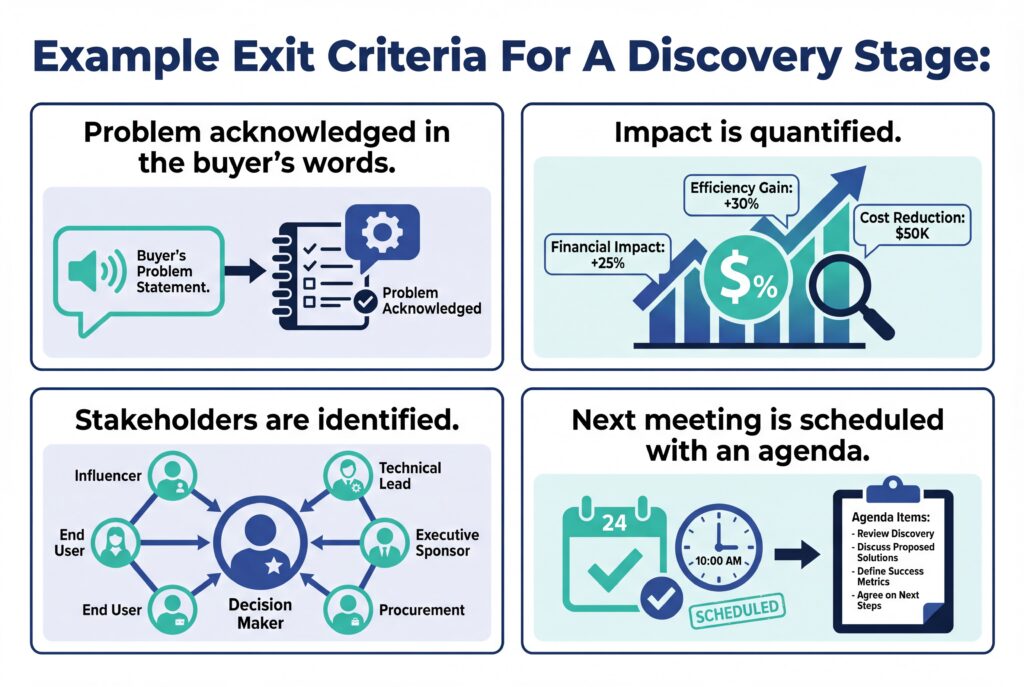
Infographic titled “Example Exit Criteria for a Discovery Stage” outlining four requirements: problem acknowledged, impact quantified, stakeholders identified, and next meeting scheduled with an agenda.

Required fields & data capture standards 

Sales operations should define required fields by stage.  
If the field is empty, the deal does not move. Full stop. 

A practical set of required fields might look like this: 
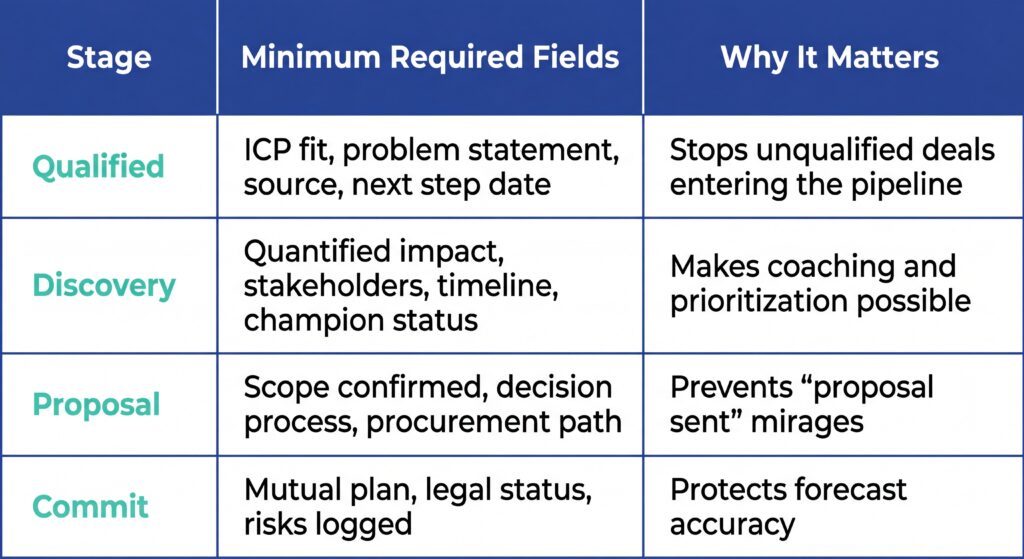
Table showing sales stages (Qualified, Discovery, Proposal, Commit) with minimum required fields for each and why they matter for pipeline quality and forecast accuracy.

Add automation checks where possible: 

  • Required fields gates. 
  • Alerts for missing next steps. 
  • Aging alerts when a deal exceeds expected time in stage. 

Pipeline segmentation for clarity 

Segmentation turns one pipeline into multiple, understandable systems. 

Segment by what changes execution. 

  • New business vs expansion 
  • SMB vs enterprise 
  • Product line 
  • Region 
  • Inbound vs outbound 

Then you can see what is really happening. 

A stalled inbound SMB motion is a different problem than an enterprise expansion cycle that slowed in procurement. Treating them as the same pipeline is how teams get generic. 

The core operating system for managing your sales pipeline 

A pipeline is only as accurate as the routines that keep it current. 

Daily rep discipline 

A disciplined rep treats the pipeline like a dynamic to do list. 

Daily means daily. Not “before the forecast call.” 
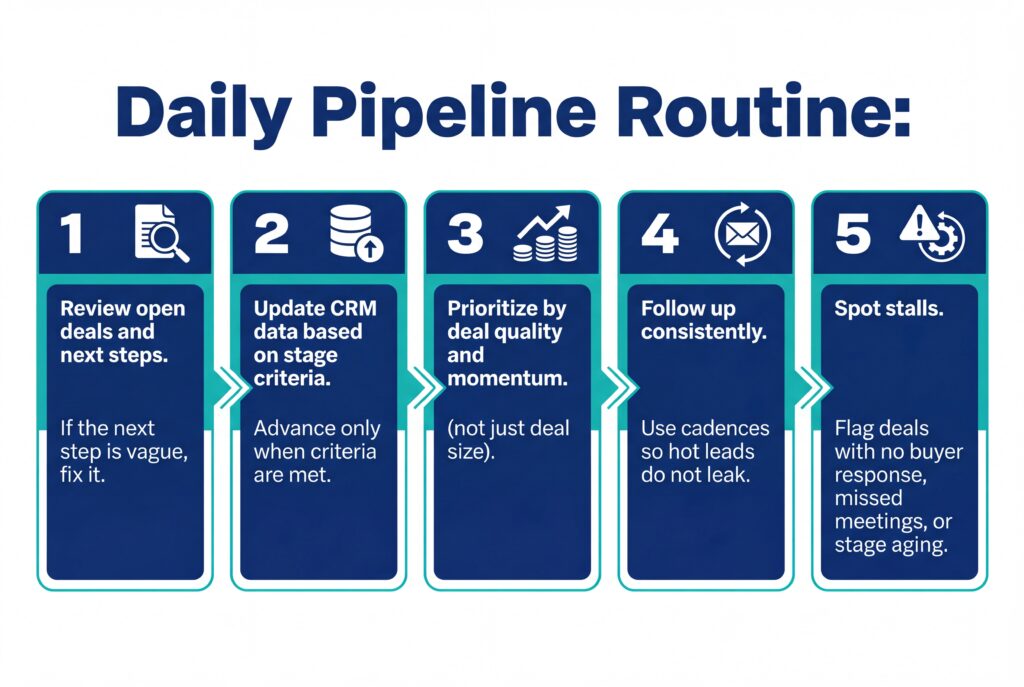
Infographic titled “Daily Pipeline Routine” outlining five steps: review open deals, update CRM by stage criteria, prioritize by quality and momentum, follow up consistently, and spot stalled deals.

One line you can coach into the team: 
If a deal has no movement and no plan, it is not a deal. It is inventory. 

Inventory belongs somewhere else. Close lost. Nurture. Recycle. Just do not pretend. 

Weekly manager cadence 

Weekly pipeline reviews should be about truth and action

A good weekly review is short, structured, and selective. 

Weekly pipeline review agenda (30 to 60 minutes): 

  • 5 minutes: coverage ratio, stage distribution, movement since last week. 
  • 20 to 40 minutes: top deals and at risk deals only. 
  • 10 minutes: coaching actions, escalations, and commitments. 

Use questions that test reality: 

  • What is the agreed next action with the buyer, and what date? 
  • Who is the decision maker? Who is the champion? 
  • What changed since last week? 
  • What would cause this to slip? 

Timebox individual deal discussion.  
Many teams use a “7 minute rule.” 

  • What is happening. 
  • What is next. 
  • What support is needed. 

Then update the CRM in the meeting. 

Monthly pipeline hygiene session 

Monthly is where you stop pipeline rot. 

A monthly hygiene session should: 

  • Close or recycle dead deals 
  • Validate stage accuracy and close dates 
  • Review stage pile ups and bottlenecks 
  • Fix recurring data gaps with enablement and ops 

If your team is afraid of closing deals as lost, you will keep a fake pipeline.  
Make “nurture” easy. Make re entry rules clear. Celebrate forecast accuracy. 

Quarterly calibration 

Pipeline stages are not permanent.  
Your buyers change. Your product changes. Your motion changes. 

Once a quarter, recalibrate: 

  • stage definitions 
  • probabilities 
  • expected time in stage 

Use real data. Not opinions. 

This is how pipeline management stays aligned to the reality of modern sales organizations. 

Prioritization & deal quality scoring 

To understand how to effectively manage a sales pipeline, you need a shared way to define deal quality.  

Then prioritize by quality and momentum. 

What to prioritize beyond deal size 

A deal’s real value is not its ACV.  
It is its probability times velocity. 

High priority signals tend to look like this: 

  • Clear ICP fit 
  • Buyer engagement is consistent 
  • Champion exists and is active 
  • Decision process is mapped 
  • Budget and timeline are real 

A big deal that is cold is a distraction.  
A smaller deal that is moving fast can be the quarter. 

A simple deal quality scorecard 

You do not need a complicated model.  
But you do need a consistent one. 

Use a 1 to 3 scoring system. 1 is weak, 3 is strong. 

Table scoring sales signals from 1 to 3 across ICP fit, problem clarity, champion, decision process, timeline, mutual plan, and engagement levels.

Total the score. 

  • Low score deals get a clear decision. Re qualify, nurture, or close. 
  • High score deals get priority, exec attention, and proactive coaching. 

Handling aging deals 

Deals age. That is normal. 

Deals aging without movement is a warning. 

A practical rule: 

  • If a deal exceeds expected time in stage, downgrade forecast confidence. 
  • If it has no buyer activity for 30 to 45 days and no next step, move it out of active pipeline. 

Some teams automatically move stale deals to nurture.  
Others require a manager sign off to keep them open. 

Pick one. Enforce it. 

Call-to-action banner asking “Is Your Pipeline Driving Decisions Or Guesswork?” with a laptop dashboard mockup and a “Start Free Trial” button.

Pipeline health metrics that help you manage 

Metrics are only useful when they trigger behavior. 

If you want real sales pipeline management tips, start here: 

The non-negotiable metrics 

  1. Pipeline coverage ratio: total pipeline value divided by quota. 
  1. Stage conversion rates: how deals move from stage to stage. 
  1. Win rate: closed won divided by closed deals. 
  1. Sales velocity: how fast revenue moves through the pipeline. 
  1. Time in stage and deal age: the early warning system. 
  1. Slippage rate: how often close dates move. 

Coverage is the headline.  
But conversion and velocity tell you what is broken. 

A common benchmark for coverage is around 3 to 5 times quota, depending on motion and win rate. Treat it as a starting point.  

Then calibrate using your own data. 

What healthy looks like 

A healthy pipeline has: 

  • balanced flow into and out of each stage 
  • clear next steps on every active deal 
  • minimal pile up of aged opportunities 
  • forecasts that match observed behavior 

An unhealthy pipeline has: 

  • bloated early stages because leads are dumped into deals 
  • close dates pushed weekly 
  • deals stuck in one stage without buyer movement 
  • forecasts that miss even when pipeline “looks strong” 

Metric to action mapping 

Here is how leaders make metrics operational: 

Table linking sales metric shifts—time in stage spikes, early stage volume drops, slippage rises, and late-stage win rate declines—to likely causes and recommended actions.

This is why pipeline management is an execution system; not a forecast ritual. 

Pipeline risks, stalls, hygiene rules 

Pipelines rot quietly. 

A deal sits. Nobody wants to kill it. It keeps its place in the forecast because removing it feels like failure. 

Then the quarter ends. 

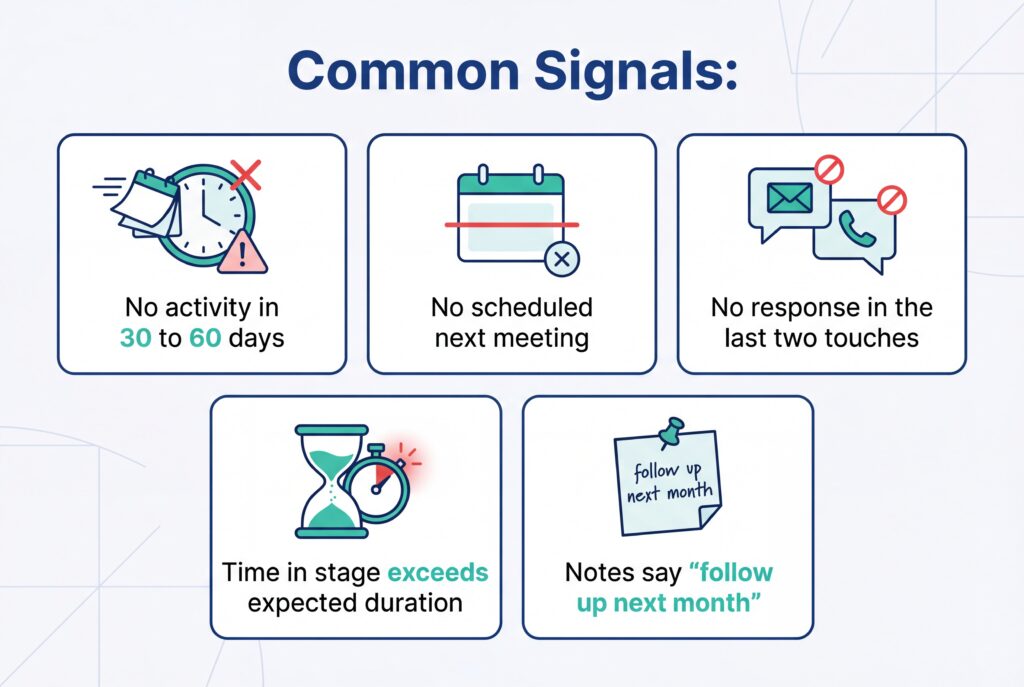
Define stalled deal signals 

A stalled deal has patterns: 

Infographic titled “Common Signals” highlighting red flags in a sales pipeline, including no activity in 30–60 days, no next meeting scheduled, no recent response, extended time in stage, and vague follow-up notes.

Your CRM should flag these automatically. 

The inventory rule 

Here’s the line that saves time and improves forecast reliability: 
If a deal has no movement and no plan, it is not a deal. It is inventory. 

Inventory has two homes: 

  • nurture 
  • closed 

Keeping it in active pipeline is how teams waste time. 

The pipeline audit playbook 

If you want quick wins this month, run an audit. 

Do it like this: 

  1. Filter for deals with no activity in 30+ days. 
  1. Filter for deals over 2 times expected time in stage. 
  1. Review each deal with the rep. 
  1. Confirm the buyer validated next step. 
  1. If there is no next step, move it out. 
  1. Remove duplicates and orphaned opportunities. 
  1. Validate ICP fit and deprioritize outliers. 

Many teams find a single day of pipeline scrub improves forecast accuracy immediately. 

Prevent sandbagging & pipeline inflation 

Pipeline inflation is usually a system problem. 

Reps hide deals when: 

  • the team punishes misses more than it rewards accuracy 
  • stages are fuzzy so “best case” becomes “commit” 
  • there is no consistent review cadence 

Fix the system. 

  • enforce stage criteria 
  • use required fields 
  • run regular reviews and hygiene sessions 

And make honesty the default. 

Running high-value pipeline reviews 

Pipeline reviews are where coaching and forecasting collide.  

If the meeting becomes a status round robin, you lose both. 

The rules of a good review 

  • Focus on the few deals that matter. Largest and most at risk. 
  • Ask questions that test buyer reality. 
  • End every deal discussion with a commitment. 

If you want to tighten this overnight, adopt one habit: 

Do not leave a deal discussion without a dated next step. 

Separate coaching from forecasting when needed 

Some teams try to do all coaching inside the forecast call. 

That turns the call into debate… 

If a rep needs help with discovery, run a coaching session.  
If a deal needs exec alignment, run a deal strategy session. 
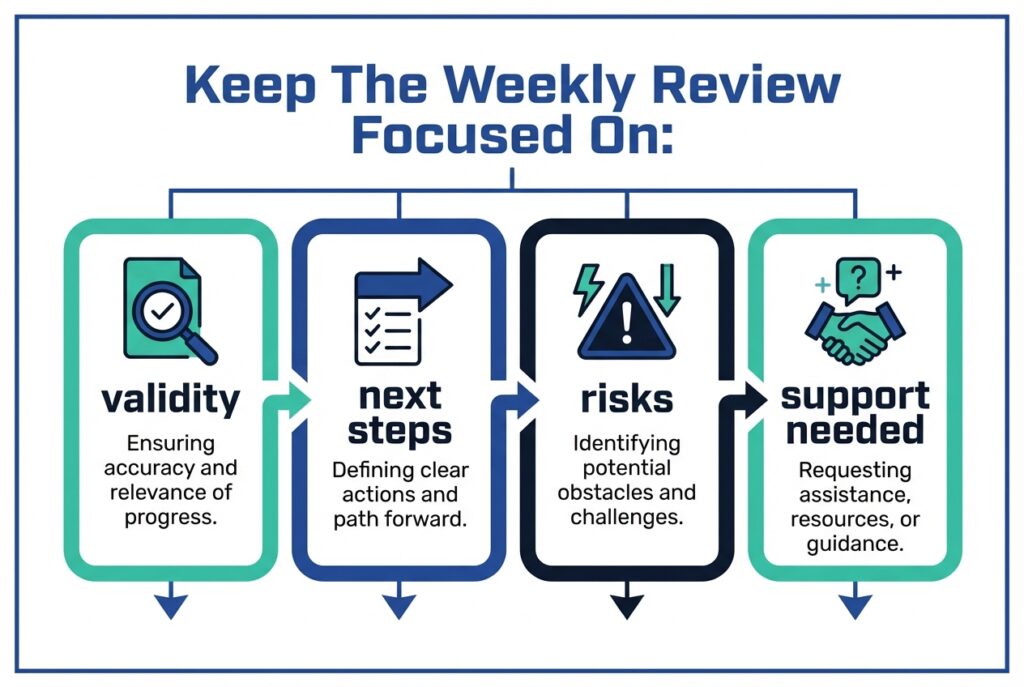
Infographic titled “Keep The Weekly Review Focused On” highlighting four areas: validity, next steps, risks, and support needed.

This makes reviews useful.  

Dashboards & reporting for CROs and sales managers 

A dashboard should help you see. 
Not impress anyone. 

What a good pipeline dashboard shows 

At a glance: 

  • opportunity distribution by stage 
  • total pipeline value and per rep pipeline value 
  • coverage ratio 
  • stalled deal flags and overdue activity 
  • stage conversion rates 
  • time in stage trends 

The goal is one page where you can answer: 

  • Where is momentum? 
  • Where is risk? 
  • Where is the bottleneck? 

Rep dashboard vs manager dashboard 

Reps need a view that drives action: 

  • prioritized deals 
  • next steps due 
  • stalled deal alerts
  • deal quality score 

Managers need a view that drives coaching and intervention: 

  • bottleneck stage 
  • deals aging beyond norms 
  • slippage clusters 
  • forecast confidence by rep and segment 

Same pipeline. Different lens. 

Alerts & automation that reduce admin 

The fastest way to reduce manager admin is to automate hygiene. 

Useful alerts include: 

  • no activity for 30+ days 
  • missing next meeting 
  • close date changed 
  • stage age exceeded 
  • required fields missing 

Automation does not replace management.  
It makes management possible at scale. 

Common pipeline management mistakes & what to do instead 

If your pipeline feels chaotic, it is usually one of these. 

Mistake 1: Treating every lead as a deal 

Do instead: Separate lead pipeline management from deal pipeline management. Convert only after qualification. 

Mistake 2: Moving stages without criteria 

Do instead: Define objective exit criteria for every stage. Tie stage movement to buyer behavior. 

Mistake 3: Letting dead deals linger 

Do instead: Enforce a re entry rule. If there is no plan, move it out. 

Mistake 4: Chasing vanity pipeline volume 

Do instead: Focus on pipeline value that can close this quarter. Prioritize quality and momentum. 

Mistake 5: Running pipeline reviews without commitments 

Do instead: Timebox deals, ask reality questions, and end with dated next steps. 

Infographic emphasizing that fixing stage criteria and next steps—through clear definitions, stage gates, and defined actions—leads to smoother operations, better collaboration, and faster results.

30 day implementation plan 

If you want a cleaner pipeline without a six month change program, use this: 

Week 1: Clarify & clean 

  • Define stages and exit criteria. 
  • Set required fields by stage. 
  • Run a pipeline audit and scrub. 

Deliverable: A smaller pipeline that you trust. 

Week 2: Install routines 

  • Daily rep routine. 
  • Weekly manager review. 
  • Monthly hygiene session scheduled. 

Deliverable: Pipeline updates stop being optional. 

Week 3: Add scoring & prioritization 

  • Roll out the deal quality scorecard. 
  • Coach reps on prioritization. 
  • Align on re entry rules for recycled deals. 

Deliverable: Effort shifts toward deals that can close. 

Week 4: Dashboard & accountability 

  • Build the one page dashboard for reps and managers. 
  • Add alerts for stalled deals and missing fields. 
  • Review baseline metrics and pick one bottleneck to fix. 

Deliverable: Visibility you can act on. 
Call-to-action banner reading “Ready To Run Pipeline As A System?” with a laptop dashboard mockup and a “Start Free Trial” button.

Frequently Asked Questions 

What are the best practices for sales pipeline management? 

The best practices for sales pipeline management focus on clear stage criteria, consistent review cadences, and deal-level accountability. Pipelines work when every stage reflects buyer progress and every deal has a verified next step. 

How often should sales leaders review and update the sales pipeline? 

Managing your sales pipeline effectively requires daily rep updates, weekly manager reviews, and a monthly hygiene audit. Infrequent reviews are one of the fastest ways pipeline data becomes unreliable. 

How do you manage a sales pipeline with long or complex deal cycles? 

For long sales cycles, deal pipeline management depends on strict stage exit criteria, time-in-stage tracking, and explicit stakeholder mapping. Without these, deals quietly stall while still appearing active. 

What’s the difference between lead pipeline management and deal pipeline management? 

Lead pipeline management focuses on qualification and nurturing before revenue is possible. Deal pipeline management begins only after a lead is qualified and is centered on progression, risk, and close execution. 

Conclusion 

Sales pipeline management lives or dies on discipline. Clear stages that reflect buyer movement. Data that gets updated because the system expects it, not because someone is chasing it. Routines that surface risk early, before deals stall quietly in the middle of the funnel.  

When prioritization is based on deal quality and momentum, and hygiene is enforced consistently, the pipeline becomes something leaders can run the business on.  

That’s how to manage sales pipeline performance in a way that supports real decisions, steadier forecasts, and fewer last-minute surprises. 

Start a free trial to see how EnableU turns pipeline strategy into a working system – with clear stages, enforced standards, and real visibility across every deal. 

Ready to Experience This in Action?

See how EnableU's contextual intelligence platform transforms sales conversations.

Book Your Discovery Call

Related Articles

Sales Quota Guide (Types, Examples, How To Set)
Sales Excellence Operating System

Sales Quota Guide (Types, Examples, How To Set)

How to design sales quota systems that align capacity, coverage, and performance.

Read More

How To Scale A Sales Team? Complete Strategy + Steps 
Sales Excellence Operating System

How To Scale A Sales Team? Complete Strategy + Steps 

A practical guide to how to scale a sales team with structure, systems, and predictable execution.

Read More

How To Do Sales Forecasting? Ultimate Guide 2026
Sales Excellence Operating System

How To Do Sales Forecasting? Ultimate Guide 2026

How modern revenue teams build accurate sales forecasts and keep them usable as plans change.

Read More

Transform Your Sales Conversations Today

Join leading sales organizations using EnableU to drive better conversations and close more deals.